Two Tools for One Health and Biosurveillance
Increasingly, disease outbreaks are being considered using the lens of One Health
Biosurveillance begins on the farm and ends on the fork. Whether you are working at a food manufacturing site, a processing plant, a harvest facility, or a storage site, or you are a grower, a farmer, or a rancher, you are part of the system of producing food for the world. In a March 2024 U.S. House Agriculture Committee hearing, Congresswoman Shontel Brown (OH-11) stated that, "Food security is national security." At least six other Congressional members expressed that same sentiment. The food industry is also becoming acutely aware that this is indeed the case. How do we increase security in the food system? In this article, the focus will be on employing two tools in a One Health vision of biosurveillance: whole genome sequencing (WGS) and hyperspectral imaging.
Let us begin by establishing a definition of One Health and biosurveillance. Quoting from the American Veterinary Medical Association: "One Health refers to two related ideas: First, it is the concept that humans, animals, and the world we live in are inextricably linked. Second, it refers to the collaborative effort of multiple disciplines working locally, nationally, and globally to attain optimal health for people, animals, and the environment."1 While not a new idea, its significance has surged recently due to evolving dynamics among humans, animals, vegetation, and the broader environment.
Biosurveillance is a complex concept defined by Homeland Security Presidential Directive 21 (HSPD-21) as "…active data-gathering with appropriate analysis and interpretation of biosphere data that might relate to disease activity and threats to human or animal health—whether infectious, toxic, metabolic, or otherwise, and regardless of intentional or natural origin—in order to achieve early warning of health threats, early detection of health events, and overall situational awareness of disease activity."2
Increasingly, disease outbreaks are being considered using the lens of One Health, which enables the recognition of where business operations intersect with people, animals, and the environment. Recognizing the intersection points enables companies to also recognize the interactions (whether direct or indirect) that each element has on all of the other intersecting elements. For example, during the COVID-19 pandemic, it was not that animals were directly impacted by the disease, but instead the impact of the disease on employees working at packing plants created an unforeseen impact on live animal production. During the peak of the pandemic, absenteeism at packing plants caused backups in the meat processing industry, which ultimately led to healthy animals being euthanized and disposed of because there was no place to harvest. Fewer employees in the food plants also caused increased burdens on those remaining, including those charged with food safety responsibilities. Prior to COVID-19, no one thought much about the impact of absenteeism on food safety.
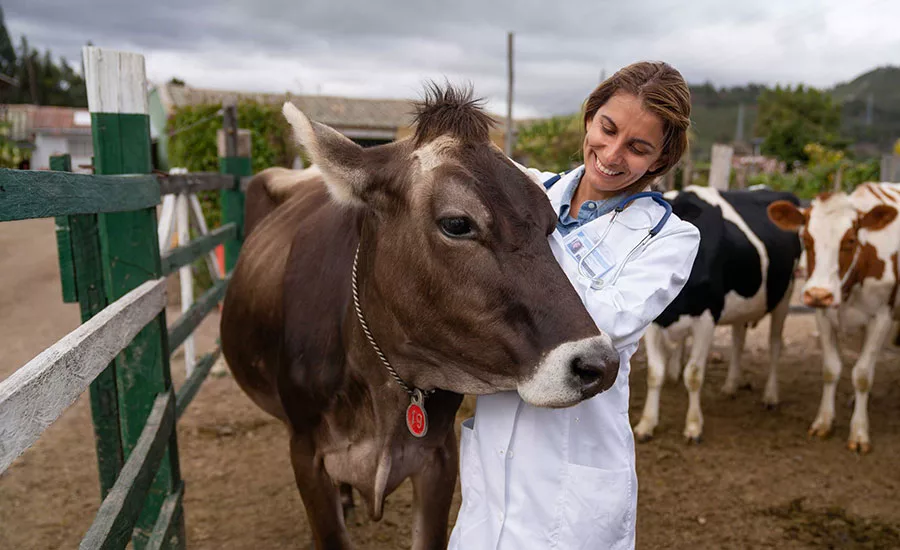
Another example of the intersectional elements of disease is how people can negatively impact animals, such as those documented cases where employees at dairy farms exposed dairy cattle to tuberculosis (TB). On multiple occasions, it was determined that people spread TB to dairy cattle, highlighting a previously unidentified gap in public health surveillance.3 Alternatively, a recent example on how animals could also potentially affect other species (or even, conceivably, public health) is illustrated by the recent example of dairy cattle that are infected with influenza A virus (highly pathogenic avian influenza H5N1 strains). Events like these are likely ongoing all around us, but fall below conventional detection methods or are missed because of the siloing of data. Better insight is critically needed.
One possible approach to solving this problem can be achieved through the combination of WGS and hyperspectral analysis. In September 2019, several food companies met to discuss the use of WGS.4 In the cited article, the authors found that the benefits of WGS for source attribution were well recognized, but could not be fully utilized, since the industry lacked a common operating picture. As a result of the findings, Baert et al. published in April 2021 the well-organized, "Guidance document on the use of whole genome sequencing (WGS) for source tracking from a food industry perspective."5
If new to the concept of WGS, consider this analogy. WGS allows organisms to be sequenced, providing in essence a unique fingerprint. An essential component of the system is a reference sequence database that allows the sample genomic fingerprint to be compared to a set of known genomic fingerprints. The more organisms that are included in the database, the more accurate it will become. WGS for source tracking is a powerful application.
Looking for quick answers on food safety topics?
Try Ask FSM, our new smart AI search tool.
Ask FSM →
Take this example: L. monocytogenes is, unfortunately, found in a product from your plant. You wonder if it could be the biofilm issue you thought was resolved. WGS analysis shows that the strain on the product is not related to the previous findings in your plant; rather, the strain was recently detected in a forage silage pit at a farm. Now, your investigation can focus on finding the source of contamination other than at your plant.
Making the determination in the L. monocytogenes example is not a simple analysis. Other data is critical to analyze the metadata collected along with the sample, such as collection date, sample location, and sample type (environmental, raw material, food product, surface swab, etc.)—all of which are important for subject matter experts to analyze.
Hyperspectral analysis, including hyperspectral microscopy, is an additional tool set that may be applied to food safety. The technology enables the recognition of a hyperspectral signature for pathogens, spoilage organisms, and commensals. The richness of the dataset created from these processes is tremendous. Hyperspectral analysis findings combined with WGS findings provide an even more precisely unique organismal signature. This, in turn, gives more insight into an already robust food safety program.
Recent advances in both hardware and software, especially in the field of artificial intelligence, enable food safety data experts to guide the development of deep learning algorithms to better address some of the problems currently encountered in conventional analysis. Where did the pathogen contaminant come from? WGS combined with hyperspectral signatures can provide valuable information.
Essential to the success of these processes is the sharing of data. Preventing the next pandemic or stopping a foodborne illness outbreak, or even detecting a nefarious event, will require the consolidation of disparate datasets. Data streams from manufacturing, public health, animal health, and environmental sampling analyzed alone are valuable, but when aggregated and analyzed collectively, they become potentially priceless. Think back to the TB example on the dairy farm. If our metadata included geospatial data on the cows, farm equipment, and employees, then we could have determined which employees came into contact with the infected cows or their environment during the timeframe in which the outbreak appears to have started.
This aggregation and analysis of data is where the greatest challenges lie. There are policy issues to be determined. There are proprietary issues to be discussed. There may be the need for a neutral entity to be developed in a public-private partnership that can analyze and report findings. Now is the time for companies, regulatory agencies, and elected officials to have this conversation. Get the attorneys working on it!
Finally, data visualization is the last step to truly delivering value. Imagine a dashboard designed for a specific end user such as the CEO, plant manager, supervisor, machine operator, grower, producer, government regulator, etc., each providing the type of timely information needed in an easily understandable and actionable format, depending on the end user. This is the future of food safety.
References
- American Veterinary Association. "One Health." 2024. https://www.avma.org/resources-tools/one-health.
- Homeland Security Digital Library. "Homeland Security Presidential Directive 21: Public Health and Medical Preparedness." October 18, 2007. https://www.hsdl.org/c/abstract/?docid=480002.
- Lombard, J.E., E.A. Patton, S.N. Gibbons-Burgener, et al. "Human-to-Cattle Mycobacterium tuberculosis Complex Transmission in the United States." Frontiers in Veterinary Science 12, no. 8 (July 2021). doi: 10.3389/fvets.2021.691192.
- Amézquita, A., C. Barretto, A. Winkler, L. Baert, B. Jagadeesan, D. Akins-Lewenthal, A. Klijn. "The Benefits and Barriers of Whole-Genome Sequencing for Pathogen Source Tracking: A Food Industry Perspective." June 24, 2020. https://www.food-safety.com/articles/6696-the-benefits-and-barriers-of-whole-genome-sequencing-for-pathogen-source-tracking-a-food-industry-perspective.
- Baert, L. P. McClure, A. Winkler, J. Karn, M. Bouwknegt, A. Klijn. "Guidance document on the use of whole genome sequencing (WGS) for source tracking from a food industry perspective." Food Control 130 (December 2021). https://www.sciencedirect.com/science/article/pii/S0956713521002863.
Robert A. Norton, Ph.D., is a Professor and Coordinator of National Security and Defense Projects in the Office of the Senior Vice President of Research and Economic Development at Auburn University. He specializes in national security matters and open-source intelligence, and coordinates research efforts related to food, agriculture, and veterinary defense.
Marcus (Marc) H. Sachs, P.E., is the Senior Vice President and Chief Engineer at the Center for Internet Security. He has deep experience in establishing and operating sharing and analysis centers including the Defense Department's Joint Task Force for Computer Network Defense, the SANS Institute's Internet Storm Center, the Communications ISAC, and the Electricity ISAC.
Cris A. Young, D.V.M., M.P.H., Diplomate A.C.V.P.M., is a Professor of Practice at Auburn University's College of Veterinary Medicine and an Adjunct Professor at the College of Veterinary Medicine at the University of Georgia's Department of Pathology. He received his D.V.M. from Auburn University's College of Veterinary Medicine in 1994. He completed his M.P.H. at Western Kentucky University in 2005 and is a Diplomate of the American College of Veterinary Preventive Medicine.