Food Contamination Traceback Litigation: Naturally Occurring Pathogens

The topic of raw chicken recently created a paralell universe—humor from the federal government and a somber federal appellate court decision dismissing a $10 million subrogation lawsuit.
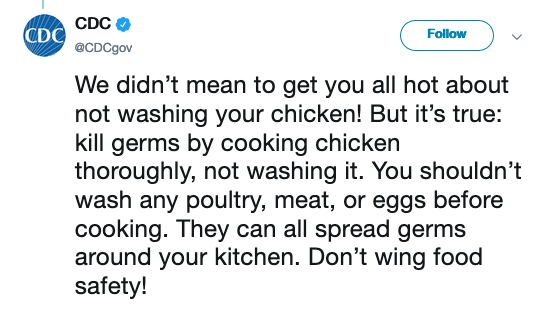
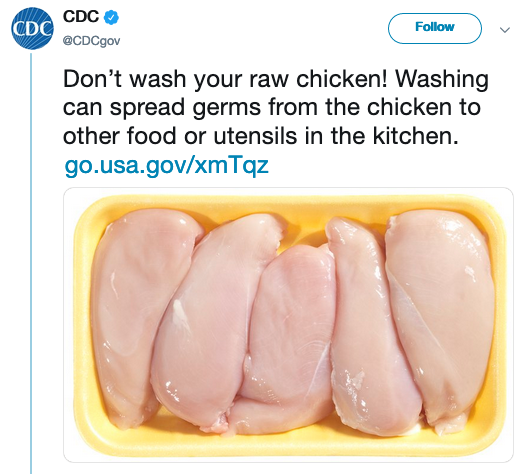 First, the government. Who knew government beauracrats had a sense of humor? The U.S. Centers for Disease Control and Prevention (CDC) issued advice not to wash raw chicken (Figure 1), and when social media erupted in response,[1] CDC tweeted out the following follow-up advice (Figure 2).
 At the other end of the spectrum, the United States Court of Appeals for the First Circuit issued a decision in Starr Surplus Lines Insurance Company, as Subrogee to AdvancePierre Foods, Inc. v. Mountaire Farms Inc., 920 F.3d 111 (1st Cir. Apr. 3, 2019). The multimillion dollar litigation started with an outbreak of Salmonella in chicken food products, the U.S. Department of Agriculture Food Safety Inspection Service (FSIS) issued a public health alert, which in turn resulted in the food product manufacturer issuing a recall. The recall resulted in a $10,000,000 million dollar first party claim, which the Plaintiff’s insurer paid.
The food product manufacturer traced back the source of the Salmonella to fresh raw chicken supplied by the Defendant. Having paid $10,000,000 million dollars, the insurer for the food product manufacturer filed suit in Maine alleging breach of implied warranty of merchantability, breach of implied warranty of fitness for a particular purpose and strict product liability (Id. at 114).
Notably, the Plaintiff’s complaint alleged—and the allegation was accepted as true for the purposes of the Defendant’s motion to dismiss—the raw chicken supplied by the Defendant was contaminated with Salmonella Enteritidis at the time of delivery (Id. at 113). Each legal theory was, however, dismissed by the District Court (the case had been removed to federal court).
On appeal, the First Circuit began its analysis with the Plaintiff’s breach of warranty claims. The First Circuit noted Maine’s warranty law (sensibly) required that there must be a defect in the product at the time of sale and, “[u]nder Maine law, raw chicken that contains Salmonella that can be eliminated by proper cooking cannot be considered ‘defective.’” (Id. at 115).
The Plaintiff thus found itself stuck with having to allege that the Salmonella in the chicken supplied by the Defendant “[w]ould persist despite proper cooking.” (Id.) Having been boxed into that corner (which the First Circuit held did not matter under either the “foreign-natural” or “reasonable expectation” test), the Plaintiff wove an interesting argument—if the presence of Salmonella was not a defect in raw chicken, why then did the FSIS determine the chicken to be adulterated and warrant a public health alert? The First Circuit rejected that argument, reasoning “Federal law governing recalls provides no basis for concluding that, if chicken is ‘adulterated within the meaning of [federal regulations],’ then the chicken is contaminated with a type of Salmonella that would persist despite proper cooking.” (Id. at 117.) That reasoning similarly doomed the Plaintiff’s strict liability claim (Id. at 118).
The First Circuit’s reference to the “foreign-natural” or “reasonable expectation” test was limited to a footnote. The “foreign natural” test generally provides objects which are natural to a product are not deemed to be foreign,[2] and the reasonable expectation test asks what a reasonable consumer would expect to find in food.[3]
The two doctrines were analyzed in Gonzalez Caban v. JR Seadfood, 132 F.Supp.3d 274, 287 (D.P.R. 2015), where the District Court noted “in recent decades there has been…a tendency to incline in favor of the reasonable expectations test,” which focuses “[n]ot on the components of the dish, but rather on the completed product, considering the nature of the dish and the nature of its preparation.” (Id.) The District Court ultimately certified two questions to the Supreme Court of Puerto Rico: “Under the principles of product liability, is a supplier/seller strictly liable for the damages caused by human consumption of an extremely poisonous natural toxin found in a shrimp, even if said food product (and its ‘defect’) are not a result of manufacturing or fabrication process?” and “If the previous question is answered in the affirmative, would it make a difference if the ‘defect’ of the food product is readily discoverable scientifically or otherwise?” (Id. at 289). As the District Court explained in a subsequent decision, 285 F.Supp.3d 502, 504-05 (D.P.R. 2018), “The Puerto Rico Supreme Court answered in the negative this Court’s certified question of law, holding that a shrimp contaminated with saxitoxin did not trigger the application of the strict liability doctrine. Because the allegedly contaminated shrimp was not manufactured, that is, that the product’s became contaminated without human intervention, the Puerto Rico Supreme Court reasoned that the case at bar falls outside of the scope of the strict liability doctrine’s protection.”
The box that Plaintiff found itself in Starr is similar to the one plaintiff ended up in Horan v. Dilbet, Inc., 724 Fed.Appx. 148 (3d Cir. 2018). In Horan, the Plaintiff ate raw clams, became sick and filed suit against the restaurant. The Third Circuit affirmed the grant of summary judgment, reasoning “because clams containing Vibrio are not per se defective, it therefore follows that Horan—in order to even reach the issue of causation—was required to first establish that the [the restaurant] created a defect in the first place…Had Horan been able to prove that the clams arrived at the [the restaurant] with non-infective dosage levels of Vibrio, then, as the District Court observed, perhaps a jury could have found that the [restaurant’]s food-handling practices created a defect, and that this defect, in turn, proximately caused Horan’s injury. But absent the ability to prove that the clams did not contain infective levels of Vibrio at the time of delivery, the jury would be speculating as to whether the [restaurant] created the defect that caused Horan’s injury.” (Id. at 154).
Whether viewed under the “foreign-natural” or “reasonable expectation” test, some foods have naturally occurring (dangerous) pathogens, but the fact that human consumption can lead to illness does not transform them into “defective food.” Instead, warnings may be warranted. In the case of raw chicken, CDC’s announcement and social media response shed public light on the danger of raw chicken. That conversation can (and should) be used by defendants to establish what reasonable consumers would expect about raw chicken. So, we have learned not only can the government be funny, it really is here to help.
Steven R. Kramer, Esq., is the Member-in-Charge of the White Plains, New York office of Eckert Seamans Cherin & Mellott, LLC, and also serves on the firm’s Board of Directors. He is national and regional trial counsel for Fortune 100 companies in class action, multidistrict, and single-party litigation. He focuses his practice on product liability, foodborne illness, pollution and toxic tort, and commercial litigation matters, having tried cases in numerous state and federal courts across the country.
References
1. Some readers may recall the fierce pre-internet public debate surrounding the advice column from “Dear Abbey” on the correct way to hang toilet paper. See, for example, wwl.radio.com/blogs/dave-cohen-wwl-first-news-early-edition/great-toilet-paper-debate-over-or-under.
2. See, for example, Stefansky v. Cantina Laredo Columbus/Nashville, L.P. c/o CT Corp., 72 N.E.3d 97, 2012 (Court of Appeals of Ohio, Tenth District 2016) (“Courts have applied this foreign-natural test to many types of food); Ruvolo v. Homovich, 149 Ohio App.3d 701, 2002-Ohio-5852, 778 N.E.2d 661 (8th Dist.) (chicken bone fragments in a chicken gordita sandwich); Mitchell v. T.G.I. Fridays, 140 Ohio App.3d 459, 748 N.E.2d 89 (7th Dist.2000) (clam shells in fried clams); Parianos v. Bruegger’s Bagel Bakery, 8th Dist. No. 84664, 2005-Ohio-113, 2005 WL 78114, ¶ 15 (pig bone in a sausage, egg, and cheese bagel sandwich); Lewis v. Handel’s Homemade Ice Cream & Yogurt, 11th Dist. No. 2002–T–0126, 2003-Ohio-3507, 2003 WL 21509258 (pistachio shells in a pistachio nut ice cream cone); Soles v. Cheryl & Co. Gourmet Foods & Gifts, 3d Dist. No. 14–99–36, 1999 WL 1054786 (Nov. 23, 1999) (pecan shells in a pecan cookie); and Krumm v. ITT Continental Baking Co., 5th Dist. No. 23–CA–81, 1981 WL 6575 (Dec. 9, 1981) (cherry pits in a cherry pie”).
3. See, for example, Nuon v. Stop & Shop Supermarket Co., LLC, FSTCV 156026683S, 2017 WL 1239585, at *2 (Superior Court of Connecticut Jan. 20, 2017).
Looking for quick answers on food safety topics?
Try Ask FSM, our new smart AI search tool.
Ask FSM →