Food Safety
search
Ask Food Safety AI
cart
facebook twitter linkedin instagram youtube
  • Sign In
  • Create Account
  • Sign Out
  • My Account
Food Safety
  • NEWS
    • Latest News
    • White Papers
  • PRODUCTS
  • TOPICS
    • Contamination Control
    • Food Types
    • Management
    • Process Control
    • Regulatory
    • Sanitation
    • Supply Chain
    • Testing and Analysis
  • PODCAST
  • EXCLUSIVES
    • Food Safety Five Newsreel
    • eBooks
    • FSM Distinguished Service Award
    • Interactive Product Spotlights
    • Videos
  • BUYER'S GUIDE
  • MORE
    • NEWSLETTERS >
      • Archive Issues
      • Subscribe to eNews
    • Store
    • Sponsor Insights
    • ASK FSM AI
  • WEBINARS
  • FOOD SAFETY SUMMIT
  • EMAG
    • eMagazine
    • Archive Issues
    • Editorial Advisory Board
    • Contact
    • Advertise
  • SIGN UP!

Food Contract Labs Are Taking a Big Bite Out of Food Safety Testing

June 3, 2014

As covered in last week’s blog, the 40,000 food plants worldwide are finding the running of in-plant food labs to be increasingly complex. Faced with the Food Safety Modernization Act (FSMA) and the possible requirement of lab accreditation, particularly for analysis of food safety compliance samples, more and more food companies are questioning the role and scope of their food plant labs (FPLs)—and considering alternatives.

One alternative is to utilize a food contract lab (FCL) for all compliance samples while continuing to analyze other food safety samples at the FPL. Another is to shut down the food plant lab entirely and utilize FCLs for all food safety test analysis. Yet a third is to have a food contract lab locate a ‘lab-in-a-box’ just outside the food plant or to have the FCL take over the food plant lab operations.

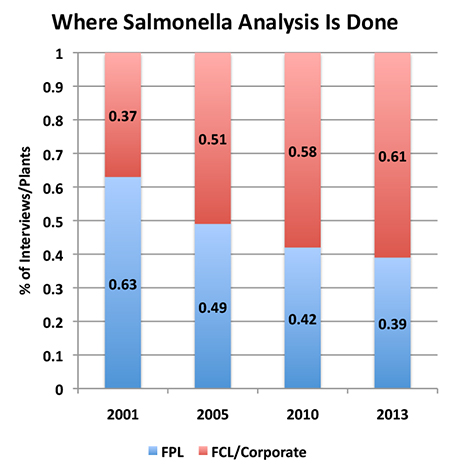
Strategic Consulting, Inc. (SCI) has been monitoring food safety testing for over 15 years, and has documented this shift in business from FPLs to outside labs. Based on data from SCI’s thousands of interviews with food plant QA/QC managers, there is a clear trend in food plants to send samples outside for analysis. The following chart is based on SCI interviews with U.S. food plants regarding where Salmonella samples are analyzed. In 2013, 61% of U.S. food plants sent Salmonella samples outside for analysis. Just 12 years ago, in 2001, the reverse was true, and 63% of the U.S. food plants did the analysis at food plant labs.
At one point all food plants had laboratories. In the 1970s, a few entrepreneurs began what has now grown into a thriving FCL industry. Many of the early entrepreneurs established outside laboratories with their own expertise as the foundation. Acting as subject matter experts and consultants, these scientist-entrepreneurs provided knowledge that helped their food industry clients solve food safety issues. Many of the early food contract labs were microbiology-based, due to industry needs and the lower cost of entry for micro versus other types of testing. These early FCLs grew through personalized service, expert consulting, scientific proficiency and strong client relationships. Over time, FCLs added basic chemistry services as necessary to support the needs of food company clients.

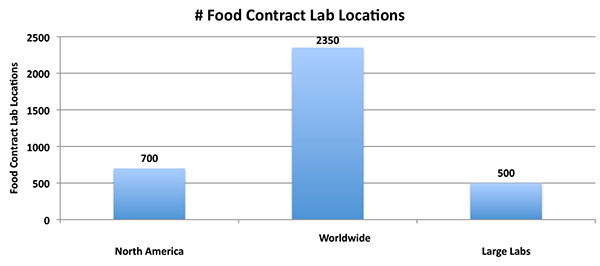
According to Strategic Consulting’s newest market research report, Food Contract Lab Report, there are 2,350 FCLs worldwide and they generated revenues of more than $3.0 billion in 2013. In fact, over the past five years, the food contract lab industry has shown a compound annual growth rate (CAGR) that exceeds overall growth in the food safety testing market. Clearly, FCLs are taking market share from the food plant labs.
FCL Market
The FCL growth rate varies slightly by geographic region and business area (microbiology, chemistry, services) but frankly, all areas are growing well.

FCL Geographic Region Analysis
•    Europe is the largest region based on total FCL revenues, but is showing slower growth than other geographic regions. Chemistry revenues remain strong in the EU.

•    North America is second in total revenues, but is catching the EU, driven by large increases in microbiology revenues.

•    Asia and the rest of the world have the smallest total revenues but the greatest growth potential of the four geographic regions.

FCL Business Area Analysis
•    The microbiology business area is second in total revenues but growing quickly, with increases in both routine microbiological and pathogen analysis.

•    Chemistry is the largest business area but slowing in growth compared to the other business areas.

•    Currently the smallest, the services business area is growing quite quickly due to increasing demand from food companies.

The future for food contract laboratories looks strong, and 5 years out, SCI expects FCLs to have continued their growth in market share. FSMA will push companies outside the U.S. to utilize accredited labs for compliance testing, which will drive rapid growth for FCLs particularly in the markets in Asia and Latin America.


Author(s): Tom Weschler

Looking for quick answers on food safety topics?
Try Ask FSM, our new smart AI search tool.
Ask FSM →


Share This Story

Recommended Content

JOIN TODAY
to unlock your recommendations.

Already have an account? Sign In

  • people holding baby chicks

    Serovar Differences Matter: Utility of Deep Serotyping in Broiler Production and Processing

    This article discusses the significance of Salmonella in...
    Food Type
    By: Nikki Shariat Ph.D.
  • woman washing hands

    Building a Culture of Hygiene in the Food Processing Plant

    Everyone entering a food processing facility needs to...
    Training
    By: Richard F. Stier, M.S.
  • graphical representation of earth over dirt

    Climate Change and Emerging Risks to Food Safety: Building Climate Resilience

    This article examines the multifaceted threats to food...
    Contamination Control
    By: Maria Cristina Tirado Ph.D., D.V.M. and Shamini Albert Raj M.A.
Manage My Account
  • eMagazine Subscription
  • Subscribe to Newsletters
  • Manage My Preferences
  • Website Registration
  • Subscription Customer Service

More Videos

Sponsored Content

Sponsored Content is a special paid section where industry companies provide high quality, objective, non-commercial content around topics of interest to the Food Safety Magazine audience. All Sponsored Content is supplied by the advertising company and any opinions expressed in this article are those of the author and not necessarily reflect the views of Food Safety Magazine or its parent company, BNP Media. Interested in participating in our Sponsored Content section? Contact your local rep!

close
  • The image displays a person selecting packaged fresh chicken meat from a supermarket display cooler.
    Sponsored byCorbion

    Developing a Future-Proof Food Safety Strategy for Meat and Poultry Products

  • The image shows a variety of fresh produce packaged in plastic trays and wrap.
    Sponsored byWaters Corporation

    PFAS-Free Food Packaging by August 2026

  • This image displays a multi-stage water filtration system designed to remove contaminants from drinking water.
    Sponsored byWaterdrop Filter

    The 4.0 ppt Era: Future-Proofing Your Food Supply Chain Against 'Forever Chemicals'

Popular Stories

half shredded block of cheddar cheese and pile of cheese shreds on wooden cutting board

Patient Count in Raw Farm E. coli Outbreak Grows, Majority are Young Children

RAW FARM-brand raw cheddar cheese shreds

Amid E. coli Outbreak, Congress Urges FDA to Mandate Raw Cheese Recall

smiling employee in bottling factory looking at camera with arms crossed in front of production line

GFSI Unveils Updated Food Safety Culture Framework

foreign material webinar


Events

April 8, 2026

Foreign Material Contamination: Why In-Line Reinspection Isn't Enough

Live: April 8, 2026, at 11:00 am EDT: From this webinar, attendees will learn why reinspecting with in-line equipment is not sufficient when it comes to potential foreign material contamination.

April 16, 2026

Recordkeeping and Document Management for Food Safety Compliance

Live: April 16, 2026, at 2:00 pm EDT: From this webinar, attendees will learn why recordkeeping and document control are essential to food safety and business management.

May 11, 2026

The Food Safety Summit

Stay informed on the latest food safety trends, innovations, emerging challenges, and expert analysis. Leave the Summit with actionable insights ready to drive measurable improvements in your organization. Do not miss this opportunity to learn from experts about contamination control, food safety culture, regulations, sanitation, supply chain traceability, and so much more.

View All

Products

Global Food Safety Microbial Interventions and Molecular Advancements

Global Food Safety Microbial Interventions and Molecular Advancements

See More Products

Related Articles

  • Taking a Byte Out of Sanitation Data Handling in the Food Plant

    See More
  • rapid microbiological methods (RMM) in food safety testing

    Rapid Testing Methods—Still a Necessary Part of Food Safety?

    See More
  • FSMA & Lab Accreditation: Tipping Point for Food Safety Testing Labs?

    See More

Related Products

See More Products
  • 9781498721776.jpg

    Handbook of Food Processing: Food Safety, Quality, and Manufacturing Processes

  • 1444333348.jpg

    Handbook of Food Safety Engineering

  • 1119053595.jpg

    Food Safety for the 21st Century: Managing HACCP and Food Safety throughout the Global Supply Chain, 2E

See More Products

Events

View AllSubmit An Event
  • May 15, 2025

    Alarm Fatigue: How to Ensure Out-of-Compliance Alarms Serve Their Purpose and Ensure Food Safety

    On Demand: This session will explore the challenges of setting effective alarms for out-of-compliance hot and cold holding temperatures in food safety management. 
  • August 7, 2025

    Achieve Active Managerial Control of Major Risk Factors Using a Food Safety Management System

    On Demand: From this webinar, attendees will learn about changes to the FDA Food Code, which now includes a requirement for FSMS. 
View AllSubmit An Event

Related Directories

  • Saldesia "Goddess of Food Safety"

    Saldesia is a distributor of Food Safety products and solutions. We are focused on supplying the Quality, Production, Safety and Sanitation departments. Product lines include Color Coded, Metal Detectable, Antimicrobial Flooring & Mats, Workwear, Footwear, Spray Nozzles, and more!
  • Romer Labs

    Romer Labs is a global leader in innovative diagnostic solutions for food and feed safety. With a focus on mycotoxins, food allergens, GMOs, and microbial contaminants, we strive to meet the ever-changing demands of our customers. Furthermore, we operate a global network of 6 ISO accredited laboratories.
×

Never miss the latest news and trends driving the food safety industry

Newsletters | Website | eMagazine

JOIN TODAY!
  • RESOURCES
    • Advertise
    • Contact Us
    • Directories
    • Store
    • Want More
  • SIGN UP TODAY
    • Create Account
    • eMagazine
    • Newsletters
    • Customer Service
    • Manage Preferences
  • SERVICES
    • Marketing Services
    • Reprints
    • Market Research
    • List Rental
    • Survey/Respondent Access
  • STAY CONNECTED
    • LinkedIn
    • Facebook
    • Instagram
    • X (Twitter)
  • PRIVACY
    • PRIVACY POLICY
    • TERMS & CONDITIONS
    • DO NOT SELL MY PERSONAL INFORMATION
    • PRIVACY REQUEST
    • ACCESSIBILITY

Copyright ©2026. All Rights Reserved BNP Media, Inc. and BNP Media II, LLC.

Design, CMS, Hosting & Web Development :: ePublishing