Food Safety
search
Ask Food Safety AI
cart
facebook twitter linkedin
  • Sign In
  • Create Account
  • Sign Out
  • My Account
Food Safety
  • NEWS
    • Latest News
    • White Papers
  • PRODUCTS
  • TOPICS
    • Contamination Control
    • Food Types
    • Management
    • Process Control
    • Regulatory
    • Sanitation
    • Supply Chain
    • Testing and Analysis
  • PODCAST
  • EXCLUSIVES
    • Food Safety Five Newsreel
    • eBooks
    • FSM Distinguished Service Award
    • Interactive Product Spotlights
    • Videos
  • BUYER'S GUIDE
  • MORE
    • ENEWSLETTER >
      • Archive Issues
      • Subscribe to eNews
    • Store
    • Sponsor Insights
    • ASK FSM AI
  • WEBINARS
  • FOOD SAFETY SUMMIT
  • EMAG
    • eMagazine
    • Archive Issues
    • Editorial Advisory Board
    • Contact
    • Advertise
  • SIGN UP!

Processing Tech

Improved sanitation and design on slicers, dicers and cutters

A cleaner cut: Improved sanitation and design is creating the slicers, dicers and cutters of the future.
By Megan Pellegrini
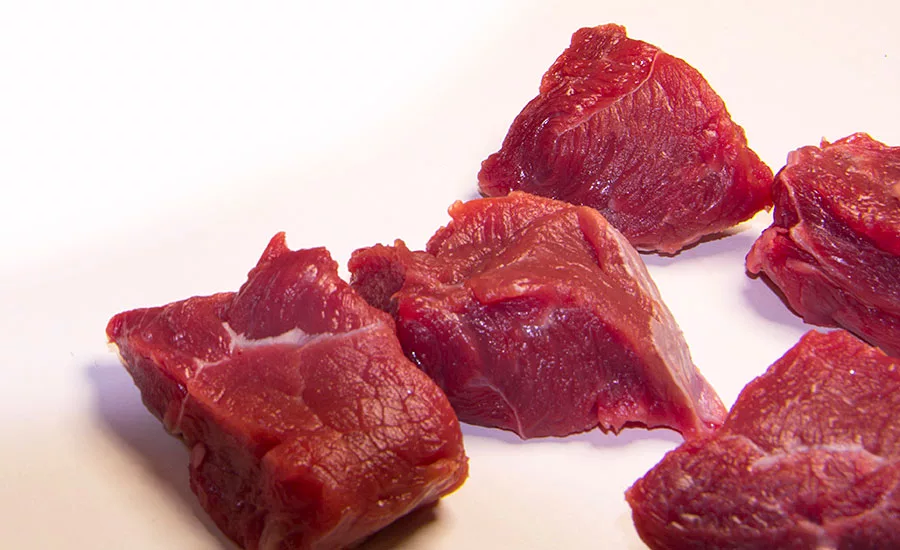
Diced Meat
May 1, 2018

Food production robots solve two problems: preventing worker injuries caused by machines or repetitive motions and improving consistency and speed in cuts. Now, wash-down robotic systems are also preventing food contamination. Improved sanitation and design on slicers, dicers and cutters in general continues to motivate the food industry.

Food contamination remains a stubborn problem to solve. According to the Centers for Disease Control and Prevention, about 48 million people in the United States still get food-borne illnesses — roughly one in six Americans.

Wash-down robots can provide a more streamlined cleaning process and even eliminate the need for humans. They have smooth casings, better ingress ratings and no loose wires for a thorough cleaning at the end of every work cycle — even by other wash-down robots.

“I have seen a lot more wash-down robotics systems in the past few years,” notes Gary McMurray, associate director at Collaborative Robotics, Georgia Tech Research Institute (GTRI), based in Atlanta.

These robots also usually come equipped with a protective surface that is resistant to bacteria, chemicals and an intense cleaning process or antiseptics and water pressure. They also must maintain an IP67 (wash down) rating for hygienic production lines because they deal with unwrapped food.

For companies that can’t rely on robotic help, the equipment manufacturer must take into account the cleanability of the equipment and the quality of the metal used, such as stainless steel 316 versus 304, says Warren Gilbert, a partner at FSS Corp., based in Elkhorn, Wis. In this case, he gives the nod to 316 as the superior stainless metal because of its ability to maintain an edge and last in a caustic environment.

“When using a better metal and pre-operational inspections, processors will find better efficiencies, cleaner cuts and a better quality product,” he says.

Looking for quick answers on food safety topics?
Try Ask FSM, our new smart AI search tool.
Ask FSM →

Under Global Food Safety Initiative (GFSI)-recognized audit platforms such as Safe Quality Food (SQF) or British Retail Consortium (BRC), there has to be a lot of validation of the cleaning process, Gilbert says.

“This includes equipment and environmental swabbing, blade or knife inspection programs, etc.,” he says.

To improve sanitary design and hygienic longevity of the equipment in challenging environments, some interesting slicer innovations include the implementation of solid materials in frames and other support elements within the equipment.

“It’s also important to note that the adoption and evolution of sanitary design standards are driving improvements in the simplification of designs, which in turn reduces harborages and increases the accessibility and cleanability of equipment for our operators and janitors,” says Mike Bartikoski, senior vice president of operations at Land O’Frost, based in Munster, Ind.

The best-in-class equipment design can also do more with less.

“Whether it be blade design, sensors or communication cables, the equipment must be able to withstand the rigors of being taken apart daily, cleaned and sanitized,” says Mike Bliss, vice president of operations at Butterball, based in Garner, N.C.


Rethinking robotics

Robot butchers have found more success in the poultry industry — such as with high-volume chicken leg deboning — than the more variable beef industry. But robot manipulators and various vision sensors are being introduced in beef to eliminate dangerous cuts, such as rib cutting.

In 2012, GTRI created a prototype system that uses advanced imaging technology and a robotic cutting arm to automatically debone chicken and other poultry products. Now the lab is looking at rethinking the entire deboning process.

“We are starting a new project at GTRI looking at a new process for deboning a bird,” says McMurray. “The idea is, how could you integrate all of the cutting tasks into a single robotic work cell?”

This new project could lead to potential savings, as far as reducing floor space, the number of employees needed and other factors, McMurray says.

“The idea is not to simply drop in a robot where a person is, but look at reorganizing the process to take advantage of automation,” he says.

Improvements in automation are also leading to progress in labor efficiencies.

“Additionally, there has been notable progress made in the automation of handling and loading technologies to interface with a wider array of consumer-driven packaging solutions — such as multi-compartment trays and deli packs,” Bartikoski says. “The development of robotics and conveyor solutions to reduce labor in product loading continue to drive labor efficiencies.”


Optimizing blade maintenance

Blade and slicer technologies continue to advance, as well.

“Some of these include the ability to track individual blades and monitor their sharpening and maintenance,” Bartikoski says. “This helps ensure optimized blade life and product/machine compatibility.”

Thanks to improvements in both original blade manufacturing technologies and maintenance/sharpening capabilities, blade enhancements are ongoing.

“Finally, the evolution and advancements of weight control systems and interfaces within the slicing process continue to support improvements in the efficacy of weight control,” Bartikoski says.

Most slicer original equipment manufacturers (OEMs) continue to refine their equipment and processes to reduce heels at slicing — minimizing rework — and increasing first pass throughput, Bartikoski says.

In the end, the key to sustainable performance is the upkeep of the equipment. “Today’s slicers are designed with the user in mind, providing systems that enhance the ability to quickly troubleshoot and diagnose an issue and return the process to normal operation,” Bliss says.

Despite increases in automation, there’s still a need for trained operators.

“This, I believe, is the point of difference,” Bliss says. “We see today that most manufacturers are focusing on service after the sale. This again is a point of differentiation.”  NP

This article was originally posted on www.provisioneronline.com.
KEYWORDS: meat cutting sanitary design principles sanitary equipment design sanitation best practices slicing

Share This Story

Megan pellegrini
Megan Pellegrini is a contributing writer.

Recommended Content

JOIN TODAY
to unlock your recommendations.

Already have an account? Sign In

  • people holding baby chicks

    Serovar Differences Matter: Utility of Deep Serotyping in Broiler Production and Processing

    This article discusses the significance of Salmonella in...
    Testing & Analysis
    By: Nikki Shariat Ph.D.
  • woman washing hands

    Building a Culture of Hygiene in the Food Processing Plant

    Everyone entering a food processing facility needs to...
    Food Prep/Handling
    By: Richard F. Stier, M.S.
  • graphical representation of earth over dirt

    Climate Change and Emerging Risks to Food Safety: Building Climate Resilience

    This article examines the multifaceted threats to food...
    Management
    By: Maria Cristina Tirado Ph.D., D.V.M. and Shamini Albert Raj M.A.
Manage My Account
  • eMagazine Subscription
  • Subscribe to eNewsletter
  • Manage My Preferences
  • Website Registration
  • Subscription Customer Service

More Videos

Sponsored Content

Sponsored Content is a special paid section where industry companies provide high quality, objective, non-commercial content around topics of interest to the Food Safety Magazine audience. All Sponsored Content is supplied by the advertising company and any opinions expressed in this article are those of the author and not necessarily reflect the views of Food Safety Magazine or its parent company, BNP Media. Interested in participating in our Sponsored Content section? Contact your local rep!

close
  • Salmonella bacteria
    Sponsored byThermoFisher

    Food Microbiology Testing Methods: Salmonella species

  • a diagram explaining indicator organisms
    Sponsored byHygiena

    How Proactive Listeria Testing Helps Prevent Six- and Seven-Figure Recalls

  • woman grocery shopping
    Sponsored byCorbion

    Designing Safety Into Every Bite: Proactive Risk Mitigation for Refrigerated Foods

Popular Stories

NRTE breaded stuffed chicken

USDA Indefinitely Delays Enforcement of Salmonella as Adulterant in Raw Breaded, Stuffed Chicken

digital map of europe

EU Publishes Food Fraud Tool Mapping Thousands of Cases Since 2016

non-conforming product

How to Handle Non-Conforming Product

Events

December 11, 2025

How to Develop and Implement an Effective Food Defense Strategy

Live: December 11, 2025 at 2:00 pm EDT: From this webinar, attendees will learn common areas where companies encounter challenges in their food defense strategies and how to address them.

May 11, 2026

The Food Safety Summit

Stay informed on the latest food safety trends, innovations, emerging challenges, and expert analysis. Leave the Summit with actionable insights ready to drive measurable improvements in your organization. Do not miss this opportunity to learn from experts about contamination control, food safety culture, regulations, sanitation, supply chain traceability, and so much more.

View All

Products

Global Food Safety Microbial Interventions and Molecular Advancements

Global Food Safety Microbial Interventions and Molecular Advancements

See More Products

Related Articles

  • Sanitary Food Processing Facility

    Sanitary design leads to improved food safety

    See More
  • SFWB_Sanitation_0220_feature.jpg

    Improving food safety and sanitation through facility layout and design

    See More
  • Construction of New Meat Facility

    Sanitary design in meat and poultry facilities

    See More

Related Products

See More Products
  • 9781498721776.jpg

    Handbook of Food Processing: Food Safety, Quality, and Manufacturing Processes

  • 1119258073.jpg

    FSMA and Food Safety Systems: Understanding and Implementing the Rules

  • 1119053595.jpg

    Food Safety for the 21st Century: Managing HACCP and Food Safety throughout the Global Supply Chain, 2E

See More Products

Events

View AllSubmit An Event
  • July 15, 2025

    Hygienic Design Risk Management: Industry Challenges and Global Insights

    On Demand: From this webinar, attendees will learn the importance of hygienic design to ensure food safety and sanitation effectiveness.
  • November 18, 2025

    Dry Sanitation and Cleaning Techniques for Facilities and Equipment

    On Demand: From this webinar, attendees will learn best practices employed by dry/low-moisture food processors for dry sanitation and equipment cleaning.
View AllSubmit An Event

Related Directories

  • Percept Brand Design Agency

    Percept is a creative, design and branding agency in Sydney, Australia. We're branding specialists, with a focus on strategic packaging design solutions that achieve successful outcomes.
×

Never miss the latest news and trends driving the food safety industry

eNewsletter | Website | eMagazine

JOIN TODAY!
  • RESOURCES
    • Advertise
    • Contact Us
    • Directories
    • Store
    • Want More
  • SIGN UP TODAY
    • Create Account
    • eMagazine
    • eNewsletter
    • Customer Service
    • Manage Preferences
  • SERVICES
    • Marketing Services
    • Reprints
    • Market Research
    • List Rental
    • Survey/Respondent Access
  • STAY CONNECTED
    • LinkedIn
    • Facebook
    • Instagram
    • X (Twitter)
  • PRIVACY
    • PRIVACY POLICY
    • TERMS & CONDITIONS
    • DO NOT SELL MY PERSONAL INFORMATION
    • PRIVACY REQUEST
    • ACCESSIBILITY

Copyright ©2025. All Rights Reserved BNP Media.

Design, CMS, Hosting & Web Development :: ePublishing