Quantera Launches Solution for Parallel Testing of Volatile Compounds in Food, Beverages
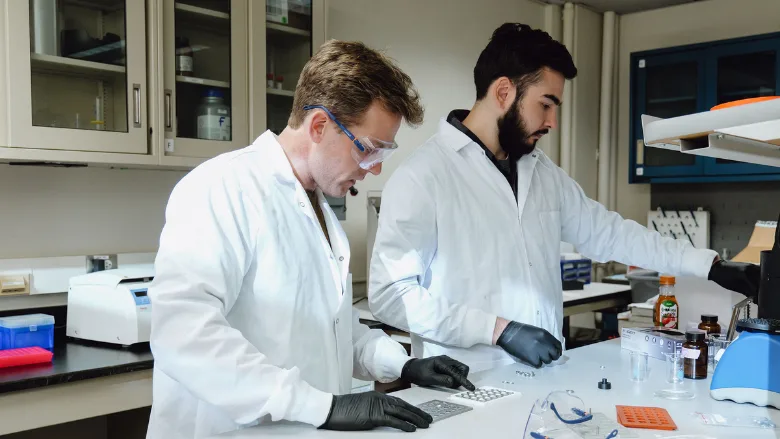
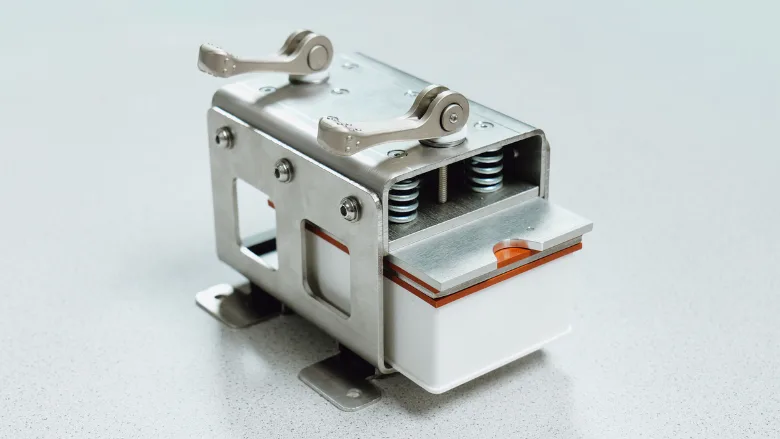
Quantera Analytical has introduced the Curio HS, a planar, parallel, cartridge-based headspace extraction platform designed to accelerate trace-level testing of volatile and semi-volatile compounds in food and beverages. Developed from research conducted at Cornell University, the technology enables laboratories to prepare dozens of samples simultaneously for analysis using existing instrumentation.
The company also announced plans to pilot Curio HS and has opened an early-access program for producers and laboratories.
Headspace analysis is used to detect volatile and semi-volatile compounds at concentrations as low as parts per billion (ppb) or parts per trillion (ppt). Applications include identifying off-flavors in beverages and dairy products, assessing compounds associated with grape ripeness, and detecting residual solvents in food packaging materials.
Conventional headspace testing typically relies on solid-phase microextraction (SPME) fibers to extract compounds from individual samples before analysis using gas chromatography-mass spectrometry (GC-MS). According to Quantera, the Curio HS enables parallel sample preparation and supports a wider range of sorbent materials and analytical instrumentation.
Parallel Sample Preparation and Analytical Capabilities
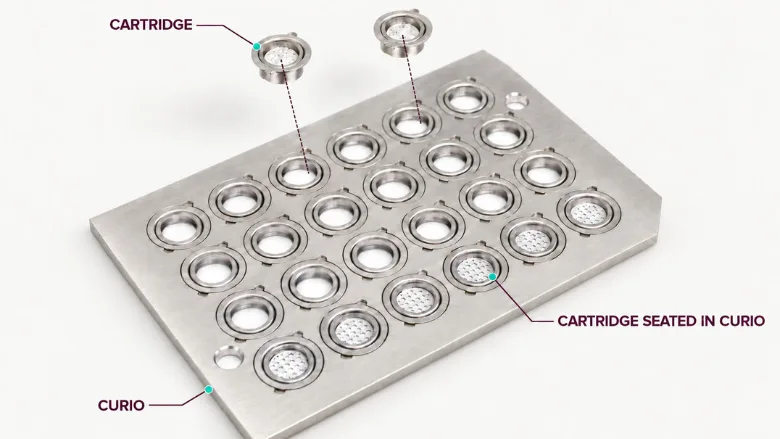
Curio HS accommodates liquid or solid samples in a multi-well plate with a standard plate footprint. An array of sorbent cartridges seals over the plate, positioning one cartridge above each sample well. According to Quantera, sample preparation requires less than two minutes per sample.
Unlike conventional fiber-based extraction systems, the cartridge-based design allows laboratories to select conventional or advanced sorbent materials based on target compounds and testing requirements without changing the device or workflow.
Cartridges can also be loaded at sample collection sites and transported to laboratories for analysis, reducing the need to ship perishable raw materials.
Looking for quick answers on food safety topics?
Try Ask FSM, our new smart AI search tool.
Ask FSM →
Curio HS is compatible with gas chromatography methods, including GC-MS and gas chromatography-flame ionization detection (GC-FID). It also supports direct analysis in real time-mass spectrometry (DART-MS) and other chromatography-free mass spectrometry systems. Liquid chromatography workflows are under development.
Quantera reported that, when paired with DART-MS, the platform can increase sample throughput by up to 60 times and reduce per-sample costs by up to 80 percent compared with conventional fiber-based extraction. For GC-MS workflows, the company reported approximately 50 percent lower per-sample costs.
The company also stated that established headspace SPME methods can be transferred to Curio HS with minimal re-optimization.
Technology Development and Industry Validation
The technology underlying the Curio HS was developed in the Cornell University laboratory of Professor Gavin Sacks, Ph.D., with research documented across 12 peer-reviewed publications.
Quantera holds an exclusive license to Cornell's patent portfolio covering the extraction geometry and workflow and has filed additional patent applications related to the Curio platform and cartridge design.
The company is preparing to deploy the technology in a pilot program with E. & J. Gallo Winery, following a research collaboration between Cornell and Gallo.
Additional industry collaborations include work with a contract laboratory serving the wine industry on high-throughput workflow design. The U.S. Department of Agriculture's Agricultural Research Service (USDA-ARS) is also co-authoring a validation study based on a pilot program with Quantera.
Additionally, Bruker Corporation is collaborating with Quantera to provide analytical instrumentation and expertise for the company's laboratory.
Curio HS is currently available through an early-access program. According to Quantera, participating producers and laboratories will receive complimentary method development support to transfer existing headspace testing methods to the platform.
Interested parties can request early access through Quantera’s website.
Quantera: www.quantera.as