Food Safety Without Borders: Building Knowledge Networks for Global Cooperation
Food safety is a global issue, and food safety professionals have always been managing amid a world of evolving risks. New pathogens are emerging, supply chains span national borders, customers' expectations are evolving, and regulatory frameworks are changing. Now, however, the pace and complexity of change are accelerating. Climate change is affecting the distribution of biological and chemical hazards, digital technologies are changing the way food is tracked and traced, and geopolitical upheavals expose vulnerabilities in international food systems.
With this in mind, more than 70 food safety leaders from 24 countries gathered at the Global Food Safety Symposium at Michigan State University from July 21–24, 2024 to discuss a pressing question: How can food safety systems become more resilient in an increasingly interconnected world? Participants repeatedly said regarding global food security: "if it is not safe, it is not food" and "food safety saves lives."
For conversations on microbial hazards and regulatory modernization to artificial intelligence (AI) and workforce development, the same message always came up. Building safer food systems is not just about improving inspections or adopting new technologies. It is about improving the people, institutions, and partnerships that help countries to anticipate, manage, and recover from increasingly complex food safety issues.
The lessons learned are not only applicable to governments but also to industry, academia, and every professional who is responsible for the protection of the food supply.
Prevention Begins Long Before an Outbreak
Today's food safety is moving from reactive to preventive. Rather than measuring success by how quickly organizations respond to outbreaks or recalls, leading food safety systems are investing in their ability to identify risks before consumers become ill.
The U.S. is facing a significant food safety crisis in 2026, marked by a major outbreak of cyclosporiasis caused by the Cyclospora parasite. The outbreak has been linked to contaminated shredded iceberg lettuce, prompting recalls and investigations. Thousands of people across multiple states have become ill. This crisis highlights the critical importance of food safety and the urgent need for stronger food safety surveillance, rapid outbreak detection, effective traceability, and coordinated public health action.
Making this change does not require more data. The information needs to be converted into actionable intelligence by stronger surveillance systems, integrated laboratory networks, improved traceability, and risk-based decision-making. Due to advances in whole genome sequencing, predictive analytics, and digital traceability, we are now at a point in time where we can identify emerging hazards much earlier than ever before.
Looking for quick answers on food safety topics?
Try Ask FSM, our new smart AI search tool.
Ask FSM →
Global Symposium participants stressed that technology alone is not the solution. Prevention is about governance, scientific knowledge, and the ability to translate data into sensible policy and operational decisions. As food systems continue to evolve, prevention is becoming not only a technical objective, but also a strategic capability.
Strong Food Safety Systems Depend on Strong People
Investment in laboratory infrastructure and regulatory modernization remains important, but one of the strongest messages of the Global Symposium was that sustainable food safety systems are ultimately built by people.
Food safety professionals today are expected to do so much more than inspections or laboratory checks. They interpret complex scientific evidence, communicate risk to diverse audiences, coordinate emergency responses, advise policymakers, and work across disciplines that include public health, agriculture, trade, and environmental management. Developing these broader leadership abilities is as important as technical expertise.
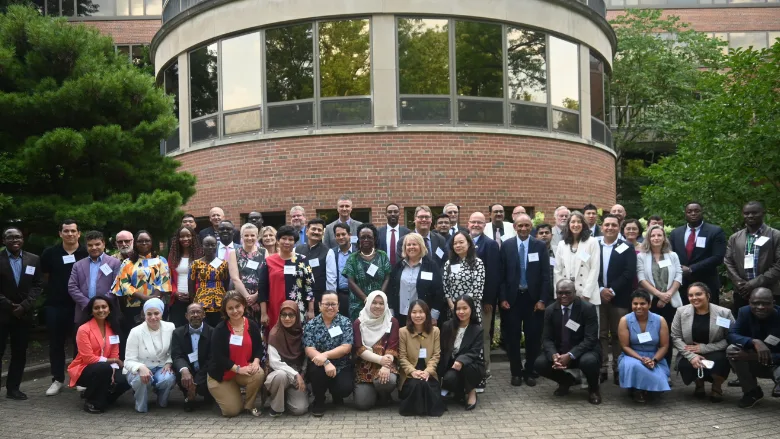
The Global Symposium also demonstrated that professional development is important far beyond the classroom (Figure 1). Participants talked of collaborations formed years earlier that continue to guide regulatory change, university curricula, and regional food safety efforts. In many cases, relationships formed through international education have become networks for scientific exchange and technical cooperation.
Figure 1. Symposium participants discussed how previously formed food safety collaborations continue to guide regulatory, academic, and regional food safety efforts
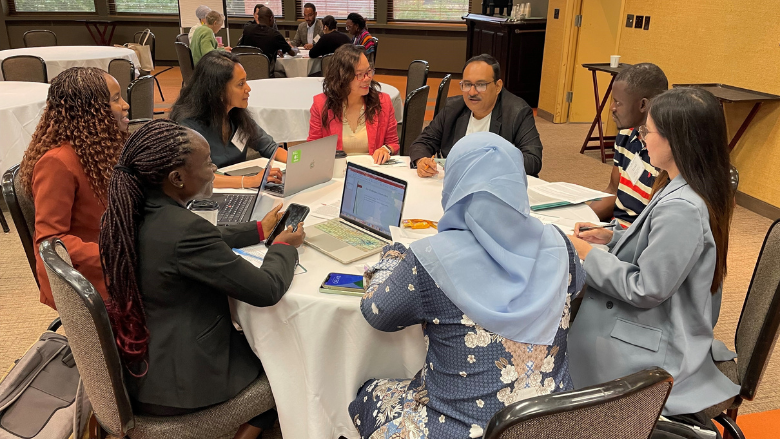 Image courtesy of MSU
Collaboration Is No Longer Optional
Food safety is always a collaboration, and today's challenges have made it more necessary than ever.
Whether the issue is antimicrobial resistance, food fraud, environmental contamination, or emergency response, no single organization has the required expertise. Government agencies, universities, industry, international bodies, and public health professionals have their own points of view that are more powerful when combined.
Food—and food safety risks—move across borders every day. Investments that strengthen surveillance, regulatory capacity, and scientific expertise in one country contribute to the resilience of the global food system as a whole. International collaboration is no longer merely development assistance; it is, in fact, a practical investment in common public health and economic security.
Innovation Should Strengthen Judgment, Not Replace It
AI, blockchain, remote sensing, digital traceability, and cutting-edge laboratory technology are changing the face of food industry conversations. Their potential to enhance food safety is very high. However, all participants at the Global Symposium advised against the notion of technology as a substitute for sound scientific judgment.
Digital tools can improve inspection prioritization, enhance supply chain transparency, support risk analysis, and improve regulatory efficiency. But technology is only as good as the governance structures, data quality, and professional expertise that underpin it.
The most successful organizations are not likely to be the ones to adopt every new technology first. In fact, they will be those that integrate innovation into existing food safety management systems in a thoughtful manner, while remaining rooted in science and risk-based decision-making.
The future of food safety will depend as much on effective implementation as on technological progress.
Measuring Capacity Building by Its Impact
The Global Symposium's perennial theme was that successful capacity building should not be measured by the number of workshops carried out or professionals trained. What matters is what happens when participants return home.
Several speakers shared examples of how they used lessons learned to modernize national regulatory systems, enhance food safety policies, and improve university education. Rebecca Lopez-Calvo, for example, discussed how international cooperation helped construct a food safety curriculum for university students in Costa Rica that has been in use for more than 15 years. Dr. Hemant G. Koshia discussed how international best practices were adapted to enhance food safety management in India's Gujarat state, emphasizing that knowledge exchange is not about replicating best practices, but about adapting them to local conditions.
These examples support an essential principle for food safety professionals everywhere: the most effective progress is achieved when knowledge creates multipliers. Good education gives people a footing where they can strengthen institutions, mentor colleagues, and provide a much stronger food safety system in their own countries.
Trust Remains the Foundation
Although there were many discussions at the Global Symposium about science and regulatory innovation, trust was probably the most central theme (Figure 2).
Consumers rarely witness the laboratory analyses, inspections, or risk assessments that protect the food supply. Their confidence depends on the assurance that decisions are transparent, evidence-based, and consistently applied.
That trust is not just about technical proficiency. It requires good communication and institutional credibility, as well as the ability to explain what is known and what is still uncertain in food safety crises. In this age of misinformation as contagious as pathogens, transparent communication has become an essential component of food safety risk management.
Figure 2. Trust was a central theme of discussions at the 2024 Global Food Safety Symposium
 Image courtesy of MSU
Looking Ahead
The discussions at the 2024 Global Food Safety Symposium presented no single blueprint for the future of food safety, and perhaps that was the most valuable lesson.
Resilient food safety systems are not built by one technology, one regulation, or one training program. They come from sustained investment in people, partnerships, scientific excellence, and institutions that can respond to evolving risks. Whether it is building up surveillance systems, increasing workforce development, embracing digital innovation, or forging international partnerships, the aim is the same: to build food safety systems that prevent problems before they occur and respond effectively when they do.
For food safety professionals, these priorities extend beyond regulatory compliance. They represent strategic investments in public health, consumer confidence, economic resilience, and the integrity of the global food supply.
As food systems become increasingly interconnected, the profession's greatest strength may not be one of a single scientific breakthrough, but of a willingness to share knowledge with one another. The conversations at the Global Food Safety Symposium reflected that mutual commitment and an enduring truth: food safety is a global responsibility, and no country can build resilient food safety systems alone.
Key Recommendation
The key recommendation from the 2024 Global Food Safety Symposium, held at Michigan State University, was to continue strengthening food safety capacity-building programs worldwide through collaboration and cooperation. With this goal in mind, Symposium participants strongly recommended establishing a "Global Food Safety Knowledge Hub" to facilitate the sharing and exchange of food safety information, training tools and resources, networking and funding opportunities, and a roster of food safety professionals. An international steering committee will be formed to advance the platform and foster global knowledge partnerships in food safety in support of a food-secure world.