Individual Quick Freezing and Isochoric Freezing in Berries: Simplicity Through Complexity
Progress in isochoric freezing technology can revolutionize the methods that are used to handle and store frozen fruits and vegetables
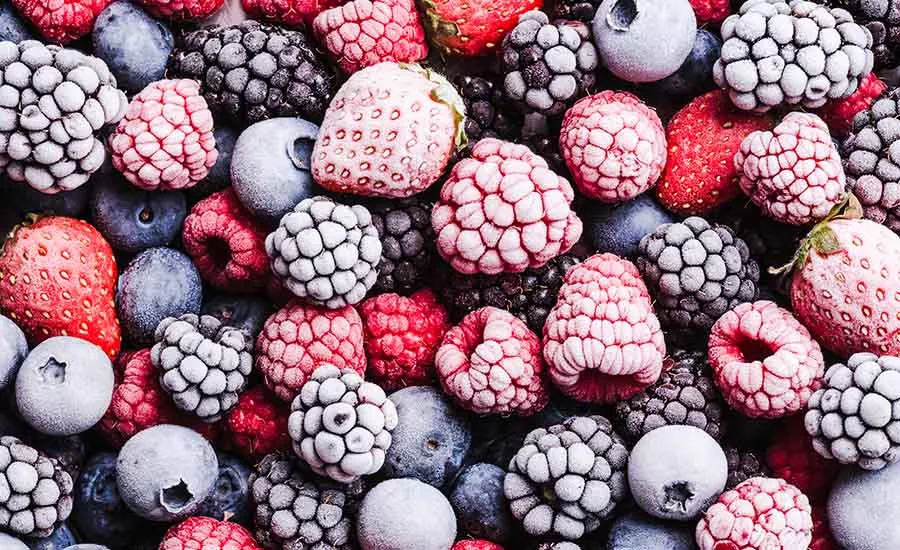
The food industry uses many techniques to preserve a wide variety of products while maintaining their quality and nutritional value. Freezing is a popular method that consists of removing heat, which ultimately decreases water activity, reduces enzymatic reactions, and inactivates the growth of microorganisms. Traditional freezing is a slow process that reduces the temperature of foods and is widely used in the supply chain. Unfortunately, large crystals are formed during the phase transition, which causes significant, irreversible changes that affect product quality.
Individual quick freezing (IQF) is a faster process where freezing plates, cryogenic gases, or forced cold air convection are used to freeze small pieces of fruits and vegetables that result in the formation of microscopic ice crystals, minimizing the potential damage of the tissue structure. Isochoric freezing is a relatively new technology that controls nucleation and crystallization, improving the quality of frozen products. Isochoric freezing occurs at a constant volume, whereas the previous two techniques occur at constant atmospheric pressure or are isobaric.1,2,3
Berries are a group of commodities that are commonly frozen and are amenable to different freezing techniques. Unfortunately, IQF berries have been involved in multiple recalls and outbreaks4,5 that have resulted in the U.S. Food and Drug Administration (FDA) releasing a Prevention Strategy for the Control of Enteric Viruses in Berries6 and the Canadian Food Inspection Agency (CFIA) conducting targeted surveys for frozen berries and frozen-cut fruits and vegetables for smoothies.7 IQF berry suppliers have designed and implemented specific HACCP programs for their facilities, which contribute to a safer supply chain.
There are environmental benefits to consuming frozen foods, including berries. They have long shelf life, which results in less food waste, primarily at the client/consumer level. Isochoric freezing is a much more efficient process and can maximize sustainability efforts by reducing the energy required to maintain the product in a preserved state. Additional research is needed to commercialize isochoric freezing and other novel freezing techniques. These types of technological shifts tend to occur when complex scientific concepts are used to provide different avenues for the applied sciences, where ideas are directed for a particular purpose and are made accessible to more people.8,9,10
Traditional Freezing, IQF, and Isochoric Freezing
Freezing techniques have evolved significantly over the past several decades. While each technique aims to preserve food quality and inhibit microbial growth, there are distinct advantages and challenges depending on the food type. Traditional freezing, or isobaric freezing, is the most common freezing method. Food is frozen at a constant atmospheric pressure, which leads to a steady decline in temperature as large ice crystals form within the food. The outcome varies by item, as all foods freeze differently depending on water content, sugar, tissue strength, and air flow. The formation of ice crystals can disrupt the food's cellular structure, having negative effects on texture, flavor, and quality.
In contrast, individual quick freezing (IQF) is a method designed to minimize the formation of large ice crystals. This technique rapidly freezes food, resulting in very small ice crystals that help maintain the food's structure and overall quality. IQF is especially useful for products like berries, where maintaining cell integrity is crucial for end-product quality. IQF can be achieved through various methods, such as air blast, spiral belt, or fluidized bed freezing. The method used will depend on the food item, but each process aims to preserve appearance, texture, and taste by preventing the damage caused by large ice crystal formation.
Isochoric freezing offers an innovative approach by preventing the formation of ice within the food itself. This method differs from isobaric freezing by occurring at a constant volume, which then results in various pressures based on freezing temperature. Food is placed in a rigid chamber filled with an aqueous solution and then frozen. Ice forms within the solution but not within the food item, which preserves the food at subfreezing temperatures without internal ice formation. Quality is maintained by avoiding cell rupture, making this technique another strong option for delicate foods such as berries. Pressure and temperature are key variables, and cellular damage can result if these variables are not maintained.
Looking for quick answers on food safety topics?
Try Ask FSM, our new smart AI search tool.
Ask FSM →
Selecting the best freezing method and equipment is dependent on the specific characteristics of a food item. Due to the small, tender quality of berries, IQF and isochoric freezing are ideal options that have been explored to improve the standard of berry preservation.11,12,13
Food Safety
Fresh and frozen berries can become contaminated through different pathways, such as poor hygienic harvesting practices and contaminated irrigation water at the field level, as well as contaminated surfaces and wash water at the facility level. These commodities have been involved in multiple recalls and outbreaks, due in large part to norovirus and hepatitis A virus infections. Viruses can resist harsh conditions and persist long-term without a "kill step" in the process. Viruses are not uniformly distributed, and current methods lack robustness for sampling, concentrating, and analyzing foodborne pathogens, making their detection complicated.
Temperature and water activity are the main parameters that need to be controlled in cold storage and transportation. Water activity (Aw), which is directly affected by temperature, is a measure of the amount of free or unbound water that is available for the growth of microorganisms. It is the ratio between the vapor pressure of food and distilled water under the same conditions.4,5,14,15
FDA and CFIA have responded to food safety events by conducting surveillance sampling on frozen berries to obtain information pertaining to the occurrence and distribution of pathogenic viruses and bacteria, respectively. These surveys can assist in providing information on certain hazards, identifying and characterizing emerging hazards, providing trend analysis, linking the source of contamination, and continuing to conduct scientific research to address knowledge gaps. Additional regulatory and enforcement options could be considered, as well, to enhance the overall effectiveness of current food safety frameworks.6,7
Specific Hazard Analysis and Critical Control Points (HACCP) systems are used to identify, evaluate, and control food safety hazards throughout the production process of frozen berries. Three Critical Control Points (CCP) are typically associated with these types of operations:
- Antimicrobial treatment in wash water, where sanitizer concentration and contact time are monitored
- IQF freezing, where internal product temperature is monitored
- Metal detection, where metal detectors are tested with samples.
It is important to note that cold storage can be characterized as an operational prerequisite program or as a process preventive control. Proper design and implementation of a HACCP plan can significantly enhance a supplier's food safety program and, by extension, support broader industry improvements by minimizing outbreaks and recalls and reinforcing consumer confidence.16
Pathogenic infections can also be prevented or minimized by strengthening food safety measures in field operations. This includes protection of irrigation water from fecal contamination since norovirus, hepatitis A virus, and Listeria monocytogenes are transmitted via the fecal–oral route. Additional new pre- and post-harvest processing technologies should be evaluated for their potential to reduce viral and bacterial contamination in high-risk foods like berries.5
Sustainability
In general, frozen foods can result in less food waste in stores, restaurants, and in home kitchens compared to fresh foods. This is due to a longer shelf life, which reduces the likelihood of spoilage and facilitates store rotation and inventory management at the retail/foodservice level. It also reduces overbuying at the consumer level, since frozen food can provide flexibility when planning for meals, allowing households to use only what they need while keeping the rest stored for future use.8
Maintaining temperature-controlled environments requires significant energy consumption, which affects the carbon footprint of the frozen food industry as a whole. A potential strategy by the American Frozen Food Institute (AFFI) to address this challenge involves assessing the feasibility of raising the standard temperature for frozen storage throughout the cold chain from –18 °C (0 °F) to –15 °C (5 °F), with the help of a task force consisting of subject matter experts. This approach challenges a globally applied standard established by the U.S. Department of Agriculture (USDA), which is used across the global cold chain. Energy consumption and costs could be significantly reduced by slightly increasing the storage temperature, as long as food safety and quality are not compromised.13
Advancements in processing technology have significantly enhanced sustainability across the food system. Isochoric freezing is characterized by lower energy needs than the more conventional freezing methods, while reducing post-harvest product loss. The design for this system is simple and can be implemented in the food industry without any major alterations to the existing infrastructure or major investments in new equipment. Further progress in this area can revolutionize the methods that are used to handle and store frozen fruits and vegetables in a way that is analogous to a paradigm shift.10,17,18
Conclusion
The phrase "simplicity through complexity" can certainly be used for many, if not all, technological innovations. The knowledge obtained from basic science, with its complex concepts, can be used to provide information that may drive changes in the applied sciences, which rely on concepts that can be seen as simple in comparison. Scientific research expands our general understanding, and its applications directly affect human advancements. The improvements in freezing methods for food commodities are a perfect example of this, as most people are not well-versed in thermodynamics but are able to understand the main principles of a given process or the essential equipment specifications.
Food production is increasingly reliant on novel technologies that improve efficiency while maintaining product quality and reducing food safety risks, particularly those related to microbiological hazards. Individually quick frozen and isochoric freezing techniques are part of this gradual progression, with additional positive effects on the environment. It is important to note that scientists and engineers use previous knowledge and data to make innovations and improvements and to generate new information. New research into antimicrobial controls can lead to further improvements in these freezing methods and possibly reduce the number of recalls and outbreaks associated with frozen berries.
References
- Noriega-Juáre, A.D., J.D. Rubio-Carrillo, M.L. García-Magaña, et al. "Comparison of individual quick freezing and traditional slow freezing on physicochemical, nutritional and antioxidant changes of four mango varieties harvested in two ripening stages." Food Chemistry Advances 4 (June 2024): 1–12. https://doi.org/10.1016/j.focha.2023.100590.
- Grover, Y., and P.S. Negi. "Recent developments in freezing of fruits and vegetables: Striving for controlled ice nucleation and crystallization with enhanced freezing rates." Journal of Food Science 88, no. 12 (2023): 4799–4826. https://doi.org/10.1111/1750-3841.16810.
- McHugh, T. and C. Bilbao-Sainz. "Isochoric Freezing: A New Technology for Food Preservation." Food Technology Magazine (November 1, 2019). https://www.ift.org/news-and-publications/food-technology-magazine/issues/2019/november/columns/isochoric-freezing.
- Tavoschi, L., et al. "Food-borne diseases associated with frozen berries consumption: A historical perspective, European Union, 1983 to 2013." Eurosurveillance 20, no. 29 (2015). https://doi.org/10.2807/1560-7917.es2015.20.29.21193.
- Nasheri, N. et al. "Foodborne viral outbreaks associated with frozen produce." Epidemiology and Infection 147 (2019): 1–8. https://doi.org/10.1017/s0950268819001791.
- U.S. Food and Drug Administration (FDA). "Constituent Update: FDA Releases Prevention Strategy for the Control of Enteric Viruses in Berries." January 17, 2025. https://www.fda.gov/food/hfp-constituent-updates/fda-releases-prevention-strategy-control-enteric-viruses-berries.
- Canadian Food Inspection Agency (CFIA). "Bacterial Pathogens and Indicators in Frozen Berries and Frozen-Cut Fruits and Vegetables for Smoothies—April 1, 2017 to March 31, 2020." Government of Canada Publications. March 10, 2021. https://inspection.canada.ca/en/food-safety-industry/food-chemistry-and-microbiology/food-safety-testing-reports-and-journal-articles/april-1-2017-march-31-2020-1.
- Martindale, W. "The potential of food preservation to reduce food waste." Proceedings of the Nutrition Society 76, no. 1 (June 14, 2016): 28–33. https://doi.org/10.1017/s0029665116000604.
- Câmpean, Ș.I., G.A. Breșcha, B.G. Vuțoiu, et al. "A comparison of raspberry freezing-damage during preservation in isochoric and isobaric conditions." Frontiers in Nutrition 11, no. 29 (July 28, 2024): 1–11. https://doi.org/10.3389/fnut.2024.1439726.
- Dhanya, R., A. Panoth, and N. Venkatachalapathy. "A comprehensive review on isochoric freezing: A recent technology for preservation of food and non-food items." Sustainable Food Technology 2, no. 1 (2024): 9–18. https://doi.org/10.1039/d3fb00146f.
- Hirschi, K. "Isochoric Freezing: The Future of Food Preservation." U.S. Department of Agriculture (USDA) Tellus. https://tellus.ars.usda.gov/stories/articles/isochoric-freezing-future-food-preservation.
- Zepp, M. "Understanding the Process of Freezing." The Pennsylvania State University, Penn State Extension. May 3, 2023. https://extension.psu.edu/understanding-the-process-of-freezing.
- Stier, R.F. "100 Years of Freezing: Thanks, Clarence Birdseye." Institute of Food Technologists (IFT). Augus 29, 2024. www.ift.org/news-and-publications/food-technology-magazine/issues/2024/september/columns/processing-100-years-of-freezing.
- Gummalla, S., D. Heldman, R.V. Tikekar, and A. Carroll. "Enhancing the Resilience and Sustainability of the Frozen Food Supply Chain." Food Safety Magazine August/September 2024. https://www.food-safety.com/articles/9662-enhancing-the-resilience-and-sustainability-of-the-frozen-food-supply-chain.
- FDA. "Water Activity (aw) in Foods." Content current as of August 27, 2014. https://www.fda.gov/inspections-compliance-enforcement-and-criminal-investigations/inspection-technical-guides/water-activity-aw-foods.
- Hossain-Jany, N., R. Islam, A.R. Mazumder, and B. Uddin. "Design and Application of Hazard Analysis Critical Control Point Principles for Typical Frozen Vegetables."Journal of Food Safety and Hygiene 2, no. 1/2 (2016): 8–14. https://jfsh.tums.ac.ir/index.php/jfsh/article/view/30.
- Bodor, A. "Growth Drivers for Frozen: Convenience, Sustainability and Personalization." American Frozen Food Institute. November 15, 2021. https://affi.org/growth-drivers-for-frozen-convenience-sustainability-and-personalization/.
- Nida, S., J.A. Moses, and C. Anandharamakrishnan. "Isochoric freezing and its emerging applications in food preservation." Food Engineering Reviews 13, no. 4 (March 31, 2021): 812–821. https://doi.org/10.1007/s12393-021-09284-x.
Javier Martinez, M.Sc. is the Director of Food Safety for Fresh Concepts.
Madison Flores is the Produce Support Manager for Fresh Concepts.