Strategies for Reducing Contamination and Cross-Contamination on Farms
SSAFE has developed a practical guide that provides farmers around the world with 47 useful and effective measures to reduce or eliminate contamination on their farms

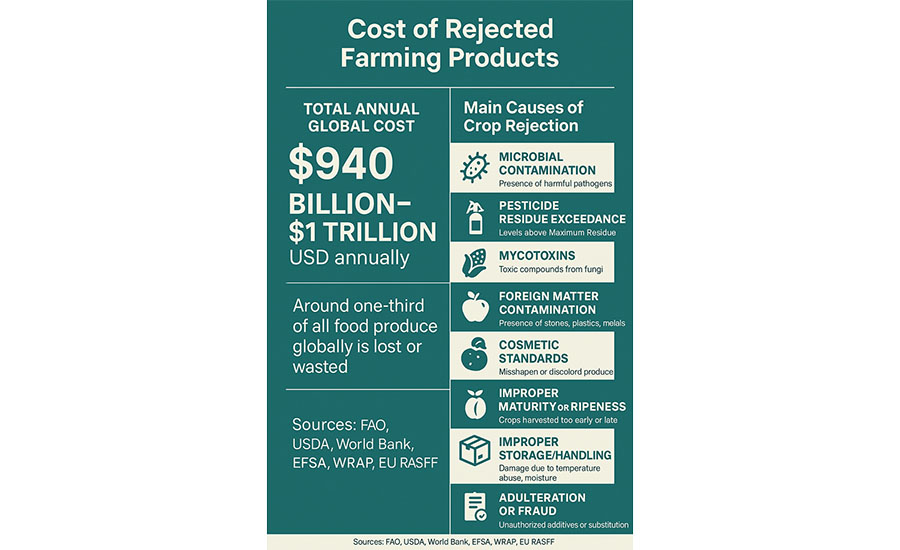
For centuries, humankind has been working hard to make food safe. Both public and private-sector organizations around the globe invest billions to make food as safe as possible for consumption. Yet, despite our best efforts, the amount of rejected food products coming from farms continues to cost billions of dollars annually (Figure 1).1–6
Contamination by allergens and biological, chemical, and physical contamination linked to poor growing and harvesting practices, undeclared ingredients, illegal dyes, incorrect pesticide use, improper use of chemicals, and other issues continue to persist and appear to be on the rise. They continue to be the major cause of food recalls. Herbs and spices, in particular, continue to be impacted extensively. Table 1 illustrates some of the most common issues related to herbs and spices.
Many governments (local, regional, and national), intergovernmental and non-governmental organizations, and the private sector have programs to train farmers to help address the issue. However, there is often a lack of oversight, expert guidance, and/or enforcement to verify that farmers are following or complying with the information set out in the training programs. Furthermore, the narrow scope of many of these programs presents a missed opportunity to address wider needs and drive meaningful change. For example, backward integration programs are common for chilis in one country but not available for paprika in a neighboring country. There is often a lack of consistency, transparency, and, in certain cases, scientific rigor in many such programs.
This is simply not good enough. The food sector works very hard to make sure its products are safe for consumption. The cost of rejected farming products running into the billions every year is not acceptable. The food industry also has a responsibility to help farmers access current best practices, based on scientific evidence, which can help improve not only their farming practices but also their livelihoods.
SSAFE Guidance Initiative
Building on our members' experience in developing and implementing capacity and capability improvement programs, SSAFE developed a practical guide that provides farmers around the world with 47 useful and effective measures, based on scientific global best practices, to reduce or eliminate contamination and cross-contamination on their farms.
While the primary focus in developing the framework was on chemical contamination and cross-contamination in the production of herbs and spices, most of the measures are applicable to the production of any non-animal-derived farming product. The guidance is applicable to all farmers everywhere, and it should be of particular use and benefit to smallholder farmers in low- and middle-income countries.
SSAFE successfully piloted the program in India, China, and Türkiye with a range of herb and spice farmers. The feedback received was positive, both in terms of the quality and ease of use of the materials, as well as the impact of the program on improvements across multiple farms. SSAFE worked with local associations and buyers to help deliver the training in person, rather than through a phone application or other form of electronic training, because the farmers preferred hands-on training from an expert.
Looking for quick answers on food safety topics?
Try Ask FSM, our new smart AI search tool.
Ask FSM →
SSAFE's 47 Measures to Reduce Contamination
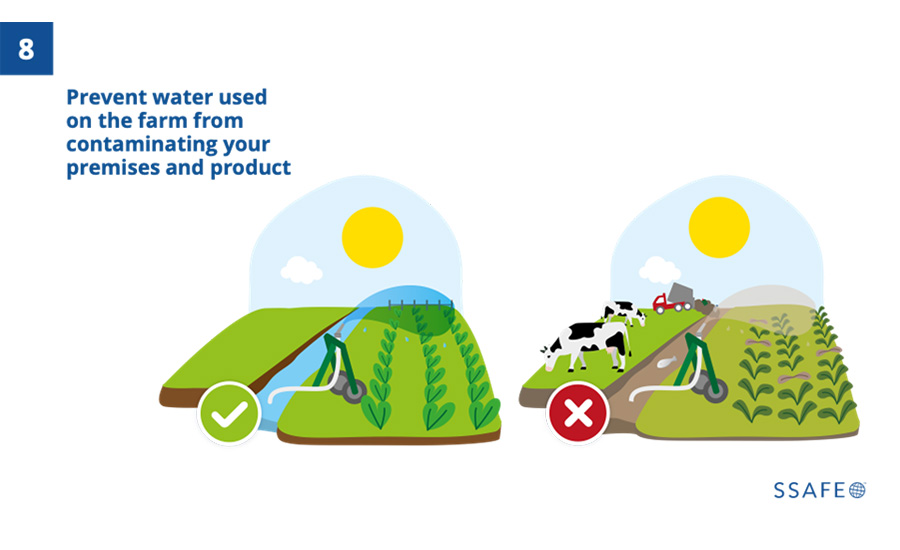
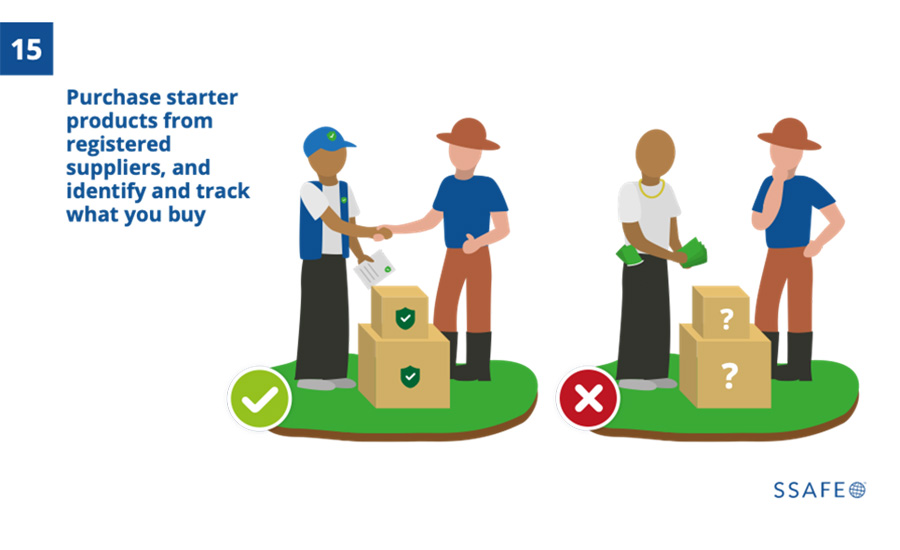
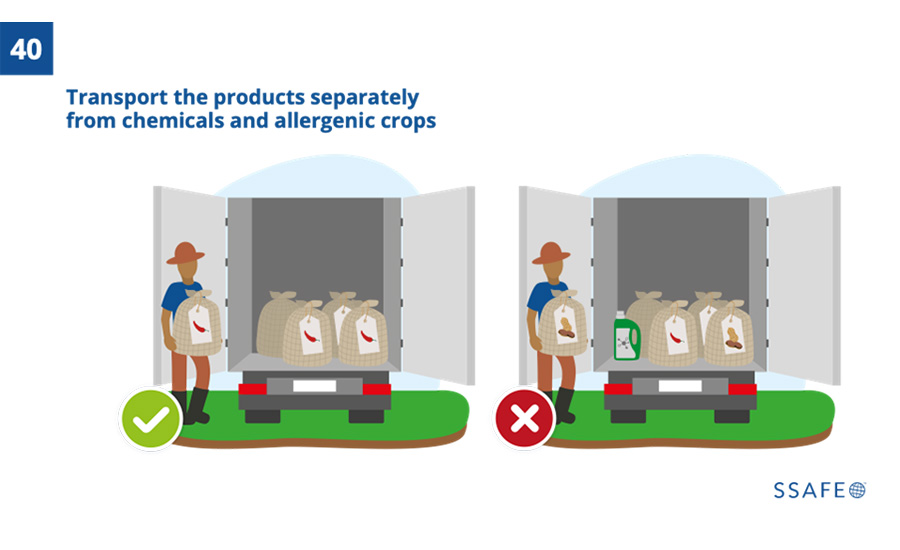
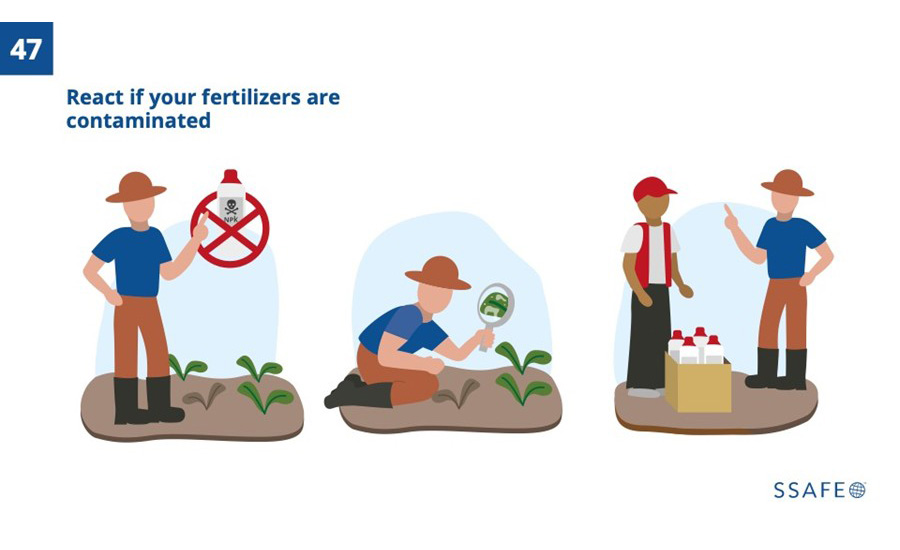
The 47 measures should be considered as practical and non-negotiable "must dos" for every farmer. Divided into several categories, each measure sets out what the farmer should do and why and how they should do it. The guidance is accompanied by a set of simple, pictorial instructions that clearly show what should and should not be done in each case, helping to provide farmers with easy and succinct instructions in regions where literacy is a challenge. Figures 2–5 show four illustrations taken directly from the guidance.
Benefits of SSAFE Guidance
The guidance has proven to be easy to use and effective, and it is a great starting point for training farmers around the world to improve their practices and reduce the amount of rejected products which, in turn, increases their profits and improves their livelihoods. Farmers are not the only stakeholders who will benefit from broad roll-out and adoption of this framework, however. Table 2 breaks down how different stakeholder groups can benefit from using this guidance.
Next Steps
To realize the maximum benefits for different stakeholder groups from this framework, it must be rolled out as broadly and deeply into farming communities around the world as reasonably practical. This is a big challenge! Food manufacturers are often five or more steps removed from the farmer, especially in the herbs and spices sector.
SSAFE members are sharing the guidance freely with suppliers, buyers, and traders of raw agricultural products and encouraging them to share it with their farming communities. The next step will be to track the reduction in rejected products within supply chains.
SSAFE is also reaching out to leading global organizations such as the Food and Agriculture Organization of the UN (FAO), the World Trade Organization (WTO), the UN Industrial Development Organization (UNIDO), national regulators, the World Bank/IFC, GLOBALG.A.P., the Sustainable Agricultural Initiative (SAI) Platform, trade associations, and non-governmental organizations. Collectively, these organizations play a pivotal role in advancing agricultural standards and food safety, and SSAFE is hopeful that they will back this transformative initiative aimed at improving farmer livelihoods while ensuring consumer food safety. Their participation is crucial in achieving these goals and making a significant impact on agricultural practices and food safety standards worldwide.
Finally, SSAFE is working collaboratively with its partners to share technical support and expertise, raise awareness, and strengthen rural development and farming communities around the world. It also plans to roll out training and capacity building programs based on the guidance. The collective goals are to make food safer, help improve farmers' livelihoods, and contribute to the reduction in food loss and waste through fewer rejected products. These goals not only support the UN Sustainable Development Goals (SDGs) but also aim to strengthen food security around the globe.
Download SSAFE's "Guidance for Good Food Safety Practices to Reduce Contamination and Cross-Contamination on Farms" for free here.7
References
- Food and Agriculture Organization of the United Nations (FAO). "Food Wastage Footprint: Impacts on Natural Resources." 2013. https://openknowledge.fao.org/server/api/core/bitstreams/1694038d-98f7-40f6-be4b-98782544b9f9/content.
- FAO. "The State of Food and Agriculture: Moving Forward on Food Loss and Waste Reduction." 2019. https://openknowledge.fao.org/server/api/core/bitstreams/11f9288f-dc78-4171-8d02-92235b8d7dc7/content.
- World Bank. "Missing Food: The Case of Postharvest Grain Losses in Sub-Saharan Africa." Agriculture & Rural Development Joint Notes 56 (May 2011). https://documents1.worldbank.org/curated/en/820211468005693818/pdf/649300BRI0ARD0560Box361547B00PUBLIC0.pdf.
- WRAP. "Transforming the World's Broken Systems." https://www.wrap.ngo/.
- EU. "Rapid Alert System for Food and Feed (RASFF)." https://food.ec.europa.eu/food-safety/rasff_en.
- U.S. Food and Drug Administration (FDA). "Import Alerts." https://www.fda.gov/industry/actions-enforcement/import-alerts.
- SSAFE. "Guidance for Good Food Safety Practices to Reduce Contamination and Cross-Contamination on Farms" 2025. https://www.ssafe-food.org/tools/guidance-document-for-good-food-safety-practices-to-reduce-cross-contamination-on-farms.
Quincy Lissaur is Executive Director of SSAFE, a global nonprofit membership organization with the purpose of strengthening the safe supply and trade of food around the world.