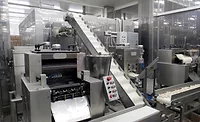
Tackling Mold Remediation in Food Processing Plants

Image Credit: IFC
Mold in food processing environments presents a significant threat to food safety, brand reputation, and regulatory compliance. Mold is a spore-forming organism, and spores are notoriously resistant to many common disinfectants. This presents a critical challenge: only agents with proven sporicidal activity can be relied upon for comprehensive remediation. Persistent mold growth can lead to costly recalls, shutdowns, and structural damage. This paper explores the causes of mold proliferation and the inherent challenges in its remediation, and also evaluates the efficacy of leading decontamination agents.
Get the expert insight you need—download the PDF and stay ahead of mold risks.
Causes of Mold in Food Processing Plants
Mold spores are ubiquitous in the environment, thriving in conditions that include:
- High humidity and condensation, especially near HVAC systems, ceilings, and cold storage areas.
- Organic residues from food particles, particularly in hard-to-reach corners, wall voids, and drain lines.
- Improper ventilation, which limits air exchange and encourages localized fungal growth.
- Structural vulnerabilities, including roof leaks, poor insulation, and cracked wall joints.
Despite rigorous cleaning protocols, mold can root itself within porous materials such as insulation, ceiling panels, and behind wall surfaces, making it difficult to eliminate with surface cleaning alone.
Challenges in Removing Mold
Several factors hinder effective mold remediation in food processing facilities:
- Biofilm formation: Mold can form biofilms that resist penetration by many disinfectants.
- Surface vs. airborne contamination: Mold spores can become airborne, settle in inaccessible areas, and recolonize even after cleaning.
- Material compatibility: Many cleaning agents are corrosive or degrade surfaces over time.
- Downtime constraints: Extended production halts for cleaning are costly, creating pressure for fast yet thorough solutions.
Evaluation of Decontamination Agents
Hydrogen Peroxide Fogging
Hydrogen peroxide vapor (HPV) is widely used for disinfection. It has proven efficacy against a variety of bacteria and fungi. However, HPV requires sealed environments and can struggle with full penetration into porous or hidden areas where mold often resides. Residual moisture and breakdown into water and oxygen may leave behind conducive growth conditions in high-humidity environments.1
Peracetic Acid Fogging
Peracetic acid (PAA) is a potent oxidizer effective against molds, yeasts, and bacterial spores. It is often deployed via fogging systems. However, PAA’s high reactivity can corrode stainless steel and other equipment over time,2 and its strong odor and potential respiratory irritation limit its use in occupied areas. Like hydrogen peroxide, its vapor-phase dynamics make it difficult to penetrate fully enclosed voids.
Ozone
Ozone (O3) is a strong oxidizing agent used in some food plant sanitation applications. It is effective against a range of microbial contaminants, including mold spores. However, its instability, high reactivity, and toxic exposure risks limit its practicality for full-facility fumigation. Moreover, ozone is highly corrosive to many metals and rubber components, posing compatibility concerns for facility infrastructure and equipment.5
Chlorine Dioxide Gas Fumigation
Chlorine dioxide (ClO2) is a true gas at room temperature, allowing it to evenly fill and penetrate all volumes of a room, including cracks, ceiling plenums, behind walls, inside drains, and under equipment. Its selective oxidizing properties enable it to destroy mold spores and mycotoxins without leaving harmful residues. 3 ClO2 decomposes into harmless salt and water, and it does not support microbial resistance.4
Unlike vapor-based fogging agents, ClO2 gas requires proper generation, monitoring, and ventilation protocols, but these are well-established and scalable for food processing environments.
Chlorine Dioxide Fogging
Chlorine dioxide fogging (vs. gas fumigation) lacks the volumetric penetration of chlorine dioxide gas and cannot access deep structural voids, insulation, or behind-wall contamination where mold often takes root. Chlorine dioxide fogging may be effective in reducing airborne mold spore counts and limiting surface contamination. However, in such cases where mold is already present, only the gas fumigation form of chlorine dioxide is considered an acceptable and effective approach for total mold elimination.7
Conclusion
In conclusion, chlorine dioxide gas fumigation is the only comprehensive eradication method.
The complexity of mold contamination in food processing plants, including its airborne nature and colonization of hidden, porous, or insulated surfaces, renders surface disinfectants and vapor-based fogging agents insufficient for complete eradication. While hydrogen peroxide and peracetic acid may play roles in routine sanitation, they fall short in full mold remediation scenarios.
Only chlorine dioxide gas fumigation offers the necessary penetration, efficacy, and safety profile to achieve full-scale mold eradication in food production facilities. Its gas-phase properties, selective oxidation, and proven record in the food industry make it the superior choice for long-term mold control.
References
- Block, S.S. Disinfection, Sterilization, and Preservation. Lippincott Williams & Wilkins, 2001.
- United States Environmental Protection Agency (EPA). "Peracetic Acid (PAA) Fact Sheet." 2006. https://www.epa.gov.
- Gordon, G. and A. Rosenblatt. "Chlorine Dioxide: The Current State of the Art." Journal of AOAC International 88, no. 1 (2005): 158–165.
- EPA Registration Number 74986-1 for chlorine dioxide gas sterilants.
- Restaino, L., E.W. Frampton, J.B. Hemphill, and P. Palnikar. "Efficacy of Ozone for the Inactivation of Bacterial Pathogens on Lettuce." Journal of Food Protection 58, no. 5 (1995): 519–522.
- ClorDiSys Solutions. "Chlorine Dioxide Gas: Material Compatibility and Corrosion Characteristics." Technical Bulletin. 2020.
- Occupational Safety and Health Administration (OSHA). "Chemical Hazards—Chlorine Dioxide." 2023.
- Rice, R.G. "Applications of ozone for industrial wastewater treatment—A review." Ozone: Science & Engineering 21, no. 2 (1999): 99–115.
- ClorDiSys Solutions. "Chlorine Dioxide Fogging vs Gas: Application Effectiveness Comparison." Technical Bulletin. 2021. Note: Chlorine dioxide can also be applied as an aqueous fog. In this form, it is effective for reducing mold spores and other microbial contamination on surfaces and in the air. However, fogging does not offer the same penetration capability as gas and cannot reach mold embedded within insulation, wall voids, or ceiling plenums. While it may help in prevention and maintenance, chlorine dioxide fogging is insufficient to eradicate established mold colonies.

Steve Flieder
Steve is an accomplished leader with experience in several industries including food safety and healthcare services. His previous roles include executive leadership positions with GE, Siemens, and DaVita. Steve holds bachelor’s degrees in biology and electrical engineering and an MBA from Kellogg. Steve is the Business Manager for IFC’s Bioremediation business division, specializing in food safety services designed to decontaminate food processing facilities of pathogenic microorganisms.