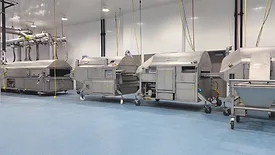
The facility supports product development, equipment testing, technical training, and process optimization for manufacturers producing coated food products. Customers can conduct production trials using complete processing lines configured to match their manufacturing requirements.
The Sennoselect Flagship Brewery Program is intended to support the development of fermentation intelligence technology. Participating craft breweries will receive early access to new technologies.
Modern investments in applied food safety research infrastructure are essential to bridge the gap between scientific discovery and real-world implementation.
The list of data, method, and research needs spans microbiological and chemical safety, nutrition, risk assessment, and other areas. It is intended to guide researchers who are interested in pursuing impactful food safety research.
This article discusses the unique challenges faced by food scientists and manufactures in product development, touching on the food safety and quality challenges during upscaling from initial concept to full production, how risks are managed, and how decisions are made for new ingredient selection, formulation, and new processes.
With a $5 million grant from the U.S. National Science Foundation (NSF), a multidisciplinary research team is developing sensor-based rapid detection technology, backed by an artificial intelligence (AI) –powered decision support system, to control Salmonella and other foodborne pathogens throughout the poultry supply chain.
With each passing year, new and emerging technologies and techniques that have promise for advancing food safety are developed and validated. This article summarizes the top food safety innovations of 2023, based on audience interest.
The longstanding partnership between HRS Heat Exchangers and Spain’s National Technological Center for the Food and Canning Industry (CTNC) has been advanced with the installation of a new pilot aseptic filling plant from HRS, giving customers and researchers the chance to test the performance of different heat exchanger types when developing new food and drink products.
Researchers have developed a way to remove Staphylococcus aureus from milk using magnetic micro-robots loaded with immunoglobulins, which could be scaled for industry use and adapted to other foodborne pathogens.
Researchers at McMaster University have developed a new, highly effective tool to mitigate bacterial contamination of foods, including pathogens displaying antimicrobial resistance (AMR), that has great potential for food safety.