Improving snack and bakery edibles
Strategies for improving legal cannabis snack and bakery edibles, plus a look at trends like CBD and microdosing
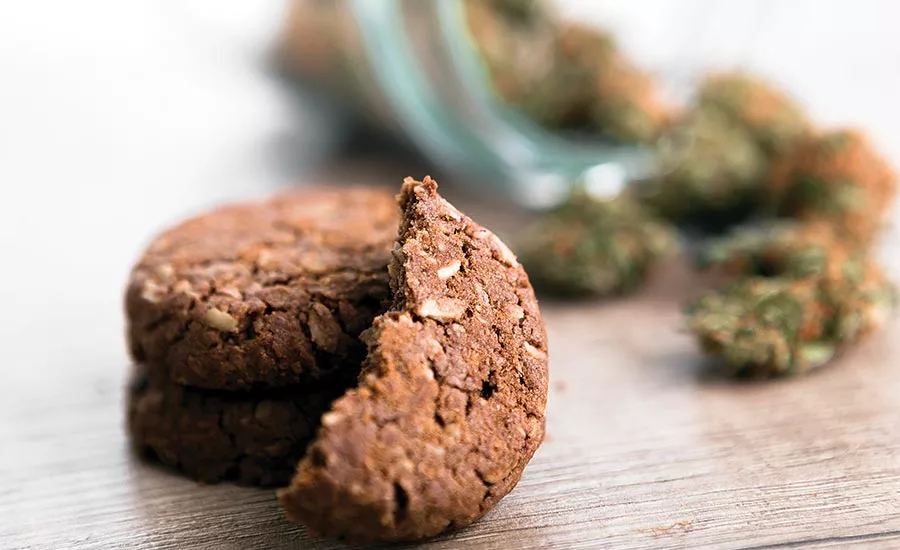
When “The Alice B. Toklas Cook Book” was first published in 1954, it included a recipe for “Haschich Fudge,” made with black pepper, nutmeg, cinnamon, coriander, dates, figs, almonds, peanuts, sugar, butter and “a bunch of canibus sativa (sic).”
Alice B. Toklas, author of the cookbook, didn’t realize that the recipe, contributed by her friend Brion Gysin, a notable writer and painter, was intended as a joke. And she reportedly did not have a clue what “canibus sativa” was…
In literary circles, Toklas was famous. With her partner, acclaimed writer Gertrude Stein, she ran a prominent salon in Paris regularly frequented by the likes of Pablo Picasso, Ernest Hemingway, F. Scott Fitzgerald, and other leaders of the modernist movement in literature and art of the day.
Sales of the book skyrocketed, and the unintentional “fudge” recipe quickly popularized the concept of cannabis edibles across Western civilization, particularly as recipes for “pot brownies” subsequently spread through the 1960s counterculture movement.
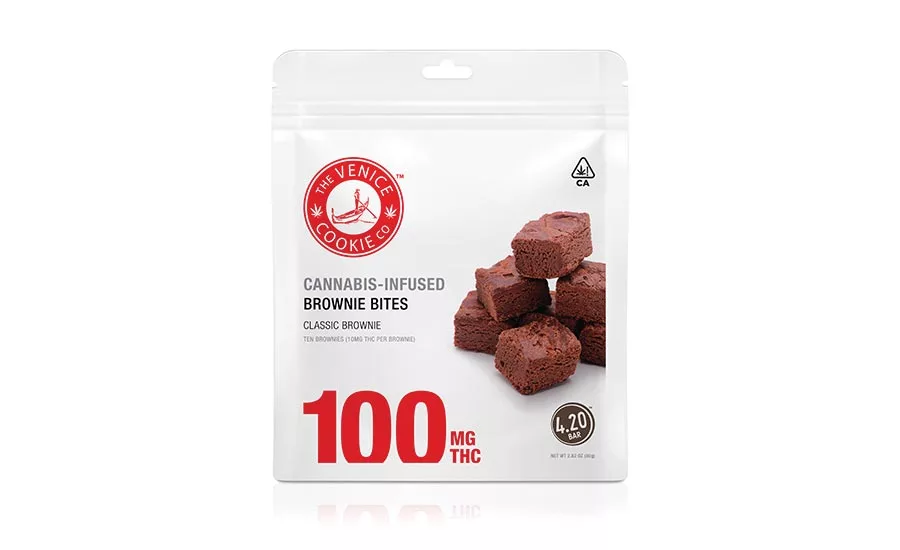
Today, cannabis edibles are legal—medically or recreationally—in over 30 U.S. states plus the District of Columbia. And we’ve come a long way since the days of Haschich Fudge. Today’s legal cannabis brownie profiles come in gourmet flavor profiles like Hazelnut Caramel and Salted Toffee, with clearly specified dosages of cannabidiol (CBD) and/or tetrahydrocannabinol (THC), sold via retail dispensaries in child-safe, highly branded packaging.
And while baked goods like brownies and cookies have clearly emerged as popular options, snacks like chips, pretzels, snack crackers and many more offer an increasingly diverse selection to today’s legal cannabis edibles consumer.
CBD ascendant
The potential medical benefits of CBD continue to unfold—including seizure prevention and treating anxiety, as well as potential use as an anti-inflammatory. Apart from CBD’s well-documented ability to help prevent seizures, clinical research on the cannabinoid is still in its infancy. Nevertheless, producers of legal edible snacks and baked goods have worked to diversify their product lineups to prominently feature CBD.
Looking for quick answers on food safety topics?
Try Ask FSM, our new smart AI search tool.
Ask FSM →
Colorado’s Sweet Grass Kitchen now offers CBD Chocolate Chip Cookies in a 10:1 ratio of CBD to THC (10 mg CBD and 1 mg THC per serving) or 1:1 CBD to THC ratio, as well as a medical 50 mg CBD to 50 mg THC option.
The Goodship also carries a wide range of CBD-focused bakery products, made with a 1:1 ratio of CBD to THC in each serving. Options include CBD Double Chocolate Cookies with White Chocolate Chips and CBD Double Fudge Brownies.
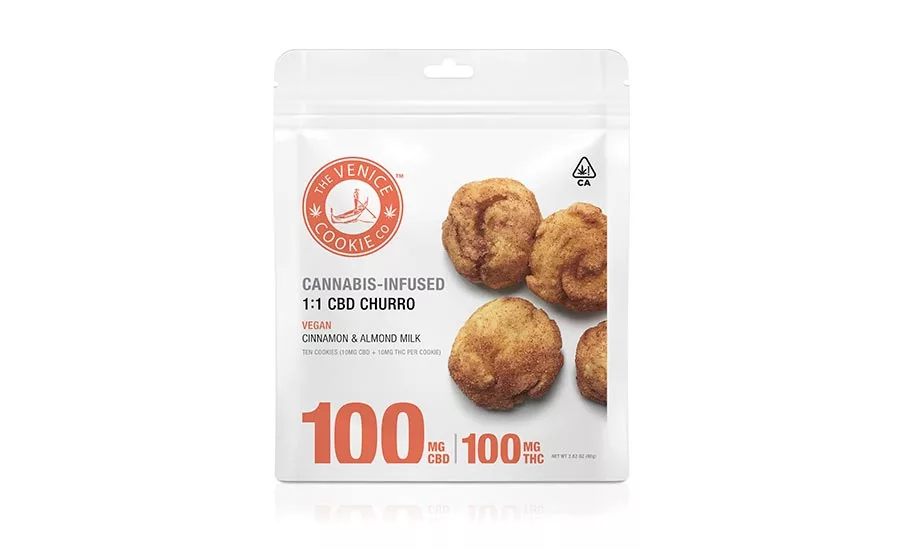
California-based VCC Brands manufactures The Venice Cookie Co. products, including the 1:1 THC to CBD Churro cookies, made with cinnamon and almond milk.
Portion-controlled snacking
The need for accurate portion control is of paramount importance when developing legal cannabis edibles. Portion sizes of 10 mg THC are common for recreational products, while those for medical cannabis edibles range higher.
“However, for many consumers, even 10 mg of THC is a high dose, which may result in an overall unpleasant experience,” says Shehzad Hoosein, vice president of research & development, Cannabistry Labs, Chicago.
Therefore, opportunities exists to develop products that provide controlled dosing, or “microdosing”—the practice of ingesting small amounts of cannabis to achieve a therapeutic benefit without any (or minimal) intoxicating effects. Over the past year or so, various snack and bakery edibles designed for microdosing have begun to hit the market.
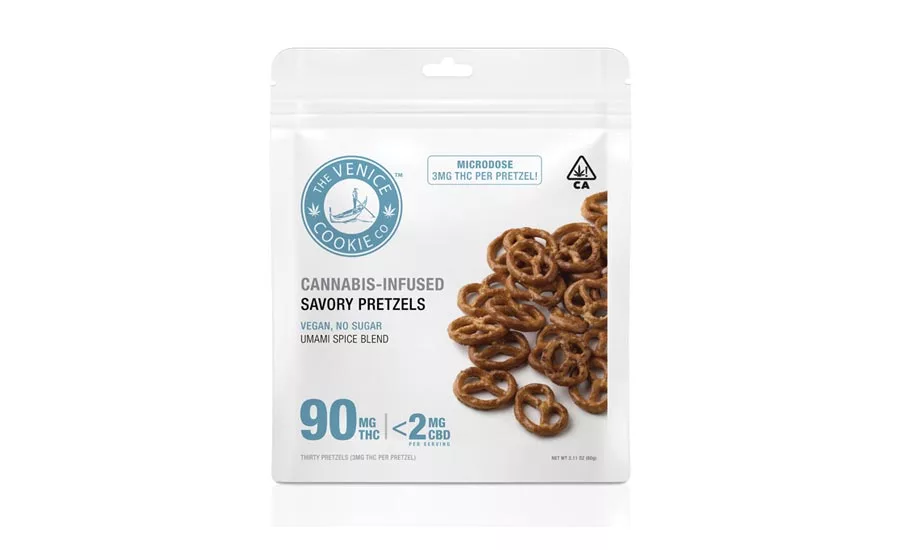
The Venice Cookie Co. offers savory snacks like pretzels, such as the Umami Spice Blend vegan option with 3 mg THC per pretzel (90 mg THC total per package).
And Laurie + MaryJane, Portland, OR, develops sweet and savory bakery products, including its Cheese Crisp Crackers, with each cracker containing just under 3 mg THC, with 10 crackers per package.
Improving production
At this early stage in the legal cannabis edibles industry, production generally remains simplified, with strong opportunities for improved quality assurance and quality control (QA/QC), ingredient standardization, and use of more-sophisticated processing equipment, including automation.
“The edibles market is fragmented, with many small players and just a few larger-scale players,” says Keith Woelfel, research & development and supply director, Stillwater Foods, Denver. At this stage in the game, automation has generally yet to come into play. “Opportunities in this area include greater food processing expertise, such as for processing consistency within and between batches; QC programs for inbound raw materials, processing accuracy and outbound products; and GMP rigor to match the food industry.”
Much of today’s legal cannabis edibles manufacturing is very hands-on, ranging from kitchen-based approaches to use of pilot-plant equipment. “What typically works as pilot-plant scale equipment in traditional manufacturing suffices as full-scale production equipment in the cannabis industry,” says Hoosein. “Also, space is usually a constraint, so manufacturers prefer equipment that can be set up for production and then taken down, rather than fixed in place.”
Due to the current lack of federal oversight of edibles production, individual states have stepped up to establish GMPs, including structures related to traceability and testing. “It is up to the manufacturer to implement their own QA/QC policies,” says Hoosein. “Consequently, this is the biggest area for improvement. Edibles producers should focus on implementing robust quality management systems and staffing their teams with quality assurance professionals from the food and beverage industry.”
In Colorado, edibles traceability requirements are set by the Marijuana Enforcement Division (MED), which focuses on traceability of THC from seed to sale, notes Woelfel. Testing is done for variables like THC potency, homogeneity and presence of pesticides. “Since edibles are not regulated by the FDA, typical traceability of the ingredients—i.e., under FSMA—are not traced to the same level of rigor.”
Label claims and ingredient declarations are also not heavily regulated. This is an area of opportunity for a greater degree of regulation and consistency, notes Woelfel. “For example, transparent labeling of all ingredients used is critical.” He notes that in some cases, certain ingredients, such as emulsifiers, are not correctly labeled, ostensibly to protect trade secrets. “Rigorous oversight of health claims is also lacking.” Better oversight would help ensure that manufacturers do not overstate product benefits. “Other food safety opportunities include building awareness, training and processes to control the top eight allergens.”
Ingredient dynamics
Product developers need to consider both the intended effect and sensory eating quality to ensure the consumer has the best possible experience, notes Hoosein. “As far as the intended effect, several elements must be considered, such as time of onset, peak intensity, duration, etc. This poses a unique challenge to product developers, as the intended effect can be inconsistent from person to person, depending on several variables. One of the biggest complaints from consumers of cannabis-infused edibles is the lack of consistency in intended effect. Much of this has to do with the biochemical pathways of the active ingredients—THC, CBD, etc.—during metabolism. Therefore, understanding the biochemistry itself becomes a critical aspect of the product development cycle.”
The supply chain for cannabinoids varies in terms of consistency, notes Woelfel. “For example, amount and types of terpenes, presence of extraneous plant materials, THC percentage, presence of other cannabinoids, type of extraction process (CO2, butane) and further distillation processes all impact the cannabis raw material used for the edible. This in turn can drastically impact the batch-to-batch sensory profile of the finished goods.”
Several factors contribute toward creating a consistent experience, starting with variability in the active raw material itself, notes Hoosein. “The cannabis flower—and, subsequently, cannabis oil—can vary in characteristics from region to region and even from lot to lot. Therefore, manufacturers must adjust formulations for each production batch based on the characteristics of the raw materials to attain a homogenous and consistent product.”
The mode of delivery is a critical factor. “When orally ingested, the active cannabinoids divert to the liver, where they are broken down into secondary metabolites before being released into the bloodstream (first pass hepatic metabolism),” says Hoosein. “Clinical studies have shown a high level of unpredictability in efficacy and dosage requirements when cannabinoids are introduced through this mode of delivery.”
Comparative analytical work focusing on different ingredient formats used in the same snack or bakery food matrix could help product developers fine-tune the consistency of their intended edibles experience.
Traditional ingredient suppliers working with legal cannabis edibles product developers face unique challenges—particularly when they’re located in different states.
“The biggest challenge is not being hands-on with a processor’s base product,” says Colleen Roberts, director of sales, Flavor Dynamics, Inc., South Plainfield, NJ. “Thus, we are more removed from the R&D process. In these situations, clear communication and descriptive language between the creative teams is very important to understanding their needs.”
For many of the upstart companies working in legal cannabis edibles today, the nuances of professional product development are new territory. “Many of the manufacturers are using flavors for the first time,” says Roberts. “So, the first challenge is to learn how to handle flavors and how to optimize use levels to achieve success in the final product. With flavors, less is oftentimes more, and over-flavoring of products is often seen with people new to the use of flavorings.”
Roberts also notes that flavors can perform multiple roles. “Some are going to support or complement the taste of their product, others might be used for their masking effects. There is a lot of work involved in finding the right fit.” She also points to the market potential of identifying regional flavor trends, local market preferences, and using label considerations like “natural” or organic.
As demand for legal cannabis snack and bakery edibles continues to grow, product quality and differentiation will continue to factor into the potential for sustained success.
This article originally appeared in the Fall 2018 issue of Cannabis Products.