Hygienic Designs Influencing Filler Technology
Advancements helping to prevent product waste in filling operations
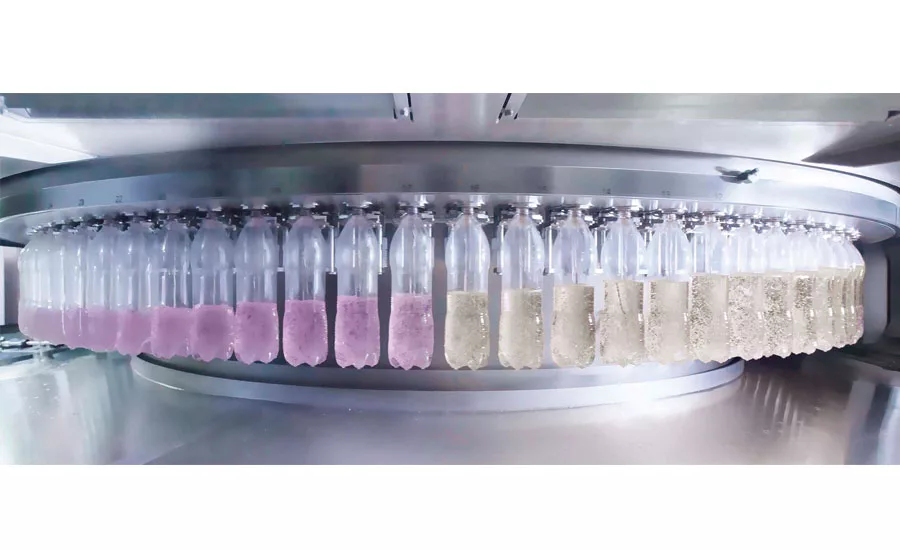
The past few years have been marked by a sharp uptick in food and beverage recalls. Stericycle Expert Solutions’ quarterly Recall Index reports that the food and beverage industries has seen the greatest spike in recalls in the past five years compared with other industries.
The fourth quarter of 2017 showed a 92.7 percent jump compared with 2012. About a third of those recalls were related to bacterial contaminations. Although many of these recalls affected food items, the risk still exists for beverages. In line with this, hygiene and product safety are “absolute, non-negotiable top priorities” for filling technology customers, says Bob Adamson, director of marketing at ProMach Filling Systems, Waukesha, Wis.
“Beverage manufacturers made it clear that their needs and expectations regarding hygienic design are beginning to exceed important industry standards such as 3-A,” Adamson says, citing customer research conducted by ProMach. The 3-A Symbol licensing program certifies that a piece of equipment has met the applicable sanitation standards designated by 3-A Sanitary Standards Inc., Mclean, Va., for that specific type of equipment. The selected standards represent the needs and interests of regulatory sanitarians, equipment manufacturers and processors, the company says.
ProMach’s research shows that this trend is influencing a few important design areas for filling machines. First, customers want hygienic machine design, including wetted and non-wetted surfaces and machine components, Adamson explains. To comply with this, ProMach engineers have been using the mantra “You can’t clean what you can’t see” to guide their design processes, he notes.
At Pack Expo last year, ProMach’s Federal brand debuted its XACT-Fil weight filler, which features easier to reach and clean parts, it says. Specifically the filling machine includes easy-to-clean, frameless upper guarding; open-access door hinges and threadless locking plungers for all change parts, eliminating hard-to-clean harborage points; and an Ingress Protection 67 wash-down rated filler base and load cell enclosures, which ensure optimum performance in wet environments. In addition, the system can be fully steam sterilized.
Norcross, Ga.-based Sidel, which has a reputation for handling sensitive products, is taking this hygiene trend seriously as well. The company has attained U.S. Food and Drug Administration approval for its Aseptic Combi Predis blow fill seal filler. “The thorough evaluation process [to earn the approval] included a detailed review of the design, critical factors and sterile zone boundaries of the machine,” explains Stephane Hacpille, vice president of sales for North America.
This approval officially qualifies the solution, which includes dry preform sterilization technology, to produce and distribute shelf-stable, low-acid products, such as teas, juices, nectars, carbonated soft drinks (CSDs), isotonics and dairy alternatives, in PET bottles, he adds.
Looking for quick answers on food safety topics?
Try Ask FSM, our new smart AI search tool.
Ask FSM →
A second customer trend that ProMach has noticed is that customers are preferring non-contact filling options, including weight and flow-meter technologies, Adamson says. Federal’s XACT-FIL fits this bill, as its non-contact filling design prevents nozzles and valves from touching the beverage containers, which reduces the possibility of contamination.
Sidel’s Hacpille notes that the company’s engineers have designed the company’s filler machines to ensure that no contact takes place between filling valves and bottles. In addition, any parts of the machine that do come in contact with the beverage prior to filling are made of stainless steel parts that easily can be sterilized, which also minimizes the risk of contamination.
The third hygiene-related trend ProMach uncovered in its research is that customers are seeking automated clean-in-place (CIP) machine processes that reduce operator involvement. In response, last year both Federal and Pacific, another ProMach brand, added an automated CIP option for its filler machines.
Draining process waste
Beyond these hygiene trends, customers also are looking to reduce waste in terms of product, time and facility space. Because beverage-makers want to ensure that the product is properly dispensed into packages, filling accuracy is essential to minimizing waste.
Sidel addresses this by using different types of flow-meters, including vortex, magnetic and mass flowmeters, Hacpille says. In addition, gentle product handling during filling minimizes beverage turbulence inside the container, reducing the risk of splash out, he states.
Federal’s weight fillers offer fill accuracy of plus or minus 0.1 percent, ProMach’s Adamson says. The system measures and monitors the actual fill weight of every container and automatically flags and rejects underfilled or overfilled containers, he adds.
Barry Fenske, director of filling technology at Franklin, Wis.-based Krones Inc., adds that other technology can assist with preventing product waste. In addition to utilizing flowmeters to ensure filling accuracy, Krones’ lines also include an inspection system post-filler that looks for too many underfills or crooked caps and communicates with the filler to identify filling valves or capping heads that are not properly performing. This helps operators identify when repairs and adjustments are needed to prevent product waste.
However, machine breakdowns and unexpected downtime related to these types of issues result in wasted production time. To prevent this, Thomas Niehr, head of aseptic filling technology for KHS, Waukesha, Wis., recommends conducting scheduled preventative maintenance. “It’s a prudent investment,” he said in a statement. Preventative maintenance can be scheduled at a convenient time during the production cycle, thus minimizing downtime.
ProMach’s Adamson notes that customers are seeking preventative maintenance packages from original equipment manufacturers (OEMs). “Employee turnover, retirements and competition for talented maintenance personnel are motivating customers to investigate and implement scheduled OEM maintenance programs,” he says. “The underlying philosophy is that preventing downtime through effective maintenance is less expensive than running equipment until it fails and then fixing it. OEMs with defined proactive maintenance service programs, executed by highly trained and experienced technicians, can provide more effective maintenance service than less-experienced customer personnel.”
Earlier this year, KHS started offering fixed-price preventative maintenance packages for its aseptic filling machines. As part of the package, KHS engineers regularly inspect the overall condition of the filling machine, correcting settings and replacing smaller wear parts as needed, and then give the beverage manufacturer a report about the machine’s operational status. “In this way, failure through wear is avoided, risks to product safety are detected well in advance, and the availability of the system is ensured,” Niehr said in a statement. He added that, because the packages are a fixed cost, beverage manufacturers easily can plan for maintenance in their budgets.
KHS notes that the more regularly and intensively a system is monitored, the shorter any downtimes are. This, in turn, reduces the cost of production in the long term.
Of course, quality filler machine parts also can reduce the chance of breakage and, in turn, reduce production interruptions and downtime, says Xavier Van Aelst, director of food and beverage at Aventics Pneumatics, Lexington, Ky. “Filling machines must work around the clock,” he says. “With an output of up to 12,000 cartons an hour in some equipment, for example, disruptions and downtime are not at all welcome. OEMs need reliable components that they can ‘set and forget,’ knowing they are robust enough to keep the machinery running.” Aventics manufactures pneumatic equipment for filling machines, among other types of machinery.
Another operational waste to consider is misused facility space. Customers now are seeking block solutions that combine multiple processes into one compact machine, experts note. “Producers and brand owners are increasingly reaping opportunities represented by integrated solutions, which deliver big [benefits] in terms of compact footprint, production efficiency and lower total cost of ownership,” Sidel’s Hacpille says.
Sidel launched two compact solutions last year. Its Aseptic Combi Predis combines the capabilities for filling multiple different types of beverages, including high- and low-acid sensitive beverages, carbonated and still beverages, beverages with and without pulp, and beverages without preservatives, in PET bottles ranging in size from 200-ml to 2 liters. “The same filling valve handles aseptically all types of sensitive beverages with no need of changeovers,” Hacpille explains. He adds that the filling configuration can be adapted to meet the required production performance factors.
The Sidel Super Combi integrates five process steps for producing waters or CSDs into one machine: preform feeding, blowing, labeling, filling and capping, and cap feeding. The machine is as much as 30 percent more compact than a stand-alone Combi blower and filler coupled with buffer conveyors and a labeler, can be operated by a single individual, and facilitates faster setups and changeovers, the company says. It also incorporates data-driven intelligence, which helps optimize performance across the entire production process.
Similarly, Krones introduced last year its Modufill VFS-M for fast filling of CSDs, juices and waters. This filler and blender machine has a smaller machine footprint because some components serve more than one purpose. For example, the carbonation tank of the integrated mixer also serves as the feed tank for the filler. In addition, because the machine combines two functions in one, it reduces both time and product loss during changeovers, Fenske says.
KHS also is embracing the block machine configuration. Last year, the company launched its InnoPET TriBlock Aqua M, which combines the Innofill PET NV filler, the Blomax Series IV stretch blow molding module and a labeler. Targeted toward the single-serve water market, the machine can process containers that are 250-800 ml. in size at rates as fast as 50,000 bottles per hour.
ProMach’s Adamson predicts that block configurations will continue to grow in popularity in the coming years. He expects that super blocks will integrate unscramblers, labelers, rinsers, fillers, cappers and more into a single system. Such developments will enable beverage-makers to optimize facility space and production, as processes will be perfectly synchronized to create a more efficient system, he says. BI