Food Safety
search
Ask Food Safety AI
cart
facebook twitter linkedin instagram youtube
  • Sign In
  • Create Account
  • Sign Out
  • My Account
Food Safety
  • NEWS
    • Latest News
    • Sponsor Insights
    • Sponsored White Papers
  • PRODUCTS
  • TOPICS
    • Contamination Control
    • Food Types
    • Management
    • Process Control
    • Regulatory
    • Sanitation
    • Supply Chain
    • Testing and Analysis
  • PODCAST
  • EXCLUSIVES
    • Food Safety Five Newsreel
    • eBooks
    • FSM Distinguished Service Award
    • Interactive Product Spotlights
    • Videos
  • BUYER'S GUIDE
  • MORE
    • NEWSLETTERS >
      • Archive Issues
      • Subscribe to eNews
    • Store
    • ASK FSM AI
  • WEBINARS
  • FOOD SAFETY SUMMIT
  • EMAG
    • eMagazine
    • Archive Issues
    • Editorial Advisory Board
    • Contact
    • Advertise
  • SIGN UP!

Using artificial intelligence for sustainably profitable food processing

Overcoming product effect and improving detection accuracy
Using artificial intelligence for sustainably profitable food processing
October 16, 2020

Despite the breadth of technology available for foreign object detection, certain types of foods display a strong product effect, making them difficult to inspect via conventional methods. Inductive metal detectors have a serious disadvantage when it comes to difficult products such as these: by increasing the detection sensitivity to adjust for product effect, the rate of false rejects increases. This leads to loss of good product.

X-ray-based product inspection systems are a possible alternative, but come with the disadvantage of being more expensive than metal detectors.

New technologies that combine high accuracy and affordability provide a promising solution to theses challenges.

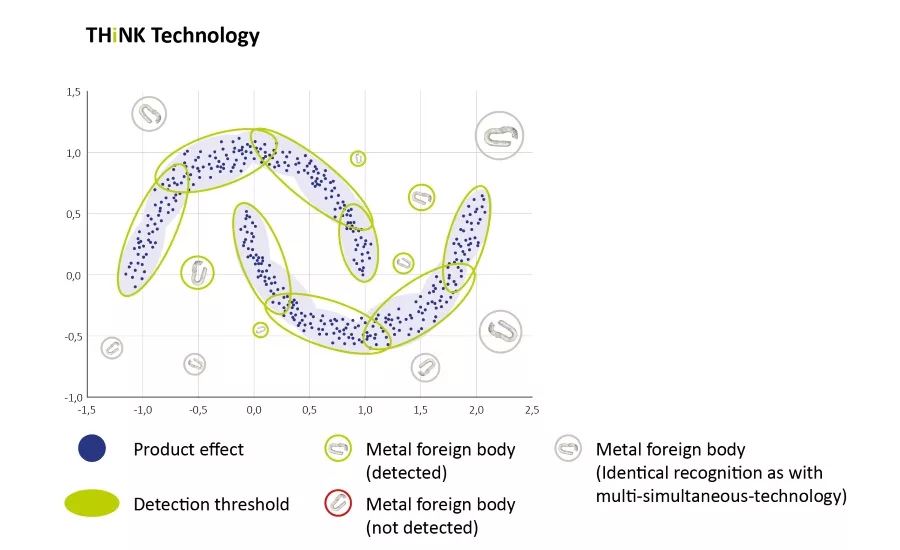
“THiNK,” the latest innovation from the Sesotec headquarters, is a metal detection system equipped with artificial intelligence. This technology makes it possible to virtually eliminate the interference caused by product effect.


How does metal detection with THiNK work?

Like conventional metal detectors, THiNK uses multi-simultaneous technology to apply several frequencies to the product being inspected. Using AI technology, THiNK isolates the signals from product effect, creating additional detection thresholds. All signals that lie outside of these thresholds are identified as metallic contaminants. The detection sensitivity increases, but false rejects are reduced by means of more “intelligent” threshold calculation.


How THiNK metal detection benefits customers

Looking for quick answers on food safety topics?
Try Ask FSM, our new smart AI search tool.
Ask FSM →

Products with high or fluctuating levels of product effect (due, for example, to metallized packaging or storage in brine or water) can be more reliably inspected. False rejects, and the food waste they cause, are reduced. Food safety regulations and standards (e.g. IFS, BRCGS, M&S, etc.) can be reliably upheld. Compared with an x-ray inspection machine, a metal detector with THiNK is the more cost-effective option.


THiNK about it…

AI algorithms increase the reliability and precision with which contaminants are detected in the food manufacturing process. AI-enabled metal detectors can even efficiently inspect products packaged in metallized films. Food waste is reduced, food safety standards are upheld, resources are saved, and profit climbs as productivity rises. THiNK technology from Sesotec will be available as a licensed model starting in November 2020.


Watch our video “Metal Detection with Artificial Intelligence” here.

For more information visit: https://www.sesotec.com/emea/en/lp/think-packexpo

This article was originally posted on www.snackandbakery.com.
KEYWORDS: foreign object detection Sesotec

Share This Story

Recommended Content

JOIN TODAY
to unlock your recommendations.

Already have an account? Sign In

  • people holding baby chicks

    Serovar Differences Matter: Utility of Deep Serotyping in Broiler Production and Processing

    This article discusses the significance of Salmonella in...
    Meat/Poultry
    By: Nikki Shariat Ph.D.
  • woman washing hands

    Building a Culture of Hygiene in the Food Processing Plant

    Everyone entering a food processing facility needs to...
    Training
    By: Richard F. Stier, M.S.
  • graphical representation of earth over dirt

    Climate Change and Emerging Risks to Food Safety: Building Climate Resilience

    This article examines the multifaceted threats to food...
    International
    By: Maria Cristina Tirado Ph.D., D.V.M. and Shamini Albert Raj M.A.
Manage My Account
  • eMagazine Subscription
  • Subscribe to Newsletters
  • Manage My Preferences
  • Website Registration
  • Subscription Customer Service

More Videos

Sponsored Content

Sponsored Content is a special paid section where industry companies provide high quality, objective, non-commercial content around topics of interest to the Food Safety Magazine audience. All Sponsored Content is supplied by the advertising company and any opinions expressed in this article are those of the author and not necessarily reflect the views of Food Safety Magazine or its parent company, BNP Media. Interested in participating in our Sponsored Content section? Contact your local rep!

close
  • Darkling Beetle
    Sponsored byElanco Animal Health

    Integrated Pest Management: Protecting Poultry Operations as Seasons Change

  • NEVIFIT 3 Compartment BPA-FREE
    Sponsored byCorbion

    The Risks of Ready-to-Eat: Five Ways to Protect Today's Prepared Meals

  • a group of workers in a food production facility
    Sponsored bySkillUp by Registrar Corp

    How to Build a Better Training Program: Data and Insights from the Global Food Safety Training Survey

Popular Stories

half full baby bottle next to rubber duckie on white surface

Organic Infant Formulas Caused Back-to-Back Botulism Outbreaks—What Gives?

June26 eBook Cover

eBook | Building a Skilled and Capable Workforce in the Food Industry

alfalfa sprouted seeds

Salmonella-Tainted Alfalfa Sprouts Sicken 109 People in 11 European Countries, One Death Reported

building a skilled workforce ebook

Events

June 30, 2026

FSMA 204 in Practice: Building a Traceability-Ready Operation

Live: June 30, 2026 at 11:00 am EDT: Attend this webinar to learn how food businesses can move from fragmented records toward a more reliable approach for recall response, FDA requests, and supply chain visibility.

July 21, 2026

Using AI Responsibly in Food Safety Management Systems

Live: July 21, 2026 at 2:00 pm EDT: This webinar will provide participants with guidance on how to effectively use generative artificial intelligence (AI) tools to develop key components of a food safety management system (FSMS).

August 6, 2026

Beyond Sanitation: Understanding the Hidden System Conditions That Allow Pathogens to Persist

Live: August 6, 2026 at 2:00 pm EDT: Attend this webinar to learn strategies for strengthening environmental control programs through a layered approach to pathogen management.

View All

Products

Global Food Safety Microbial Interventions and Molecular Advancements

Global Food Safety Microbial Interventions and Molecular Advancements

See More Products

Related Articles

  • chip manufacturing

    Beneficial AI: Safe, Secure, and Trustworthy Artificial Intelligence for Food Safety

    See More
  • Artificial Intelligence and Food Safety: Hype vs. Reality

    See More
  • Key Technology FM AI

    Key Technology Introduces FM Alert with Artificial Intelligence

    See More

Related Products

See More Products
  • 9781498721776.jpg

    Handbook of Food Processing: Food Safety, Quality, and Manufacturing Processes

  • 1119071127.jpg

    Food Safety, Risk Intelligence and Benchmarking

  • 1119053595.jpg

    Food Safety for the 21st Century: Managing HACCP and Food Safety throughout the Global Supply Chain, 2E

See More Products

Events

View AllSubmit An Event
  • May 28, 2026

    Advanced Sanitation Strategies for Allergen Risk Reduction in Food Processing

    On Demand: From this webinar, attendees will learn why validation and verification are necessary for allergen control, and how analytical tools can support allergen management programs.
View AllSubmit An Event
×

Never miss the latest news and trends driving the food safety industry

Newsletters | Website | eMagazine

JOIN TODAY!
  • RESOURCES
    • Advertise
    • Contact Us
    • Directories
    • Store
    • Want More
  • SIGN UP TODAY
    • Create Account
    • eMagazine
    • Newsletters
    • Customer Service
    • Manage Preferences
  • SERVICES
    • Marketing Services
    • Reprints
    • Market Research
    • List Rental
    • Survey/Respondent Access
  • STAY CONNECTED
    • LinkedIn
    • Facebook
    • Instagram
    • X (Twitter)
  • PRIVACY
    • PRIVACY POLICY
    • TERMS & CONDITIONS
    • DO NOT SELL MY PERSONAL INFORMATION
    • PRIVACY REQUEST
    • ACCESSIBILITY

Copyright ©2026. All Rights Reserved BNP Media, Inc. and BNP Media II, LLC.

Design, CMS, Hosting & Web Development :: ePublishing