Regulatory Aspects of Food Additives
Evaluating the safety of food additives requires careful consideration of the available scientific evidence
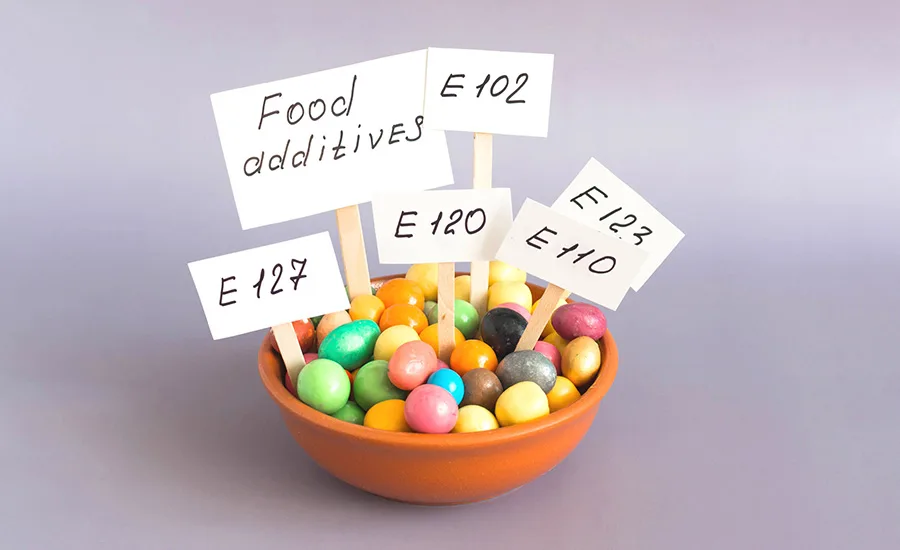
Food additives are coming under increased scrutiny and criticism. For this reason, it is important to understand where they come from, why they are used, and how they are approved before making a critical decision.
Food additives are food ingredients that fulfil a specific technological purpose. They are not just chemicals created in laboratories, but also common products consumers use every day in their kitchen. For example, let's say you want to make light, fluffy pancakes at home. Most people use flour, milk, and eggs, but often add a touch of baking soda (i.e., sodium bicarbonate, or E500) to make the pancakes light and fluffy. Whereas the flour, milk, and eggs are ingredients, E500 is an additive.
There are many more examples of additives around the world over many centuries. In ancient China, paraffin wax was burned to help ripen fruit; this was effective because it releases traces of ethylene gas. The ancient Egyptians colored food with saffron, and the Romans added alum (potassium aluminum sulfate) to bread to make it whiter.1
In today's world, social and cultural perspectives on food additives differ from place to place. For example, monosodium glutamate, better known by its initials MSG, gained notoriety in the West following a letter to the New England Journal of Medicine in 1968. The letter suggested that symptoms such as headache, nausea, and numbness that the writer experienced when eating in Asian restaurants were due to the use of monosodium glutamate in those cuisines. On the other hand, in Japan, additives such as monosodium glutamate that enhance umami (one of the five basic tastes alongside sweet, sour, salt, and bitter), have been used for centuries and are seen as a way to bring out the natural flavors of food, rather than as an artificial addition.
The Importance of Codex
Food additives are used to help keep food safe, to extend shelf life and increase the availability of food (resulting in better food security), or to provide the texture and taste that consumers desire. Safety is particularly important because the stated goal of everyone who works with food is that all food must be safe. That goes for additives, too.
Science is central to the assessment and regulation (globally, regionally, and nationally) of these food additives. The current approach to food additives, based on the evaluation and analysis of science by independent experts from around the world through a robust and well-defined process, is the best approach we have to protect consumers while maintaining the supply, shelf life, and convenience of food. Although our understanding of food additives and their potential effects in the human body continues to develop as science progresses, it is important to recognize that food additives go through a rigorous process to make sure they are safe for humans. The safety of food additives is reassessed as new scientific evidence emerges.
The Codex Alimentarius Commission (Codex) is the preeminent international body for food safety standards. These include standards for the safe use of additives in food. Codex standards provide a valuable and trusted resource for its 188 member countries, particularly those who may not have the resources or expertise available to undertake their own safety assessments. The open and transparent processes used by Codex facilitate understanding of the standards and also facilitate their use in domestic rulemaking. Implementation of Codex standards delivers consumer protection, drives harmonization, and supports international trade. Without Codex standards, the trade of safe food across national borders would be far more difficult. These standards are recognized by the World Trade Organization (WTO) under the Sanitary-Phytosanitary (SPS) Agreement, and are referred to in the case of trade disputes.
Looking for quick answers on food safety topics?
Try Ask FSM, our new smart AI search tool.
Ask FSM →
The adoption of Codex standards by member countries is voluntary. The standards must be incorporated into relevant domestic regulation to have effect, and implementation must include measures to monitor and incentivize compliance. Countries take various approaches to adoption, but all must meet the relevant WTO obligations. Alternatively, countries may decide to set rules for use of food additives that are stricter than Codex standards, in which case their domestic rules must meet their general WTO obligations—e.g., that the rules are science-based, non-discriminatory, and transparent. While food additives regulations differ between countries and jurisdictions, they have in common a strong level of oversight, including an evaluation before market approval to ensure that the food containing the additives is safe for the entire population. A list of approved food additives is usually publicly available in each jurisdiction.
Are Food Additives Safe? The Rigor of Codex Standards Setting
The Codex General Standard for Food Additives2 sets out four criteria that food additives must meet before they are approved for use at specifically defined levels:
- They are safe
- Their use is justified
- They are used according to good manufacturing practice
- They meet agreed specifications of identity and purity.
The evaluation of food additive safety is typically undertaken by independent experts who are convened to inform regulatory decision-making. For Codex, this task is performed by the Joint FAO/WHO Expert Committee on Food Additives (JECFA), and its advice on the safety of additives is openly published in meeting reports. The process of commissioning an expert evaluation of the safety of a food additive by a JECFA meeting follows a longstanding process, which is summarized in Figure 1. Independent experts will consider the type of evidence available and its relevance to human health. By taking this approach to evaluating the evidence, more informed decisions can be made about the safety of food additives at expected levels of consumption.
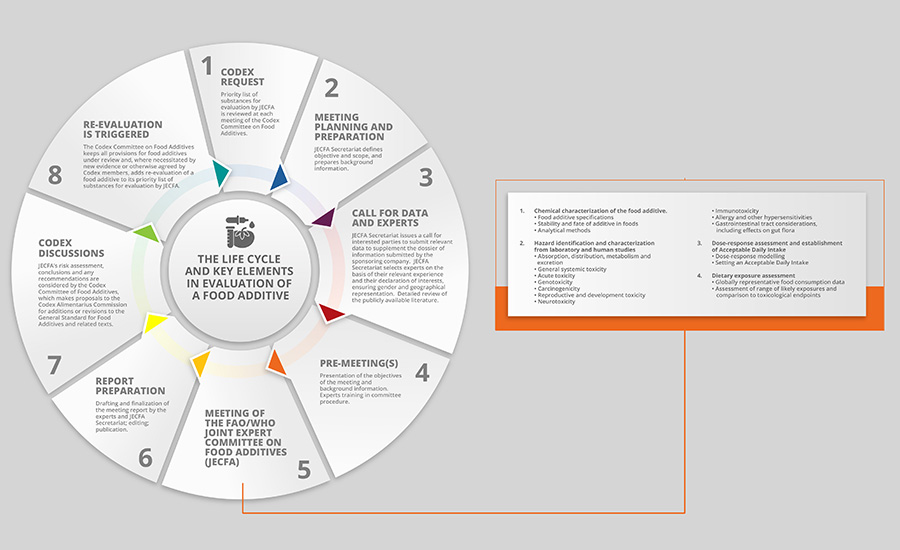
Evaluating the safety of food additives requires careful consideration of the available scientific evidence. Different testing methods, including cell studies, animal studies, and human studies, each provide valuable insights into the potential health effects (both positive and negative) of additives. New methodologies continuously emerge (e.g., artificial intelligence, machine learning), and each type of study has its limitations. However, over time, the methodologies continue to improve and additives are continuously reviewed.
Where there is sufficient evidence for JECFA to complete a favorable evaluation, it will usually set a numerical Acceptable Daily Intake (ADI), expressed in terms of the amount of the additive that can be consumed relative to the body weight of the individual, daily over a lifetime, without appreciable health risk. Only food additives that have been assigned an ADI, or otherwise determined to be safe by JECFA, will be considered for inclusion in the Codex General Standard for Food Additives.2
The levels of additives in a food and the amount of that food that is consumed also play a crucial role in determining the safety of food additives. Therefore, assessing likely human exposures to food additives is a key part of the independent expert assessment. Tools are available to support the estimation of probable daily dietary exposure to a food additive from all food sources. Codex has published Guidelines for the Development of Maximum Levels for the Use of Food Additives with Numerical Acceptable Daily Intakes,3 which provides guidance to screen proposals for use of additives based on consideration of their maximum use level and the physiological upper limit to the amount of food and drink that can be consumed each day. Codex uses these guidelines to set maximum use levels for food additives in various food categories that ensure the intake of an additive from all its uses does not exceed its ADI.
Furthermore, as part of its risk assessment of food additives, JECFA will develop specifications for the identity and purity of those additives. These help ensure that commercially available food additives:
- Are of appropriate quality
- Can be manufactured consistently
- Are equivalent to the material that was subjected to the toxicological testing.
Justifying the Use of an Additive
Food additives can only be used in a food if they fulfil a recognized function4 and, as such, need to be justified. Justification relates to a technological need, but many food additives also have the potential to contribute to broader food system objectives, such as contributing to meeting the United Nations' global Sustainable Development Goals (SDGs) and improving food security by preventing spoilage and waste.
It is also important to recognize that food producers do not include additives if they cannot be justified or have a function. Additives add cost to the product, which in the competitive global food market is not desirable as it makes products less competitive and less appealing to consumers. There is a clear commercial imperative for minimizing the use of (or not using) a food additive, especially beyond its desired function.
In terms of additives usage, Codex also requires that:
- The quantity of the additive added to food shall be limited to the lowest possible level necessary to accomplish its desired effect
- The quantity of the additive that becomes a component of food because of its use in the manufacturing, processing, or packaging of a food, and which is not intended to accomplish any physical or other technical effect in the food itself, is reduced to the extent reasonably possible.
Conclusion
Food additives are added to food for specific technological reasons. While food additives regulations differ between countries and jurisdictions, they have in common a strong level of oversight, including an evaluation of risk before market approval to ensure that the food containing the additives is safe for the entire population.
The Codex Alimentarius Commission sets internationally agreed maximum levels for use of those food additives for which the FAO/WHO Joint Expert Committee on Food Additives has assigned an Acceptable Daily Intake. These maximum use levels ensure that the amount of that additive routinely consumed by adults, children, or specific groups of consumers, from all uses of that additive, does not exceed its Acceptable Daily Intake. This process is rigorous, science-based, agreed upon by global experts, and reviewed regularly or when new scientific information becomes available.
Finally, the implementation of Codex standards into national regulations delivers consumer protection, drives harmonization, and supports trade between countries. Food additives preserve the safety, nutrition, and quality of foods we all consume.
References
- Science Museum. "Food: A Chemical History." 2019. https://www.sciencemuseum.org.uk/objects-and-stories/chemistry/food-chemical-history.
- Codex Alimentarius. General Standard for Food Additives. CXS 192-1995. https://www.fao.org/gsfaonline/docs/CXS_192e.pdf.
- Codex Alimentarius. "Annex A: Guidelines for the Development of Maximum Levels for the Use of Food Additives with Numerical Acceptable Daily Intakes." General Standard for Food Additives. CXS 192-1995. https://www.fao.org/gsfaonline/docs/CXS_192e.pdf.
- A full list of internationally recognized functional classes of food additives (e.g. color, preservative, sweetener) is available here: Codex Alimentarius. Class Names and the International Numbering System for Food Additives. CXG 36-1989. https://www.fao.org/fao-who-codexalimentarius/sh-proxy/fr/?lnk=1&url=https%253A%252F%252Fworkspace.fao.org%252Fsites%252Fcodex%252FStandards%252FCXG%2B36-1989%252FCXG_036e.pdf.