Developing a Future-Proof Food Safety Strategy for Meat and Poultry Products
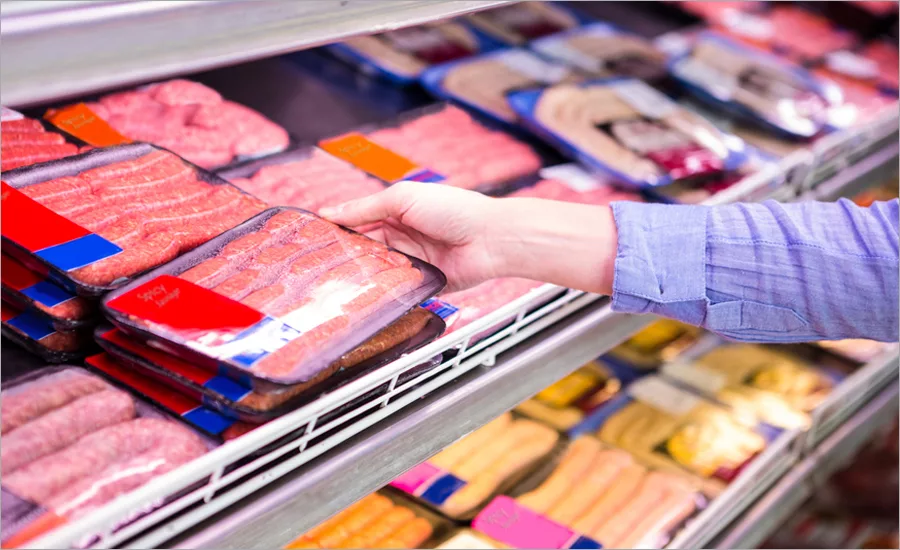
Meat and poultry do not have the luxury of a "set it and forget it" food safety strategy. These products sit at the intersection of high consumer expectations, such as fresh taste, quality, and simpler labels, and unforgiving microbiology challenges, including high water activity, complex processing steps, long cold chains, and real-world handling variability. The result is a familiar tension for large manufacturers: move faster and meet evolving expectations, such as label simplification and sodium reduction, without sacrificing safety.
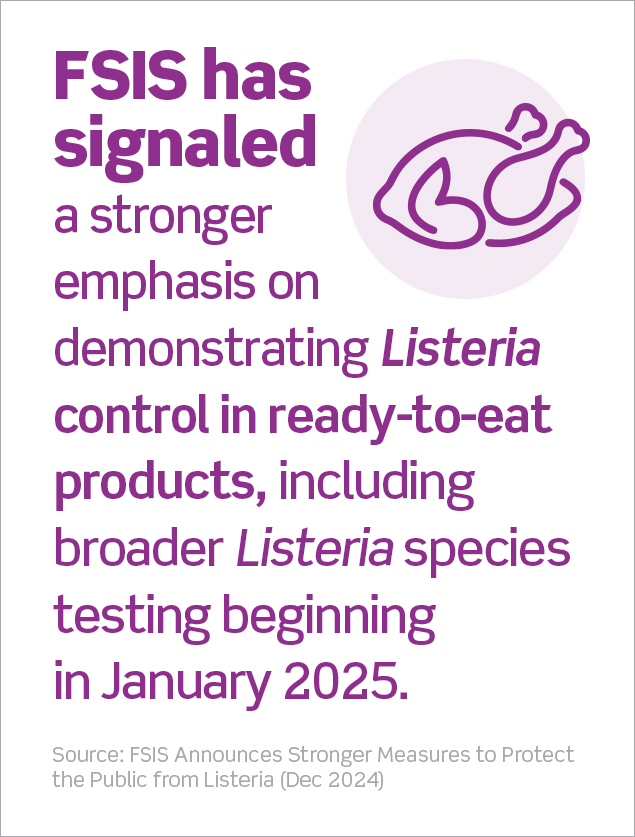 Image credit: Corbion
What is changing is not the risk landscape so much as the pace and direction of scrutiny. The U.S. Department of Agriculture's Food Safety and Inspection Service (USDA-FSIS), for example, has signaled a stronger emphasis on demonstrating Listeria control in ready-to-eat (RTE) products, including broader Listeria species testing beginning in January 2025.1 Raw poultry policy can also shift quickly, highlighted by FSIS's withdrawal of its proposed Salmonella framework in April 2025.2
Changes like these can intensify internal pressure to reformulate, and in some cases may require it. At the same time, consumer expectations and nutrition-driven requirements, including sodium reduction, continue to grow, as seen in USDA school meal standards that provide a clear multi-year timeline to push sodium limits downward.3
These developments are signals of a single truth: food safety programs built around today's formula, label, and assumptions will be stressed by tomorrow's continued changes.
The manufacturers who stay ahead are adopting one mindset: build with change in mind.
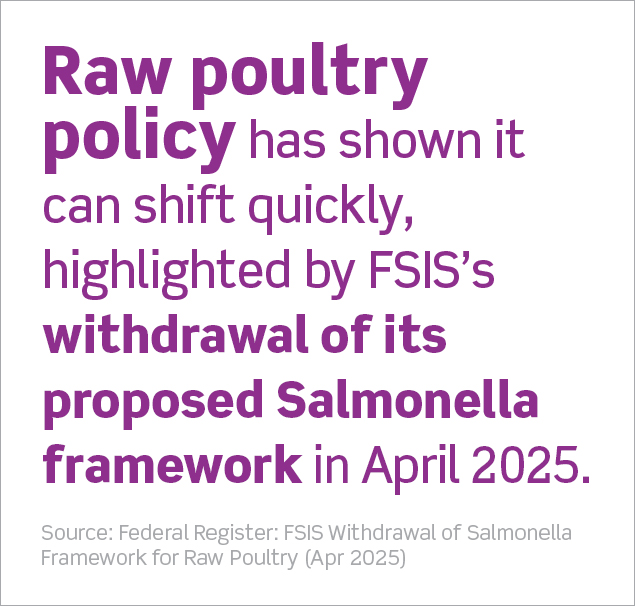 Image credit: Corbion
The Future-Proof Framework
Tip 1: Make Reformulation a Controlled Safety Event
Most costly safety situations do not come from discovering a new pathogen. They come from underestimating the impact of a "small" change, such as sodium reduction, a new flavor system, a shelf-life extension target, a packaging tweak, or a yield adjustment.
In meat and poultry, these changes can influence microbial growth dynamics by altering water activity, pH, available nutrients, the competitive microflora, or the performance of previously protective hurdles. Sodium reduction is a classic example. Salt contributes more than taste and texture. In many products, it also helps inhibit and slow the growth of spoilage microorganisms and pathogens. When sodium is reduced by lowering salt, the key question is not only whether quality is maintained. It is also what safety margin has been removed and what will replace it.
Future-proofing starts with a simple operating rule: any change that could affect growth, survival, or exposure should automatically trigger a quick, structured safety review. This review should start with questions such as:
- What food safety risks are most likely for this product or application?
- Which hurdle or hurdles may have weakened due to the change?
- What control or controls are now required, and how will we prove they work?
This approach helps prevent label-driven formulation changes or regulatory shifts from inadvertently creating vulnerabilities.
Tip 2: Design Multi-Hurdle Systems that Still Work with Clean-Label Constraints
In some cases, the push for simpler labels can remove redundancy. That is not inherently unsafe, but it can make systems more fragile if a single control is carrying too much weight or if new risks are introduced.
A future-proof strategy distributes control across four levers:
- Formulation, including inhibition strategy, pH, and water activity decisions, and functional hurdles
- Process, including validated lethality where applicable, cooling control, and handling discipline
- Packaging, including barrier performance, seal integrity, and atmosphere decisions
- Cold chain reality, including time and temperature variability rather than best-case assumptions.
This is also where label-friendly interventions can add meaningful value within a multi-hurdle approach. Nature-based ingredients, such as vinegar and fermented offerings, can function as formulation hurdles that help maintain antimicrobial protection while supporting premium label goals.
This becomes even more important for RTE products, where Listeria can grow at refrigeration temperatures and where FSIS has emphasized stronger measures and expanded testing.1 When regulators and customers want confidence that controls work, day in and day out, multi-hurdle strategies help create resilience and protect brand trust.
Move 3: Predictive Validation for Real-World Variability
Traditional validation and challenge studies remain essential during reformulation and new product development. The challenge is timing and efficiency. In many cases, traditional challenge studies require multiple rounds of testing, which increases costs and extends timelines. If a vulnerability emerges late, the response is expensive: rework, delayed launches, or added controls that were not designed into the product from the start.
A future-proof approach starts by predicting risk early, then implementing controls where they matter most. One practical way to do that is to leverage predictive modeling tools, such as the Corbion Listeria Control Model (CLCM), to map how a formulation behaves under realistic conditions.
Predictive tools can replace alternative scientific justifications, such as challenge studies. This, in turn, reduces trial-and-error, shortens the path from concept to a confident launch, and helps teams identify where safety margins are most likely to erode. For meat and poultry manufacturers balancing cleaner labels, faster innovation cycles, and intensified scrutiny, predictive modeling is one of the most practical ways to future-proof food safety strategies.
Looking ahead
Food safety for meat and poultry will always be high-stakes. The next era will reward companies that pair rigorous control with speed and flexibility, because products, policies, and expectations will keep shifting.
That is where building a reliable strategy becomes key. It helps manufacturers meet clean-label goals, support evolving consumer expectations (such as lower-sodium targets), and stay prepared for future regulatory shifts, all without sacrificing safety.
References
- U.S. Department of Agriculture, Food Safety and Inspection Service (USDA-FSIS). "FSIS Announces Stronger Measures to Protect the Public from Listeria monocytogenes." December 17, 2024. https://www.fsis.usda.gov/news-events/news-press-releases/fsis-announces-stronger-measures-protect-public-listeria.
- USDA-FSIS. "Notice of Withdrawal: Salmonella Framework for Raw Poultry Products." April 25, 2025. https://www.fsis.usda.gov/policy/federal-register-rulemaking/federal-register-rules/salmonella-framework-raw-poultry-products.
- USDA. "Updates to the School Nutrition Standards." Updated February 12, 2026. https://www.fns.usda.gov/cn/school-nutrition-standards-updates.