Researchers Develop Affordable, Scalable Mushroom-Based Food Packaging
University of Maine (UMaine) researchers have developed plastic-free food packaging made from mycelium and wood-based cellulose nanofibrils (CNFs). Not only is the novel material free of chemicals of concern and likely safe for people and the environment in the long term, but it also decomposes easily.
The project’s findings were published in the journal Langmuir.
Naturally Water- and Oil-Resistant
Mycelium is the root-like system of fungi that has water-resistant properties. CNF is a type of cellulose, which is an oil-proof natural polymer derived from plants.
Combining CNF with a mycelium coating, the novel material capitalizes on the water- and oil-resistant advantages of both components, making it an ideal substitute for plastic food packaging.
Mushroom-Based Packaging is Safe
Unlike plastic—which performs well as a packaging material but contains thousands of chemicals with known and unknown long-term health effects—mycelium materials are proven to be safe through humanity’s history of consuming fungi.
“Plastics are very good at what they do, but then again so were [per- and polyfluoroalkyl substances (PFAS)] forever chemicals and lead in paints and gasoline,” said Caitlin Howell, Ph.D., UMaine Associate Professor of Bioengineering and the study’s corresponding author. “It sometimes takes us a while to understand the long-term impacts of the things we invent... The nice thing about fungi is that we already eat them, so we know that they’re going to be safe for us long-term.”
Inspired by Nature: The Mycelium Material Production Process
To develop the material, the researchers first grew the fungus from which the mycelium is derived, then blended it with a growth-promoting nutrient mixture and added CNFs. The blending process ensures that the hyphae, which are the branching filaments that make up the structure of fungi, grow uniformly.
Looking for quick answers on food safety topics?
Try Ask FSM, our new smart AI search tool.
Ask FSM →
Mimicking mycelium’s behavior in nature, when the researchers gave mycelium a material to grow on—in this case, CNFs—it naturally tried to grow and fit itself through gaps. “Nature has solutions, and as humans, we can look at and adapt to those solutions and better fit in with our ecosystem; we don’t have to choose plastic,” said Dr. Howell.
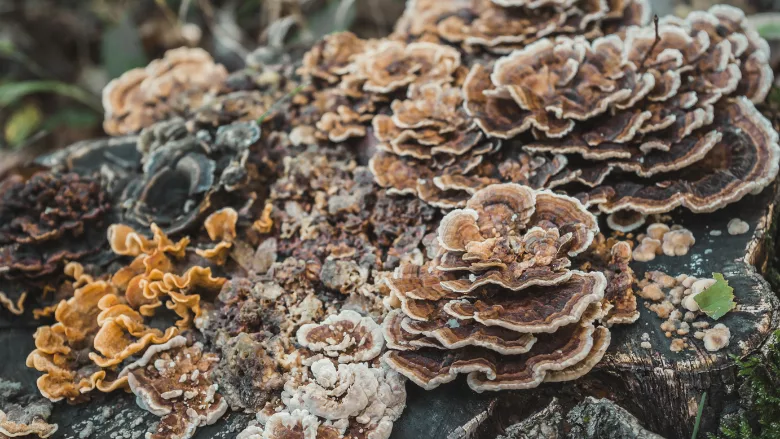
Not only do the CNFs add their own oil-proof properties to the final material, but they also serve as food for the mycelium during production. The researchers used the fungus Trametes versicolor (also known as turkey tail mushroom) because it grows on decaying trees in the wild, meaning that it could successfully grow with the wood-derived CNFs.
Once fully grown and dried, the resulting material is approximately 25 microns (µm) in thickness. The process developed by the researchers can be used to create a coating that can be applied on top of a material like paper, or it can be used to create a film comprising just CNFs and mycelium, which is slightly fuzzy on one side and feels like plastic on the other.
Shortened Production Time Drives Down Cost of the Already Affordable Material
An important advantage of the process developed by the UMaine researchers is the shortened production time. Typically, mycelium-based materials need weeks to grow and process into a usable product. The researchers were able to cut the production time of their novel material down to three days.
Improving the scale of production drives down the already low cost of mycelium-based packaging materials. Adapting the coating method to common industrial machines could further increase the production output from square centimeters (cm2) to square meters (cm2) per hour.