Why Staying the Course on FSMA Rule 204 is a Strategic Advantage for Forward-Looking Food Companies

With the U.S. Food and Drug Administration's (FDA's) recent, 30-month extension for FSMA Rule 204 compliance, many food companies are reassessing their traceability initiatives. For some, the extra time may seem like permission to pause or deprioritize investments. But for those who stay the course and continue to implement smarter traceability systems, the delay offers a rare opportunity: a chance to lead.
Now is not the time to slow down. It is time to pull ahead.
Early Movers Will Win on Multiple Fronts
Companies that remain committed to their traceability roadmaps will secure strategic, operational, and commercial benefits well before the extended deadline arrives. We see examples of this in practice with existing clients.
Strengthened Recall and Risk Management
FSMA 204 requires traceability data to be provided to FDA within 24 hours during foodborne illness investigations.1 Early adopters will be better positioned to meet this requirement, thereby reducing the risk of regulatory penalties, lawsuits, and brand damage.
They will also gain the trust of customers, regulators, and consumers by demonstrating readiness and transparency in a food safety event.
Operational Efficiencies and Process Improvements
Modernizing traceability is not just about compliance; it is a catalyst for operational excellence.2 Companies actively implementing new systems are already seeing gains from:
- Reduced manual data entry and fewer errors
- Faster receiving and shipping workflows
- Improved inventory and quality control.
These efficiencies translate into real cost savings and free up resources for higher-value work.
Competitive Advantage with Key Customers
Retailers, foodservice chains, and distributors are watching closely. Many are building their own traceability systems and prioritizing supplier partners who can integrate cleanly and reliably.
Looking for quick answers on food safety topics?
Try Ask FSM, our new smart AI search tool.
Ask FSM →
Suppliers who can demonstrate FSMA 204 readiness will be in a stronger position to win contracts, participate in private label programs, and meet customer-led ESG or transparency requirements. Laggards may find themselves excluded from these opportunities.
Better ROI on Digital Infrastructure
By acting now, companies can spread implementation costs over time, phase upgrades logically, and integrate traceability solutions with other business systems such as Extended Producer Responsibility (EPR), quality assurance (QA), and warehouse management system (WMS) platforms.
More importantly, traceability data can be mined for broader insights, from identifying root causes of quality issues to monitoring yield variability to informing sustainability metrics. Delaying this journey only delays the return on these data-driven advantages (Figure 1).3
Figure 1. Benefits of Adopting New Technologies, from Internal to External Impact (Credit: Tim Marsh)
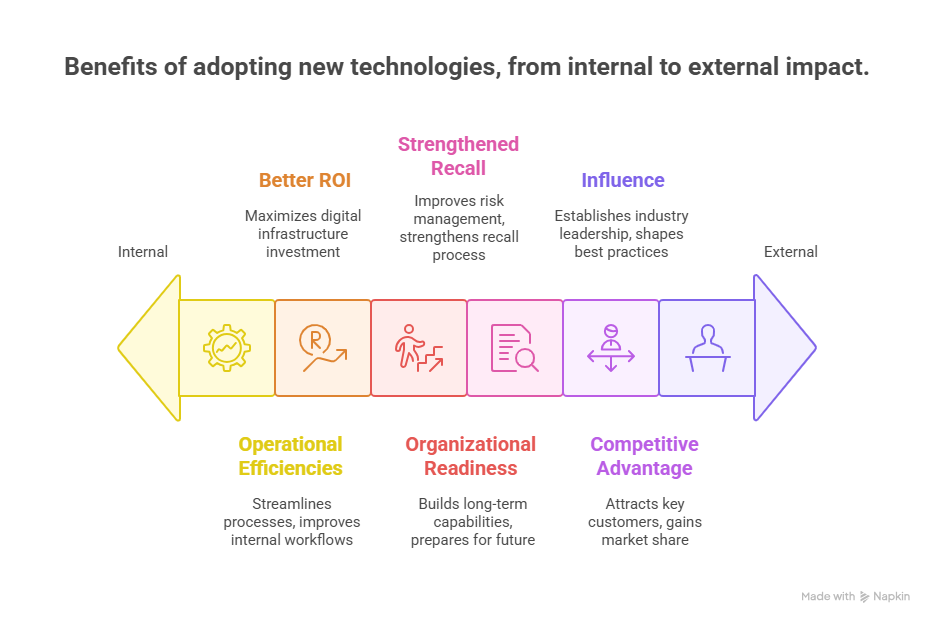 Image courtesy of Tim Marsh
Organizational Readiness and Long-Term Capability
Regulatory compliance does not happen overnight. Companies that begin building capability now—across quality, operations, IT, and compliance—will be better prepared when enforcement begins.4
They will also have the opportunity to pilot solutions, test supplier engagement strategies, and refine standard operating procedures (SOPs) without the pressure of a looming deadline.
Influence and Industry Leadership
Early movers are not just rule-followers; they become standard-setters. By engaging early, companies can join industry pilots, shape data-sharing norms, and collaborate with tech providers and peers to refine the future of traceability.
A Shifting Tech Landscape—and a Strategic Window for Early Adopters
The FSMA 204 extension has had an unexpected ripple effect—not just among food companies, but across the ecosystem of technology providers supporting compliance. Many SaaS-based traceability platform providers have seen their FSMA sales pipelines slow, prompting a shift in their business models.
In response, these providers are expanding their platform capabilities beyond basic compliance to include value-added functions like supplier performance management and quality monitoring. At the same time, they are offering unusually favorable commercial terms to encourage early adoption—terms that are unlikely to last as demand rebounds closer to the new deadline.
For food companies ready to act, this presents a unique opportunity to secure enterprise-grade tools at reduced cost, influence product development, and form deeper partnerships with solution providers before market conditions tighten again.
The Road Ahead
FDA's FSMA 204 extension is not a reason to delay; it is an opportunity to act smart. Companies that remain on course will not only be ready for enforcement—they will also be reaping business value from traceability investments long before the rest of the market catches up.
For decision-makers in food safety, food quality, procurement, and compliance, the question is no longer whether to act, but how to lead.
References
- U.S. Food and Drug Administration (FDA). FSMA Final Rule on Requirements for Additional Traceability Records for Certain Foods. Current as of August 6, 2025. https://www.fda.gov/food/food-safety-modernization-act-fsma/fsma-proposed-rule-food-traceability.
- Gobal, E. "How Enhanced Traceability is Transforming Supply Chain Management." Shipping and Freight Resource. May 14, 2025. https://www.shippingandfreightresource.com/how-enhanced-traceability-is-transforming-supply-chain-management.
- Yiannas, F. "How to Create Business Value from FDA's Extended Food Traceability Timeline." Wall Street Journal. May 22, 2205. https://deloitte.wsj.com/sustainable-business/how-to-create-business-value-from-fdas-extended-food-traceability-timeline-834023eb.
- Richard, R. "FSMA Rule 204: Why Digital Traceability Can't Wait." Supply Chain Management Review. May 13, 2025. https://www.scmr.com/article/fsma-rule-204-why-digital-traceability-cant-wait.