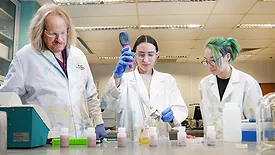
After further optimization and validation, the approach could possibly offer an alternative to conventional culture-based screening methods that typically require three to five days. The bacteriophage amplification strategy, which was tested against Salmonella on chicken meat, could be adapted to detect other viable foodborne bacteria.
Phage W5, isolated from poultry and livestock slaughterhouse effluent, significantly inhibited the growth of Salmonella in milk, pork, and eggs, and effectively prevented and eradicated biofilms on food-contact surfaces. The absence of virulence and antibiotic resistance genes supported its suitability as a food-grade biocontrol agent.
Researchers at McMaster University have developed a new, highly effective tool to mitigate bacterial contamination of foods, including pathogens displaying antimicrobial resistance (AMR), that has great potential for food safety.