From Farm to Threat: Integrating Biosurveillance, Biointelligence, and Biosecurity (B3) into the Food Safety Enterprise—Part 2

Need to Know
- The B3 framework aims to shift food safety surveillance from reactive pathogen detection to proactive identification of emerging biological threats
- Continuous environmental monitoring and AI-driven analytics could help identify pathogen harborage sites before contamination reaches food-contact surfaces
- Integrating biosurveillance data with predictive risk assessments could enable more targeted environmental sampling, sanitation interventions, and preventive controls
- A hypothetical COVID-19 analysis illustrates the potential implications of earlier biological threat detection and reduced delays in coordinating response efforts
- Food businesses can begin adopting B3 principles through environmental sensor monitoring, cross-sector data sharing, and investments in explainable AI
In Part 1 of this article series, we established that the current national biosurveillance architecture is structurally reactive, meaning that it confirms biological threats after they enter the food system rather than detecting them before. We introduced the B3 (Biosurveillance, Biointelligence, and Biosecurity) framework developed at Auburn University, the AU-BISR five-layer sensor architecture that operationalizes it, and the Products of Logic (PoL) decision pipeline that transforms raw sensor data into actionable intelligence. We demonstrated the architecture's pre-clinical value through a Highly Pathogenic Avian Influenza (HPAI) H5N1 poultry scenario in which a complex-level risk Course of Action (COA) was generated before a single bird showed clinical signs.
Part 2 brings the same architecture inside the processing facility, scales it to the pandemic level, and provides practical guidance for food businesses ready to act.
What B3 Means for Food Processors: A Listeria monocytogenes Pre-Clinical Detection Scenario
Consider a scenario familiar to every food safety professional: It is mid-winter, and a large ready-to-eat (RTE) deli meat processing facility is operating at full capacity. The facility has 200 environmental monitoring sites, weekly swabbing rotations, a mature Hazard Analysis and Critical Control Points (HACCP) plan, and a clean regulatory history. By every conventional metric, the facility is in control.
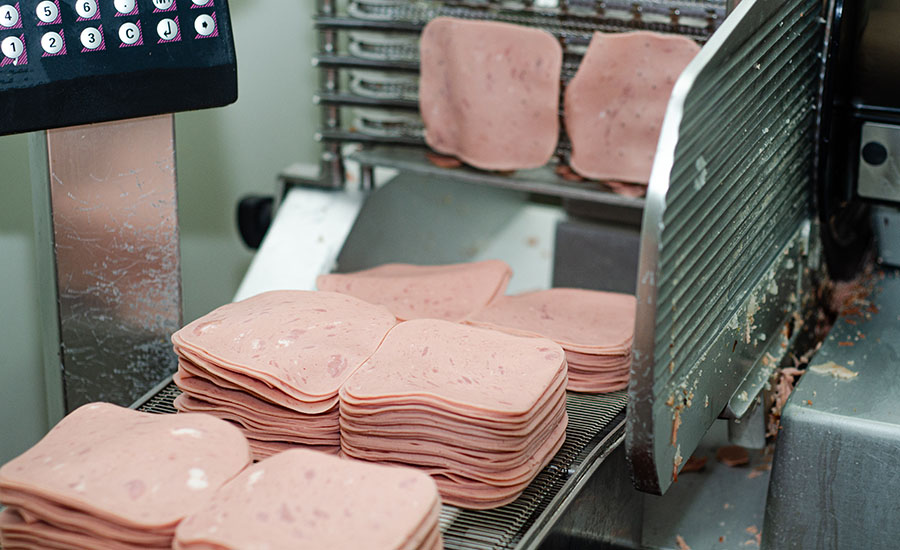
Yet, somewhere in the cold processing corridor—perhaps in a floor drain beneath a slicer frame, in a condensate drip zone behind a refrigeration unit, or in a wall-floor junction the mop head never quite reaches—Listeria monocytogenes is establishing a persistent environmental niche. It is not yet detectable by the weekly swab rotation. No employee has reported illness. No regulatory flag has been raised.
Under the current system, the contamination niche expands. Product-contact surfaces become colonized. Finished product tests negative on the sampling schedule because the sampling schedule was not designed to find what it has not yet been told to look for. Weeks later, a cluster of listeriosis cases appears in three states. Whole genome sequencing (WGS) done by the Centers for Disease Control and Prevention's (CDC's) PulseNet matches clinical isolates to the facility's environment. The U.S. Food and Drug Administration's (FDA's) Coordinated Outbreak Response and Evaluation (CORE) network initiates an investigation. A voluntary recall is issued. By then, contaminated product has been distributed, purchased, and in many cases consumed.
Now imagine this scenario with AU-BISR B3, allowing detection and response processes to unfold earlier at every stage.
Weeks Before Any Swab Turns Positive
Layer 3 ground and environmental sensors—e.g., continuous electrochemical Volatile Organic Compound (VOC) arrays at drain exhaust points, HVAC return air sampling nodes, and condensate collection zones—detect a statistically significant shift in the facility's chemical signature baseline. Microbial metabolic byproducts associated with Listeria biofilm formation, including acetoin, diacetyl, and specific short-chain fatty acid profiles, appear at concentrations 1.8 sigma above the established seasonal VOC baseline at two adjacent drain locations in the cold processing corridor. Simultaneously, Layer 3 thermal infrared sensors detect a subtle but persistent 0.4 °C elevation in the wall–floor junction zone adjacent to the slicer line, consistent with the localized metabolic heat signature of an expanding biofilm mass in a protected harborage site (Figure 1).
Looking for quick answers on food safety topics?
Try Ask FSM, our new smart AI search tool.
Ask FSM →
A Product of Logic (PoL 1) risk mask (RM) is generated: two facility grid cells flagged as chemically anomalous; one as thermally anomalous. No positive swab. No clinical signal. No consumer complaint. But AU-BISR has already identified the highest-probability contamination zone in the facility.
Days Before Product Contact Surface Colonization
At PoL 2 multi-sensor fusion, the VOC anomaly, thermal deviation, and historical swab data are correlated against three additional data streams:
- Acoustic pattern-of-life monitoring at the slicer line detects a subtle vibration frequency increase consistent with biofilm-induced surface roughening on the drain channel substrate, a physical signature of mature Listeria biofilm structure that is invisible to visual inspection.
- Water activity and humidity sensors at the drain proximity zone record persistent micro-humidity elevation consistent with inadequate drain geometry, a known Listeria harborage amplification factor.
- Facility operational data integration confirms that the flagged zone falls within a documented sanitation shadow: the scheduled clean-in-place (CIP) cycle has 23 percent less dwell-time contact than adjacent zones due to drain geometry.
The PoL 2 fusion product generates a Facility Contamination Risk Surface, a georeferenced grid of the processing floor in which the wall–floor junction at Slicer Line 3, Drain Cluster B is identified as the highest-probability Listeria harborage niche in the facility, with a fusion confidence score of 87 percent.
Before a Single Product-Contact Surface Tests Positive
At PoL 3, the Long Short-Term Memory (LSTM) neural network—which is tracking the slow, coherent VOC drift trajectory over 19 days—generates a Contamination Escalation Score (CES) crossing the high-alert threshold. The gradient boosted decision tree model, with SHapley Additive exPlanations (SHAP) explainability output, identifies three dominant contributing factors driving the score:
- VOC metabolite drift, contributing 44 percent of predictive weight.
- Persistent thermal microclimate anomaly, contributing 33 percent.
- Sanitation shadow dwell-time deficit at the flagged drain cluster, contributing 23 percent.
Every contributing factor, every sensor reading, and every weighting parameter is documented in the PoL evidence chain, ensuring that the resulting PoL 4 decision product can withstand both the U.S. Department of Agriculture's (USDA's) Food Safety and Inspection Service (FSIS) and FDA's regulatory scrutiny, legal challenge, or third-party audit review.
The PoL 4 Course of Action: Before the Recall
A PoL 4 Decision Product Course of Action (COA) is delivered to the facility's food safety manager and quality Assurance director. The COA includes:
- Immediate targeted environmental swabbing at Slicer Line 3, Drain Cluster B and the eight highest-probability adjacent grid cells, a precision 14-site intensive campaign focused on the AI-identified harborage zone, not the routine 200-site rotation.
- Sanitation protocol intensification: extended CIP dwell time, elevated sanitizer concentration, and drain disassembly inspection within 24 hours.
- Voluntary product hold advisory on all finished product from Slicer Line 3 during the preceding 72-hour window, pending swab result confirmation.
- Collection re-tasking: redirect Layer 3 VOC and thermal arrays to 15-minute sampling intervals at the flagged zone for 96 hours, generating continuous PoL 0 data for the next analytical cycle.
The targeted swab campaign, executed within 24 hours, returns a confirmed Listeria monocytogenes positive at Drain Cluster B. Sanitation is intensified. The harborage niche is eliminated. The product hold is lifted after three consecutive negative environmental results. No consumer is exposed. No recall is issued. No enforcement action is initiated.
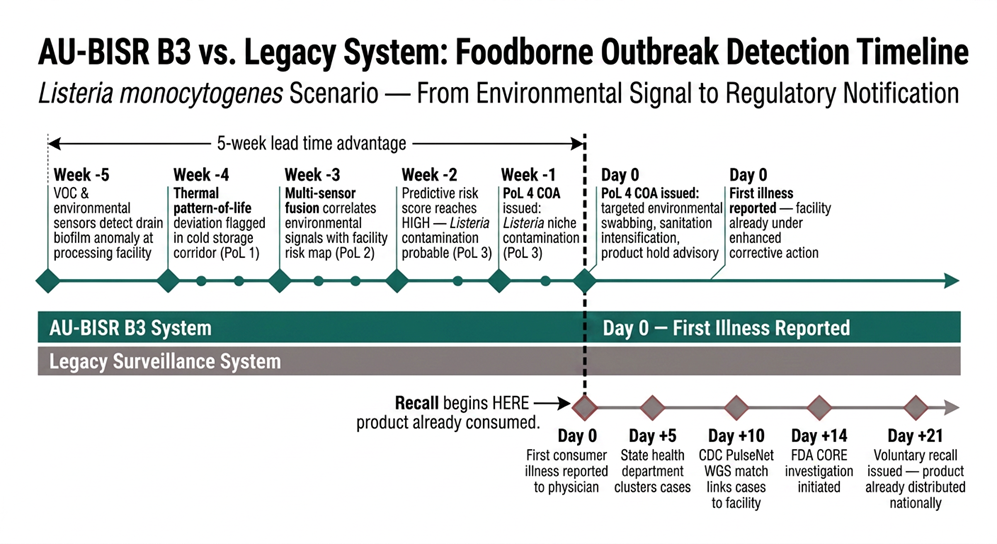
As the hypothetical example in Figure 2 shows, by the time a food safety manager receives the FDA recall notification under today's system (e.g., day +21), AU-BISR would have detected the environmental contamination signal at week –5, generated a facility risk map at week –3, scored the threat as "high" probability at week –2, and issued a targeted corrective action order at week –1. The product that triggered the recall would never have shipped. The consumers who were harmed would not have been exposed. The reputational and financial damage would not have occurred. The difference is not better testing after the fact; it is continuous, pre-clinical, sensor-driven biosurveillance before the pathogen ever reaches the food.
The Operational Value Statement
This scenario illustrates three capabilities that no conventional environmental monitoring program, however well-designed, can replicate on its own:
- Pre-swab detection: AU-BISR's continuous, multi-sensor chemical, thermal, and acoustic monitoring detects the biological signature of Listeria biofilm establishment before any swab sampling protocol is triggered because the sensors are always on, always fusing, and always comparing against a continuously updated facility baseline.
- Precision targeting: The PoL 2 Facility Contamination Risk Surface directs sampling resources to the highest-probability harborage zones rather than distributing them across a fixed rotation schedule, reducing the probability of false-negative results driven by sampling location selection bias.
- Auditable AI explainability: The SHAP-documented PoL 3 risk score and the PoL 4 COA evidence chain provide a fully traceable, regulatory-defensible record of every analytical step from raw sensor reading to intervention recommendation, ensuring the food safety manager's decision to issue a product hold is supported by documented, reproducible evidentiary reasoning.
AU-BISR's B3 architecture is not a replacement for existing environmental monitoring programs, HACCP frameworks, or supplier verification systems. It is the pre-clinical biosurveillance layer that sits upstream of them, detecting the biological threats that conventional programs are not yet looking for and at the spatial and temporal resolution that the threat demands.
The COVID-19 Lesson for Food Safety
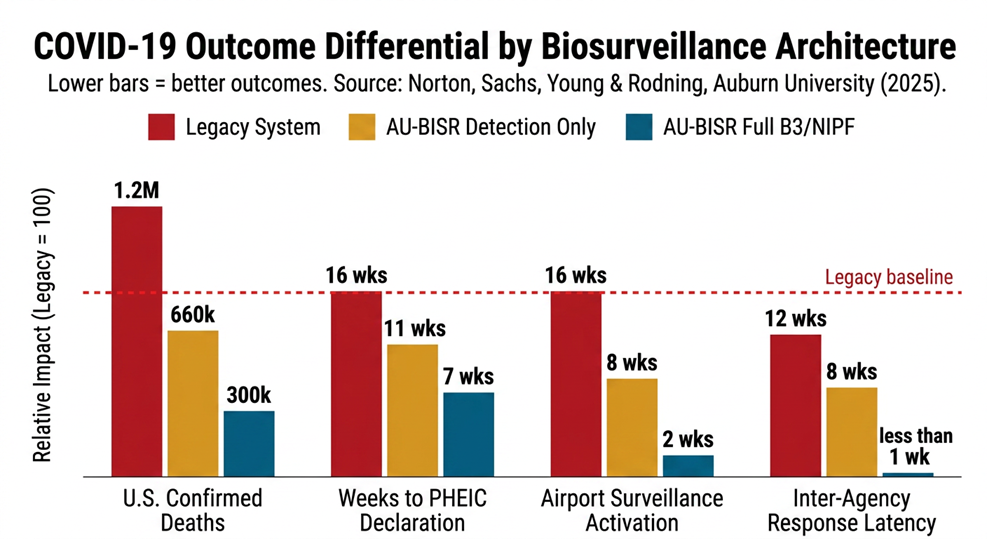
The AU-BISR team applied counterfactual B3 analysis (See Analytical Framework Notes for details) to the COVID-19 pandemic timeline, and the results are sobering. A fully operational AU-BISR system with standing National Intelligence Priorities Framework (NIPF)-aligned Priority Intelligence Requirements (PIRs) governing biological threat collection would have generated a PoL 4 international alert product on approximately December 1, 2019: six to eight weeks before the WHO Public Health Emergency of International Concern (PHEIC) declaration of January 30, 2020.
The modeled outcome differential is stark. Under the legacy architecture, U.S. confirmed COVID-19 deaths reached approximately 1.2 million. Under the full AU-BISR B3/NIPF architecture with pre-authorized biosecurity COA execution and standing PIR assignments, the estimated U.S. death toll would have been 240,000–360,000, a reduction of 720,000–960,000 American lives. These are not abstract projections. They reflect the specific operational consequence of eliminating inter-agency authorization latency and the resulting weeks consumed by emergency declaration processes before any biosecurity response could legally begin—in other words, that which B3 is structurally designed to prevent.
Figure 3 illustrates this example scenario. The red bars in the graph show: 1.2 million U.S. deaths, 16 weeks to a global emergency declaration, and 12 weeks of inter-agency authorization delay before any pre-positioned biosecurity response could begin. The teal bars show: 300,000 deaths, PHEIC declaration in 7 weeks, and inter-agency latency reduced to less than one week—because biosecurity response did not require a declared emergency to begin. For food safety professionals evaluating investment in pre-clinical biosurveillance infrastructure, this chart is the business case.
For food safety professionals, the parallel is direct. Every foodborne illness cluster that escalates from early signal to multi-state outbreak before detection represents the same architectural failure at a smaller scale including surveillance data in one agency, analytic al capacity in another, response authority in a third, and no closed-loop system connecting them in real time. The 2022 National Biodefense Strategy explicitly calls for modernizing biosurveillance and integrating food and agricultural biosurveillance planning, but as the Biodefense Commission's 2024 Biodefense in Crisis report documents, implementation has dangerously lagged behind the policy declaration.
One Health as Operational Architecture, Not Aspirational Language
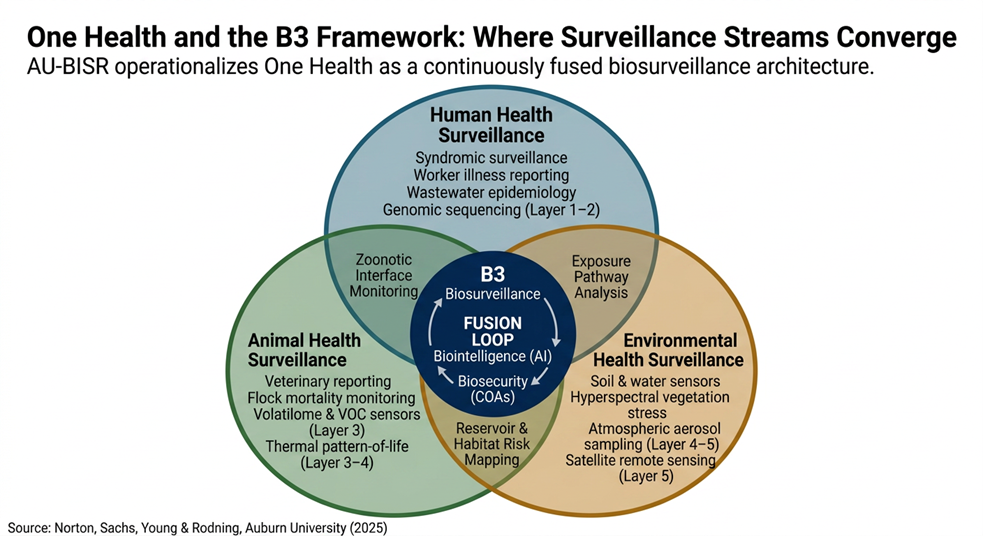
The food safety community is broadly familiar with the One Health framework, which is the recognition that human, animal, plant, and environmental health are inextricably interconnected. FDA's One Health Initiative frames the agency's ecological surveillance of foodborne pathogen distribution as a One Health application; USDA APHIS's Strategic Framework, funded with $300 million in American Rescue Plan resources, establishes early warning system development as a standing priority. What AU-BISR's B3 framework contributes is the operational architecture that converts One Health from an aspirational interdisciplinary concept into a continuously executing, sensor-driven, AI-analyzed, decision-product-generating system.
The B3 fusion loop is One Health operationalized (Figure 4). It collects biosurveillance across human, animal, and environmental domains simultaneously. Biointelligence fuses those streams into predictive risk assessments, and biosecurity executes interventions that generate new biosurveillance data, automatically closing the loop and initiating the next analytical cycle.
The food industry's investment in this architecture is not a diversion from core food safety operations. It is the logical extension of the environmental monitoring programs, WGS investments, and supply chain traceability systems that leading food businesses have already built.
Practical Pathways for the Food Industry
For food safety professionals and food business leaders, the B3/AU-BISR architecture offers several near-term, actionable integration pathways:
- Volatilome baseline development: Commission facility-specific seasonal VOC baseline profiles for poultry, swine, and cattle operations—the Layer 3 foundation that enables AI-driven deviation detection.
- Engagement with BIO-ISAC: The Bioeconomy Information Sharing and Analysis Center (BIO-ISAC) is the emerging institutional home for biosurveillance data, making possible its integration across the food and agriculture sector. Food businesses should engage BIO-ISAC as the coordination mechanism for multi-sensor data fusion and B3-aligned early warning product development.
- USDA-APHIS Wildlife Biosecurity Assessment participation: The approximately 150 facilities that have completed USDA Wildlife Biosecurity Assessments have, in general, experienced lower HPAI incidence. These assessments are an entry point to the sensor-based, risk-stratified biosurveillance posture B3 requires at scale.
- One Health data integration: Establish data-sharing agreements with state veterinary laboratories, USDA-APHIS, and CDC FoodNet successor systems to enable the cross-domain PoL 2 fusion that converts individual sensor readings into actionable Reservoir Interface Risk Surfaces.
- AI/ML investment in predictive analytics: Begin building interpretable AI analytical capacity: gradient boosted models, Bayesian evidence fusion, and anomaly detection algorithms that the PoL 3–4 decision product tier requires. Explainable AI is not optional in a regulatory environment: every biosurveillance recommendation informing a recall, quarantine, or depopulation order must be auditably traceable to its evidentiary basis.
The Imperative of Integration
The food safety community has spent decades building increasingly sophisticated tools for detecting biological threats after they enter the food system. WGS has transformed outbreak investigation. Predictive analytics are improving supply chain risk management. Environmental monitoring programs are more sensitive than ever.
The next evolutionary step is not a better microscope or a faster sequencer. It is a closed-loop B3 architecture that connects the farm, the production facility, the atmospheric corridor, and the satellite orbit into a single, continuously fused early warning system. This new fused system can generate actionable intelligence before the pathogen reaches the food, before the animal dies, before the worker falls ill, and before the regulator is called. As the National Biodefense Strategy recognizes, and as AU-BISR's COVID-19 counterfactual analysis quantifies with devastating clarity, the difference between a contained outbreak and a national crisis has never been a matter of detection capability alone.
It has always been a matter of what institutions and businesses are authorized, funded, and architecturally structured to do with what they detect, and how quickly. The B3 framework is the answer to that question. The food safety profession is the right community to build it.
References
- Norton, R., M. Sachs, C. Young, and S. Rodning. "AI and MASINT-Assisted Biosurveillance: How AU-BISR Turns Farms and Facilities into Early-Warning Sensor Platforms for Avian Influenza." Auburn University Biosurveillance-ISR Program. Report to U.S. Government. 2025.
- U.S. Department of Agriculture, Animal and Plant Health Inspection Service (USDA-APHIS). "APHIS Announces Final Strategic Framework for Enhancing Surveillance of SARS-CoV-2 and Other Emerging Zoonotic Diseases." February 9, 2022. https://www.usda.gov/about-usda/news/press-releases/2022/02/09/aphis-announces-final-strategic-framework-enhancing-surveillance-sars-cov-2-and-other-emerging.
- USDA. "USDA Invests Up to $1 Billion to Combat Avian Flu and Reduce Egg Prices." February 26, 2025. https://www.usda.gov/about-usda/news/press-releases/2025/02/26/usda-invests-1-billion-combat-avian-flu-and-reduce-egg-prices.
- USDA-APHIS. "APHIS American Rescue Plan (ARP) Surveillance Program: Strategic Framework." February 2022. https://www.aphis.usda.gov/sites/default/files/arp-strategic-framework.pdf.
- Centers for Disease Control and Prevention (CDC). "About One Health." Current as of October 23, 2026. https://www.cdc.gov/one-health/about/index.html.
- U.S. Food and Drug Administration (FDA). "Cross-Cutting Topics: One Health Initiative." Current as of September 6, 2025. https://www.fda.gov/science-research/focus-areas-regulatory-science-report/cross-cutting-topics-one-health-initiative.
- CDC. "Foodborne Disease Outbreak Surveillance System." September 6, 2024. https://www.cdc.gov/nors/about/fdoss.html.
- The White House. National Biodefense Strategy and Implementation Plan for Countering Biological Threats, Enhancing Pandemic Preparedness, and Achieving Global Health Security. October 2022. https://bidenwhitehouse.archives.gov/wp-content/uploads/2022/10/National-Biodefense-Strategy-and-Implementation-Plan-Final.pdf.
- Biodefense Commission. "The National Blueprint for Biodefense: Immediate Action Needed to Defend Against Biological Threats." April 2024. https://biodefensecommission.org/wp-content/uploads/2024/05/National-Blueprint-for-Biodefense-2024_final_.pdf.
- Sachs, M., W. Bowman-Zatzkin, and R. Norton. "A Biosurveillance Ecosystem for Food Safety and National Resilience." Food Safety Magazine October/November 2025. https://www.food-safety.com/articles/10788-a-biosurveillance-ecosystem-for-food-safety-and-national-resilience.
- Sachs, M., R. Norton, and C. Young. "Leveraging AI for Food Safety Without Becoming its Victim." Food Safety Magazine February/March 2026. https://www.food-safety.com/articles/11280-leveraging-ai-for-food-safety-without-becoming-its-victim.
- Norton, R., M. Sachs, and C. Young. "A Future View of AI-Enhanced Biosurveillance and Comprehensive Food Safety Programs." Food Safety Magazine December 2023/January 2024. https://www.food-safety.com/articles/9110-a-future-view-of-ai-enhanced-biosurveillance-and-comprehensive-food-safety-programs.
- Arredondo-Rivera, M., Z. Barois, G.E. Monti, J. Steketee, and A. Daburon. "Bridging Food Systems and One Health: A Key to Preventing Future Pandemics." One Health 18 (April 2024): 100727. https://doi.org/10.1016/j.onehlt.2024.100727.
- U.S. Department of Health and Human Services, Administration for Strategic Preparedness and Response. National Biodefense Strategy. 2026. https://aspr.hhs.gov/biodefense/Pages/default.aspx.
Analytical Framework Notes
Structured counterfactual scenario analysis is a formal epidemiologic method in which a hypothetical intervention is introduced into a documented historical baseline, and outcome differentials are estimated by applying published modeling parameters to the difference between the hypothetical and actual response timelines. This is the same framework used by the CDC, World Health Organization (WHO), and academic epidemiologists for pandemic preparedness modeling, vaccine impact estimation, and early warning system evaluation.
Analytical Steps:
- Empirical Baseline. Actual pandemic outcomes were anchored to verified published data.
- AU-BISR Hypothetical Detection Timeline. The AU-BISR team reconstructed a hypothetical detection sequence using MASINT signature categories that were physically present in the Wuhan environment during August–November 2019 but were not being monitored by any institution operating under a standing Priority Intelligence Requirement (PIR) for biological threat collection.
- Quantifying the Exponential Growth Disadvantage. The analysis applied published SARS-CoV-2 transmission dynamics to quantify the compounding case burden generated by the 6–8-week detection delay.
- Mortality Reduction Estimation. Mortality reduction estimates were derived by applying the proportional detection-timing advantage to the empirical mortality baseline, calibrated against published epidemiologic modeling demonstrating the nonlinear sensitivity of pandemic trajectory to early detection timing.
- Inter-Agency Authorization Latency. A distinct but analytically separable component of the estimate accounts for the elimination of inter-agency authorization latency, the 10–12 weeks historically consumed by emergency declaration processes before any biosecurity response could legally begin under the legacy architecture.
Important Caveats. These estimates are structured projections, not predictive model outputs. They rest on the assumption that AU-BISR would have been operationally deployed and institutionally connected to actionable response authorities at the time of detection, an assumption that reflects the architecture's designed state, not its current deployment status. The estimates are consistent with the published academic literature on early detection impact (Bradshaw et al., 2023, Nature Communications; Grassly et al., 2020, Science), but they involve scenario-based reasoning and should be interpreted as order-of-magnitude mortality impact assessments rather than precise epidemiologic forecasts. The AU-BISR team presents them not as settled fact, but as quantified illustrations of the structural cost of biosurveillance fragmentation and the structural value of closing the B3 loop before the next index event.
Select Acronym Notes
LSTM (Long Short-Term Memory): A specialized recurrent neural network designed to detect patterns in sequential, time-ordered data by selectively retaining long-range historical information. In AU-BISR, LSTM networks analyze multi-sensor time-series streams at PoL 3 to identify slow, coherent pre-clinical signals, gradual volatilome drift, persistent thermal anomalies, and progressive vegetation stress that precede biological threat events by days to weeks.
MASINT (Measurement and Signature Intelligence): An intelligence collection discipline that detects, characterizes, and identifies physical phenomena through the measurement of their distinctive signatures, such as electromagnetic, acoustic, chemical, nuclear, thermal, and biological. In AU-BISR, Layers 3–5 of the sensor architecture function as MASINT collection tiers, capturing the invisible physical fingerprints of biological events before any pathogen can be confirmed by laboratory culture.
NIPF (National Intelligence Priorities Framework): The U.S. government's authoritative mechanism for establishing and communicating national intelligence collection priorities to the Intelligence Community. In the AU-BISR context, NIPF-aligned Priority Intelligence Requirements (PIRs) govern biological threat collection tasking, enabling pre-authorized biosurveillance collection without waiting for an emergency declaration.
PIR (Priority Intelligence Requirements): Formally established intelligence collection requirements that define what information is needed, by whom, and within what timeframe to support specific decision-making needs. In AU-BISR's NIPF-aligned architecture, standing PIRs for biological threat collection enable continuous pre-clinical surveillance without requiring individual collection authorizations for each emerging event.
PoL (Products of Logic): The AU-BISR analytical framework that transforms raw sensor data into actionable decision products across five ascending levels: PoL 0 (raw data ingestion), PoL 1 (single-sensor risk mask generation), PoL 2 (multi-sensor fusion), PoL 3 (predictive risk scoring), and PoL 4 (decision product synthesis and COA generation).
RM (Risk Mask): A geospatial analytical product generated at Products of Logic Level 1 (PoL 1) within the AU-BISR system. It is a georeferenced raster grid layer, a map overlay in which every spatial cell (pixel) is assigned a classification or color-coded value representing the probability or intensity of biological risk at that precise location, computed from single-sensor data processed through AI algorithms.
SHAP (SHapley Additive exPlanations): A game theory-derived machine learning interpretability method that quantifies each input variable's contribution to a specific model prediction. In AU-BISR, SHAP explainability is embedded in PoL 3 analytics to ensure every biosurveillance risk score is auditably traceable to its sensor-level evidence, meeting both Intelligence Community evidentiary standards and food safety regulatory defensibility requirements.
VOC (Volatile Organic Compound): Carbon-based chemicals that evaporate readily at room temperature, producing characteristic odor and chemical signatures. Microbial metabolic activity, including pathogen infection and biofilm formation, produces distinctive VOC profiles. In AU-BISR's Layer 3 sensing, electrochemical and GC-MS VOC arrays continuously monitor facility exhaust and air return streams for statistically significant deviations from established seasonal baselines.