From Insight to Action: A Practical Self-Assessment Guide to Improve Food Safety Through Your Psychosocial Environment
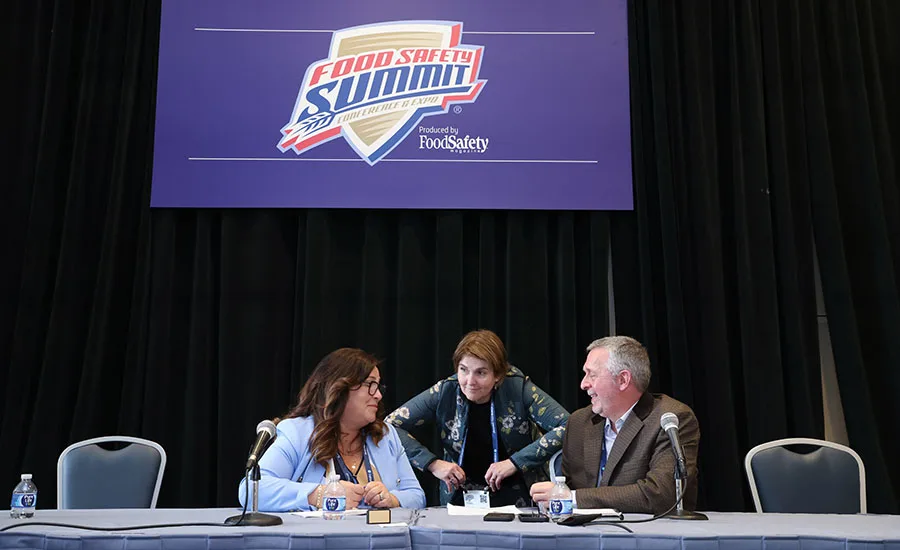
Spir Marinakis, Dr. Lone Jespersen, and Andrew Clarke lead the "Practical Tips to Improve Food Safety Through Your Psychosocial Environment" workshop at the 2026 Food Safety Summit
Need to Know
- Workload, input to work, and control over daily tasks can influence employees' ability to consistently execute critical food safety activities
- Psychosocial risks can be assessed systematically by examining how workplace conditions affect high-priority frontline tasks
- Familiar tools, including leader standard work, root cause analysis, and employee feedback mechanisms, can help identify and address psychosocial barriers to food safety
- A targeted action plan can help organizations turn assessment findings into practical improvements in frontline food safety performance
At the 2026 Food Safety Summit in Rosemont, Illinois in May, more than 400 food safety professionals participated in a workshop focused on a simple but increasingly important question: How do we improve food safety by improving the conditions in which people work? Rather than revisiting the theory behind psychosocial factors, this workshop emphasized practical application. The objective was clear: provide attendees with tools they could immediately take back to their facilities and use to strengthen frontline performance and food safety outcomes.
Led by Andrew Clarke of Loblaw Companies Ltd., Spir Marinakis of Maple Leaf Foods, and Dr. Lone Jespersen of Cultivate SA, the workshop was intentionally structured as a working session. Recorded testimonials by Jeremiah Johnson of Hormel Foods, John Petie of Kayem Foods, and Robert Prevendar of Yum! Brands were used to highlight specific challenges with the psychosocial environment. Participants were not passive observers. They were asked to engage, reflect, and apply. Through case studies, video examples, and facilitated discussions, the group explored how the psychosocial environment shapes behavior in real time and what can be done, practically and immediately, to improve outcomes (Figure 1).

The message resonating from this workshop was clear: Food safety performance is not just a function of systems, procedures, and technology. It is also a function of people and the psychosocial environment in which those people are expected to perform.
For many food safety professionals, this can feel challenging. We are trained to analyze hazards, verify controls, and investigate deviations. We are comfortable with technical systems. Psychosocial factors—some of the conditions that influence behavior, decision-making, and performance—can seem less tangible.
The good news is that psychosocial factors can be assessed systematically.
Throughout the workshop, speakers emphasized that food safety professionals already possess many of the tools needed to address psychosocial factors. The challenge is not creating new systems but applying familiar tools more intentionally. Leader standard work (LSW), root cause analysis (RCA), structured leadership development, and employee feedback mechanisms can all be used to understand and improve the conditions that influence food-safe behaviors. The practical application of these tools was a central theme throughout the workshop (Figure 2).

This article serves as a summary of that workshop, and, more importantly, a practical guide that you can use at your own plants and sites. Using the Food Safety Psychosocial Risk Assessment and Action Planner as a framework, you can perform your own self-assessment of three key psychosocial factors, identify where these factors may be influencing food safety performance, and develop actionable improvement plans. The process is designed to help teams ask better questions, identify barriers, and begin improving the conditions that support consistent food safe behavior.
Looking for quick answers on food safety topics?
Try Ask FSM, our new smart AI search tool.
Ask FSM →
Click here to download your planner worksheet.
Understanding Three Key Psychosocial Factors
The workshop and this self-assessment process focus on three psychosocial factors that are especially relevant to frontline food safety performance:
- Workload
- Input to work
- Control over daily tasks.
Together, these factors shape what happens during what the presenters described as the "moment of truth"—when an employee must decide between competing priorities, respond to a problem, or determine whether a food safety task receives the attention it requires.
As was previously noted, food safety performance is shaped not only by systems and standards, but also by the psychosocial conditions in which people are expected to execute them. Three conditions are especially important to workers: manageable workload, meaningful input into work, and control over daily tasks, which is supported by their immediate supervisor and others. Together they reduce friction, improve communication, and help teams focus consistently on the activities that matter most.
For further information about these three factors and others, see the previous two Food Safety Magazine articles in this series: "Where Food Safety Systems and Culture Collide: Do You Know Your Company's Psychosocial Risks?" and "The Connection Between Psychosocial Factors and Food Safety Outcomes."
Before completing the planner worksheet, it is useful to consider these factors through the lens of some realistic, hypothetical frontline scenarios.
Frontline Scenario: Workload
Workload refers to the volume, pace, and complexity of tasks relative to the realistic time, staffing, and cognitive capacity available to complete them. When demands exceed capacity, critical food safety tasks can become deprioritized, shortcuts can emerge, and risk can increase despite strong technical systems.
A case study example was presented to the participants, and their feedback was sought:
Maria starts her shift as an operator at the bakery, already way behind on her assigned tasks for the day (Figure 3). Two key coworkers have called out sick, but production targets remained the same. While Maria is doing her metal detector checks, she is repeatedly pulled away to clear jams, restock ingredients, and help a new hire. As the morning rush builds, her critical control checks of the detector's functionality run late. Maria knows how important they are, but with bread backing up and supervisors urging speed, she pencil-whips her records and moves on—hoping nothing goes wrong.

Notice that Maria's issue is not knowledge. She understands the importance of the critical control point (CCP) checks. The problem is that the work environment places her in a position where competing demands overwhelm her capacity and force her to make choices. The food safety failure is a symptom of the workload conditions surrounding her.
Workshop discussions emphasized that workload management is itself a food safety control. Critical tasks must be visible, prioritized, and aligned with realistic capacity so they are not displaced by competing operational demands. A practical tool for evaluating workload is leader standard work (LSW).
In food manufacturing, LSW is a structured system of daily, weekly, and monthly leadership activities that ensures consistent execution of safety, quality, production, sanitation, and compliance standards. It helps supervisors and managers routinely verify processes, coach employees, solve problems, and drive continuous improvement across manufacturing operations.
Rather than relying on assumptions, LSW brings facts and data to the discussion by documenting routine responsibilities, measuring time demands, identifying recurring interruptions, and revealing where overload exists. Food safety leaders can use LSW to identify low-value activities, rebalance responsibilities, and ensure that critical food safety work receives the time and attention it requires.
Ask yourself:
- Where in your operation are employees routinely overloaded?
- Which food safety tasks are executed during peak workload periods?
- Are new responsibilities regularly added without removing existing tasks?
- Do supervisors depend on employees "making it work" despite unrealistic demands?
Frontline Scenario: Input to Work
Input to work describes the extent to which employees can influence work processes and decisions that affect their ability to perform effectively. It includes being heard, contributing ideas, and participating in problem-solving.
This scenario illustrates this challenge:
Gerta, a QA line technician in a sausage facility, monitors critical smokehouse temperatures and humidity (Figure 4). She notices uneven heat profiles that she thinks could impact lethality. She believes these can be traced to loading patterns and possibly changed air flow velocity since new fans were installed last week. She flags her concerns to the maintenance manager and her FSQA supervisor, but they dismiss her concerns. Adjustments are made upstream without her involvement, and monitoring tasks remain reactive. Gerta is accountable for verification records, yet she has little influence over decisions that determine whether smokehouse critical limits can be properly maintained.

Again, the problem is not capability. Gerta sees a developing issue and raises concerns. The system fails because the person closest to the work has little influence over decisions affecting food safety performance.
People closest to the work are often best positioned to improve it. When employees are encouraged to identify unnecessary complexity, simplify processes, and participate in problem-solving, organizations frequently discover practical improvements that would otherwise be missed. This empowerment should always operate within clear food safety and business guardrails, but involving frontline employees in root cause investigations, HACCP reviews, process change management, and continuous improvement efforts strengthens both engagement and execution.
Ask yourself:
- How often are frontline concerns acted upon?
- Are operators and supervisors involved in process changes?
- Do frontline employees participate in root cause analyses?
- Would employees say their opinions shape decisions?
Frontline Scenario: Control Over Daily Tasks
Control over daily tasks refers to the degree of autonomy employees have to sequence work, adapt to changing conditions, and prioritize food safety when circumstances require it. It is not about unlimited authority; it is about having enough decision-making power to respond appropriately to emerging risks.
This scenario provides a vivid example:
Alex is a frontline supervisor in a starch-molded candy factory overseeing depositing, drying, and mold handling (Figure 5). If humidity spikes mid-shift, Alex knows from experience that drying times should be extended and molds re-sequenced to prevent sticking and microbial risk. However, Alex is expected to follow the preset schedule and hit output targets. He cannot pause the line or adjust priorities without approval, so corrective actions are delayed despite clear warning signs.

Alex possesses both the knowledge and experience needed to manage the issue but lacks the authority to act promptly.
Control is strengthened when employees are supported by systems that promote psychological safety and trust. Additional examples discussed during the workshop included "buddy systems" for new employees, regular leadership check-ins, peer support networks, and structured engagement programs that help employees raise concerns early and navigate complexity. Employees are more likely to take ownership of food safety outcomes when they feel supported, respected, and safe when speaking up.
Ask yourself:
- Can supervisors stop production for food safety concerns?
- Are the methods of engaging with higher management clear to all employees?
- Do employees know where decision-making authority begins and ends?
- Are approvals creating unnecessary delays in risk management?
While workload, input to work, and control over daily tasks are three of the most important psychosocial factors influencing food safety performance, they are by no means the only ones that organizations should evaluate.
We have chosen to focus on these factors because they are particularly relevant to day-to-day food safety decision-making, influencing employees' ability to follow procedures, prioritize food safety requirements, and respond effectively to operational challenges. However, the broader psychosocial environment also plays a significant role. Factors such as employee fatigue, work-life balance, role clarity, supervisor support, communication, psychological safety, staffing levels, employee well-being, recognition, and overall organizational culture can all affect food safety behaviors and outcomes.
Together, these factors shape how people think, make decisions, and act in the workplace, reinforcing the view that psychosocial factors should be considered a critical component of any comprehensive food safety management system.
Step 1: Assess the Impact of Psychosocial Factors in Your Operation
The first section of the Food Safety Psychosocial Risk Assessment and Action Planner asks participants to consider how workload, input to work, and control over daily tasks affect frontline behavior within their own facility.
This section should be conducted as a multi-function reflection exercise involving team members from food safety and quality, operations, maintenance, human resources, and others. The goal is not to identify individuals but to understand system conditions.
As you review each factor, look for recurring observations such as:
- Missed or delayed food safety checks
- Incomplete documentation
- Escalation delays
- Excessive overtime
- Frequent schedule disruptions
- Dependence on individual intervention
- Repetitive corrective actions for similar issues.
Workshop discussions emphasized that organizations often focus on symptoms while overlooking underlying psychosocial conditions. A missed food safety check, for example, might be recorded as operator error. A deeper analysis might reveal unrealistic workloads, unclear authority, or a lack of employee input into scheduling decisions.
Document your observations honestly. This becomes the foundation for everything that follows.
Step 2: Create a Task–Time Map
The worksheet next asks participants to identify the ten tasks that consume the greatest amount of time for a typical frontline supervisor.
For each task, note:
- Duration
- Frequency
- Criticality (1–5 rating, with 1 being of little significance and 5 being of crucial importance).
At first glance, this may seem like a simple exercise. In practice, it often produces powerful insights.
Many organizations add tasks over time to their employees' workloads:
- Additional records
- Additional meetings
- New verification requirements
- New product launches
- Extra reporting obligations.
Rarely do they remove old tasks.
As a result, frontline leaders gradually inherit increasing responsibilities. This is to be expected as these leaders gain experience and skills. This tool should be utilized as part of change management as new responsibilities are added to an individual's task load. Workshop presenters emphasized that understanding workload begins with understanding how time is actually spent.
A typical task–time map might reveal new information about existing activities, as shown in Table 1.
TABLE 1. Example of a task–time map (Credit: A. Clarke et al.)
| Task | Duration | Frequency | Criticality |
|---|---|---|---|
| Pre-operational inspections | 45 min | Daily | 5 |
| CCP verification review | 20 min | Daily | 5 |
| Corrective action investigations | 60 min | Weekly | 5 |
| Employee coaching | 60 min | Daily | 4 |
| Documentation review | 45 min | Daily | 4 |
| Line troubleshooting | 90 min | Daily | 4 |
| Production meetings | 30 min | Daily | 3 |
| Schedule adjustments | 30 min | Daily | 3 |
| Audit preparation | 120 min | Weekly | 3 |
| Reporting activities | 60 min | Daily | 3 |
The numbers themselves are less important than the patterns they reveal.
Ask yourself:
- Which tasks deliver the greatest food safety value?
- Which activities consume time but contribute little value?
- Which high-criticality activities are most vulnerable during busy periods?
- Where is multitasking creating risk?
Many teams have discovered that critical food safety activities were competing directly against production demands for limited attention and time.
Following completion of the task–time map, leaders may choose to apply leader standard work to validate findings. LSW helps separate perception from reality by using direct observation and structured review of daily activities. This evidence-based approach allows organizations to identify workload imbalances, eliminate unnecessary work, and better protect critical food safety activities during periods of operational pressure.
Step 3: Complete the Barrier Grid
The barrier grid is where the analysis becomes more targeted.
For each significant task identified in the task–time map, assess the impact of workload, input to work, and control over daily tasks using the worksheet's 1–5 scale, with 1 equaling little impact and 5 indicating a potential contributor to failure.
This exercise helps convert broad observations into identifiable risks, as shown in Table 2.
TABLE 2. Sample Barrier Grid (Credit: A. Clarke et al.)
| Task | Workload | Input to Work | Control Over Daily Tasks |
|---|---|---|---|
| CCP Verification | 5 | 2 | 3 |
| Environmental Monitoring | 4 | 2 | 2 |
| Corrective Actions | 3 | 4 | 4 |
| Sanitation Verification | 5 | 1 | 2 |
Look for clusters of high scores. A task scoring 4 or 5 across multiple factors deserves closer examination because it may represent a point where psychosocial conditions are undermining food safety reliability.
Examples of such points include:
- Workload-driven risks
- Verification tasks consistently postponed
- Documentation completed retrospectively
- Employees covering multiple roles simultaneously
- Input-related risks
- Repeated unresolved concerns
- Ineffective change implementation
- Low engagement during investigations
- Control-related risks
- Delayed responses to emerging hazards
- Excessive approval requirements
- Unclear decision authority.
The workshop challenged participants to stop asking, "Who made the mistake?" and start asking, "What conditions made the mistake more likely?"
The barrier grid helps support that shift. This is also an ideal point to apply root cause analysis (RCA). Food safety professionals routinely use RCA to investigate technical failures, but the same tool can be used to identify psychosocial contributors. Rather than stopping at operator error, organizations should ask whether workload pressures, lack of employee input, unclear authority, insufficient support, or weaknesses in the leadership system increased the likelihood of failure.
Step 4: Identify the Most Impacted Frontline Tasks
The planner worksheet then asks: Which critical tasks are most impacted by these factors in your facility?
This is where priorities begin to emerge. Most facilities will not uncover dozens of urgent problems. Typically, 3–5 key tasks consistently surface as subject to these factors.
Those tasks might include:
- CCP monitoring
- Line clearance verification
- Environmental monitoring
- Allergen changeovers
- Corrective action implementation
- Sanitation verification.
The objective is to identify the key areas where small, incremental psychosocial improvements could generate the greatest overall impact. Organizations often become overwhelmed by attempting broad culture change initiatives. The workshop advocated for targeting specific operational realities instead. Small improvements to a handful of critical activities frequently create meaningful gains in performance.
Step 5: Build a 30-Day Change Plan
The final section of the worksheet converts insights into action. For each priority issue, complete the following:
- Improvement action
- Timeline
- Owner
- Support needed
- Measure of success.
The emphasis is on small, achievable changes rather than large, transformation projects. Examples of such changes are described below for each frontline scenario presented earlier.
Workload Example
- Improvement action: Remove duplicate reporting process
- Timeline: 30 days
- Owner: Operations manager
- Support needed: Food safety and IT
- Measure of success: 30 minutes per shift returned to supervisors.
Input to Work Example
- Improvement action: Add operator representative to monthly HACCP review
- Timeline: 30 days
- Owner: Food safety manager
- Support needed: Operations leadership
- Measure of success: Frontline recommendations documented and acted upon.
Control Over Daily Tasks Example
- Improvement action: Establish clear stop-work authority for food safety concerns
- Timeline: 14 days
- Owner: Plant manager
- Support needed: Training department
- Measure of success: Employees can describe escalation process during interviews.
When selecting actions, focus on what can realistically be influenced within your organization. The worksheet intentionally emphasizes action over analysis. A good assessment that leads to one improvement is more valuable than a perfect assessment that sits on a shelf.
Leadership's Role in the Process
One theme consistently emerged throughout the workshops: leadership behavior is the most important enabler of psychosocial improvement. There are several reasons for this:
- Leaders shape workload through priorities
- They influence input by listening (or not listening)
- They create control through delegated authority and decision rights
- Most importantly, leaders determine whether psychosocial factors become a legitimate topic of discussion or remain hidden beneath operational metrics.
Leadership development programs can also play an important role in reducing psychosocial risks. In your organization, work to create clarity around roles, define specific responsibilities, delineate decision-making authorities, and define communication expectations. By developing leaders who understand both operational execution and workforce support, organizations strengthen the conditions that enable consistent food safety performance.
Visible leader presence, active listening, regular frontline engagement, and responsiveness to concerns were repeatedly cited in the workshop as practical ways to strengthen food safety performance through improved psychosocial conditions.
Consistent Voice from Industry
One of the most powerful takeaways from the workshop was the consistency of opinion among food safety leaders from different organizations (Figure 6). Whether representing manufacturing, retail, or consulting environments, speakers shared a common view: understanding and improving psychosocial factors is becoming an increasingly important component of food safety culture, operational excellence, and workforce resilience. The industry is moving beyond awareness and toward practical action.

Start Small, Start Now
Improving psychosocial factors does not require a major culture initiative, a consultant, or a large budget. It begins with understanding how work is actually experienced by the people responsible for delivering food safety every day. The Food Safety Psychosocial Risk Assessment and Action Planner provides a practical method for gaining this understanding. By examining workload, input to work, and control over daily tasks, food safety leaders can identify conditions that influence behavior, uncover hidden barriers, and develop meaningful improvements.
Food safety systems do not operate on procedures alone. They operate through people. When organizations create environments where employees have manageable workloads, meaningful input, and appropriate control over their work, they improve more than morale. They strengthen execution, increase resilience, and reduce the likelihood that critical food safety decisions will fail when they matter most.
The challenge is straightforward:
- Complete the planner worksheet
- Have the conversation
- Identify one barrier
- Implement one improvement
- Then keep repeating the process.
Organizations improve food safety when they create manageable workloads, involve employees in improving the work, and provide control over daily decisions and tasks that are supported by employees' immediate supervisors and others. These conditions help employees make better decisions at the moment of truth, when food safety priorities compete with production and operational pressures.
Let's revisit Maria and see how things are going at her bakery job:
A few months after completing the food safety psychosocial risk assessment and implementing the action plan, Maria's bakery looked very different. Using task–time mapping, leader standard work, and root cause analysis, the team discovered that missed food safety checks were driven by workload pressures and constant interruptions, not a lack of knowledge. They rebalanced responsibilities, provided backup coverage for critical tasks, and gave supervisors more authority to protect food safety activities during busy periods. As a result, CCP checks were completed on time, documentation improved, and Maria no longer had to choose between production demands and food safety.
The reality is that organizations do not need entirely new systems to begin this work. By applying familiar tools such as leader standard work, root cause analysis, structured leadership development programs, and employee engagement mechanisms, psychosocial factors can be transformed from abstract concepts into practical improvement opportunities. Every improvement in the psychosocial environment strengthens the food safety system itself.
Acknowledgment
Huge thanks to Bob Lijana, Cultivate SA's Editor-in-Chief, for his editing wizardry. Thank you to Stacy Atkinson and the Food Safety Summit team. We would also like to thank the attendees of this latest workshop for once again sharing their collective insights on this topic.