When Should You Start the Conversion of Agricultural Commodities to Food, Particularly for Fresh-Cut Items?
In fresh produce, and especially in fresh-cut products, there is no kill step; once contamination occurs, the risk remains
Many people would argue that agricultural commodities are food, and that is partly true. For this article, however, I use "food" to mean something that is ready to eat. Raw commodities require further processing or preparation before consumption, even if that processing is as simple as peeling. Washing alone is not enough for this discussion. The distinction is somewhat arbitrary, but it makes the argument that follows easier to frame.
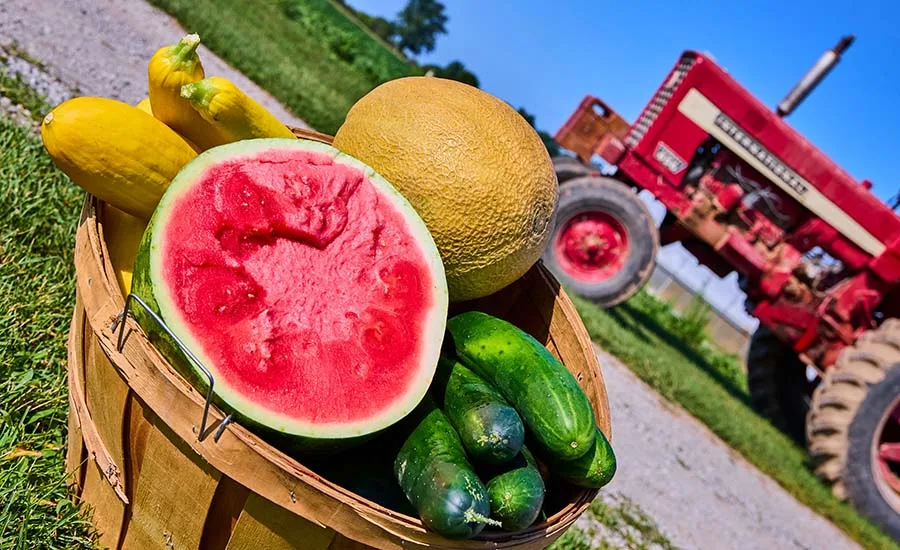
We make the conversion from raw agricultural commodities to food routinely and rarely think about it. I still smile when I remember my children eating cherry tomatoes straight from the backyard vine as a secret summer treat—an instant conversion to food. The berries they ate at the "U-Pic" farm before they were weighed were also converted at the moment of consumption. Now consider a cantaloupe from the grocery store. It may have been field-packed or packed in a packinghouse, but either way it must be prepared before it is ready to eat. The rind is not edible and may harbor pathogens, especially Salmonella. When the melon is cut, the edible flesh and even the kitchen can become contaminated unless the area is sanitized. Many people prepare cantaloupe at home without thinking about this hazard.
The same question applies in a store preparation area. The U.S. Department of Agriculture (USDA) has long noted that sanitizing treatments for cantaloupe are only marginally effective.1,2 Store preparation may be more convenient, but it is not necessarily safer. So, how should the conversion process for melons be controlled, and when should it begin? More broadly, what can we generalize about converting raw agricultural commodities into food?
The Argument for Starting Conversion Early
Although the answer may seem simplistic, we need to start at the beginning and maintain control at every step of the supply chain. Each step should produce something as clean as, or cleaner than, the step before it. Going backward is not acceptable. Once a potential hazard has been addressed, it should not be reintroduced through recontamination. A crop that remains uncontaminated during production should not become contaminated during harvest. Once the path toward becoming food begins, each subsequent step should keep a product moving in that direction.
Another reason to start the conversion to food as early as possible is that microbial contamination in fresh produce usually cannot be undone. In fresh produce, and especially in fresh-cut products, there is no kill step. Once contamination occurs, the risk remains. That reality forces growers and processors to rely on prevention from the outset. One could argue that the beginning comes even before a raw agricultural commodity exists. Soil amendments used to prepare the field must be suitable for food production, or the crop may become contaminated microbiologically or chemically. Likewise, an unsuitable site or neighboring hazards can make a crop unacceptable. The same care must continue throughout the supply chain.
The problem of "going backward" is especially important in the U.S. under the Federal Food, Drug, and Cosmetic Act (FD&C Act). If food becomes contaminated or is even potentially contaminated, it is considered adulterated. For that reason, allowing a product to move backward in its safety status is never in the best interest of the product or the business. In this context, "going backward" includes nearly any form of contamination or filth.
During production, outside factors can introduce hazards into agricultural commodities, and growers and processors work to minimize them to protect consumers. Although chemical residues can be a concern, this article focuses on microbial pathogens. Chemical residues are usually the result of human actions and are often prevented by avoiding the causative practice. Pathogens, by contrast, are harder to exclude because they are frequently tied to environmental conditions.
Looking for quick answers on food safety topics?
Try Ask FSM, our new smart AI search tool.
Ask FSM →
Food is expected to be safe. Any time something will be consumed, contamination should be avoided, and those efforts cannot start too early. However, correcting every unsafe handling practice is far beyond the scope of this short article. It does not address the "instantaneous" conversions associated with direct consumption or food handling in the home. Those issues are better addressed through improved Good Agricultural Practices (GAP) programs during production, which are beyond this discussion.
Instead, the focus here is on situations where process changes can solve previously difficult problems. These examples are closely tied to branded fresh-cut products, where branding makes safety responsibility and liability more visible. The topics below reflect new research that may create opportunities for continuous improvement, lead to new best practices, and move the conversion to food earlier in the process.
So far, I have offered a general answer to the question posed in the title. Before turning to research-based solutions that may suggest a better starting point, it is useful to establish the industrial context. Three background areas are especially relevant to fresh-cut processing, as explained below.
Three Truths for Fresh-Cut Produce
The "three truths" of fresh-cut processing are:
- Keep it cold
- Keep it clean
- Use good product.
When these truths are violated, problems follow. Many proposed remedies for such failures have proved to be little more than bandages. Early in the history of fresh-cut products, operations hoped to use culls and seconds, but that approach faded when the resulting quality could not justify the cost of prepared products. Today, a significant share of raw materials for fresh-cut operations is grown specifically for that purpose.
In the absence of a kill step, fresh-cut products will always contain low levels of less desirable bacteria, including both spoilage organisms and potential pathogens. When the three truths listed above are violated, those organisms can grow before the product reaches its expected shelf life. That is why temperature control remains critical throughout the supply chain.
The innovations discussed below do not change the need to follow these truths. They are already embedded in GAP programs, standard operating procedures (SOPs), and other quality and safety systems. Any new process must work within them rather than replace them.
Remember, Change Takes Time
Produce has long been prepared for market in ways that deliver quality and value, and those systems generally meet customer expectations. That history gave rise to packinghouses, field-packing operations, wash lines for removing dirt and soil, and preservative waxes and coatings for some commodities. Transportation systems have also evolved to supply many perishable items year-round. The produce marketplace is constantly changing, and the pace of change is accelerating.
The fresh-cut industry is a relatively new addition to this marketplace, and it introduces an important new dynamic: branded products and liability. Early fresh-cut processes evolved from familiar methods used to remove dirt and soil. They were designed around quality and the principle of "do no harm." For most of the last decade, wash system chemistry focused on preventing cross-contamination, and control systems have become strong enough to support that goal. Food safety innovations such as those discussed below are being developed now, but they may not be the final word. They may simply mark another milestone on the path to better processing. Research takes time to become accepted best practice, and integrating improvements into commercial systems takes time, as well.
The regulatory framework allows processors to maintain the quality of the water used to wash produce, and the control systems for this purpose are improving. Data systems are collecting more information to provide greater insight and control. Avoiding deviations will reduce the potential for problems.
Embracing Change
The need for change is often driven by new information. There is a familiar story about three generations of homemakers who cut the ends off their Sunday roasts before cooking. When asked why, each pointed to the previous generation's practice. Eventually, someone learned the original reason: the roasting pan had simply been too small. Nothing changed until someone questioned the practice.
Too often, processes continue by rote after the original rationale has been forgotten. Practices can persist long after the conditions that justified them have disappeared. Some legacy systems have accumulated multiple bandages over time, creating a costly and unnecessarily complex set of operations. The worst case is reusing an available legacy system for a new product simply because it already exists. None of these outcomes is desirable. Each can be improved by a willingness to embrace change, but improvement happens only when information provides clear direction.
Embracing change may mean reviewing an entire process from the ground up, or it may mean improving a process that already exists. Redesigning instead of adding yet another step can be expensive, but it can also deliver a large payoff. In practice, many legacy processes are only marginally effective and may benefit from a complete redesign based on current knowledge. In many cases, they are trusted simply because they have long been assumed to work. What is needed is evidence—either to validate these legacy processes or guide their redesign.
Safer Cantaloupe?
Returning to cantaloupe, this fruit has been linked to multiple outbreaks for decades. In 2025, FDA, the Centers for Disease Control and Prevention (CDC), and the Western Growers Association (WGA) convened a symposium on the many cantaloupe outbreaks.3 In that context, relying only on raw material specifications and supplier approvals becomes a "numbers game." If one buys enough melons, a problem is likely to be encountered eventually. Contaminated melons are present in the marketplace.
As noted earlier, melon rind is difficult to sanitize and can contaminate the edible flesh during cutting, especially in commercial operations that use automated peelers. Peeling is therefore not a mitigation step. This makes fresh-cut cantaloupe particularly challenging. Should processors assume that most melons are pathogen-free and proceed, or should they test and risk confirming contamination that makes the fruit unusable? Alternatively, should they cut the melon and then sanitize the pieces in a chlorine wash? Without better information, each of these choices is risky.
There are also clear benefits to keeping problems out of the plant, whenever possible. It is easier to contain a hazard than to mitigate it after it enters the process. For many fresh-cut products, the interior is nearly sterile before cutting, which makes exterior sanitation an important first step—even when it is difficult, as with cantaloupe. This same pattern will appear in the other examples.
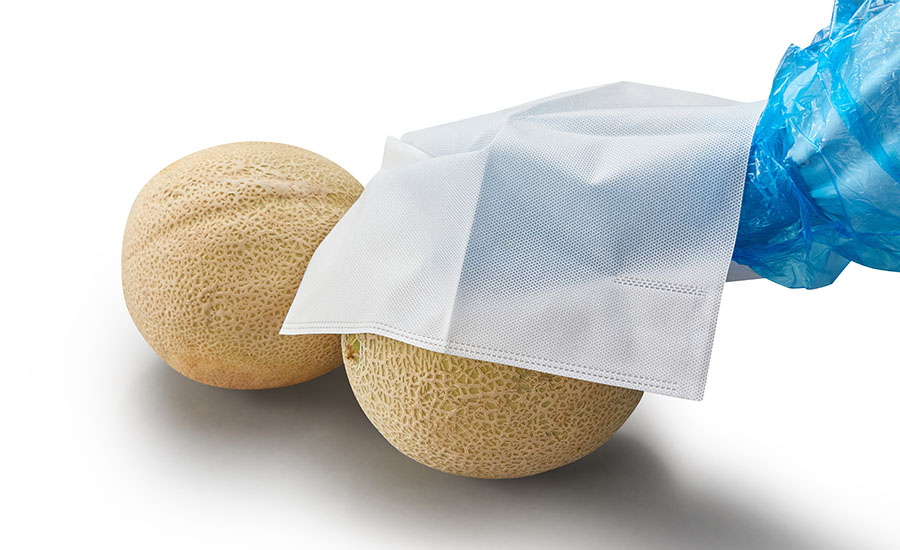
Recent research has shown that both surface contamination and internalization through blossom infection are potential risks.4 Because internalization remains largely intractable, this discussion focuses on surface contamination. The USDA bench-scale treatments with nisin and steam cited earlier1,2 performed better on netted rind than chemical sanitizers, but they did not achieve the desired risk reduction and were not considered scalable. Early in this work, and partly to avoid shipping melons to the laboratory, researchers applied cloth-based aggregated sampling (Figure 1) similar to methods used in the beef industry.5 Even with careful handling, simply peeling the melon produced only about a 1-log reduction in inoculated generic Escherichia coli, unless extraordinary efforts were used. An automated commercial peeler produced no reduction because of inherent cross-contamination. Pilot plant studies then led to a practical, proprietary, silver ion-based process that achieved about a 3-log reduction for inoculated generic E. coli and about a 1.5-log reduction for natural lactic acid bacteria (Figure 2).
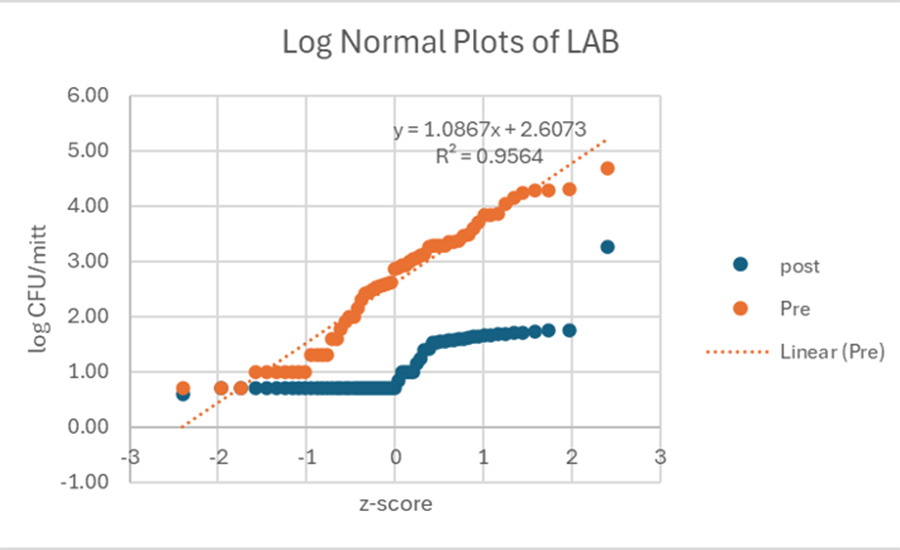
The first commercial unit based on this research was installed at a processor facility for validation. Natural lactic acid bacteria were used as the metric.6 This work shows the limits of judging process efficacy from only a few comparisons of natural populations. As expected, the data indicate a largely log-normal distribution of concentrations. The difference between pre- and post-process samples shows that the system is highly effective at reducing the more resistant lactic acid bacteria at commercial scale. The processor plans to install this mitigation at additional facilities. Other processors may wish to consider whether this approach could reduce risk in their cantaloupe operations. If surface contamination never enters the fresh-cut fruit preparation area, then it cannot contaminate the food.
Processing Cleaner Onions
The preparation of slivered and diced onions presents another opportunity to revise the process through pretreatment. Plant hygiene has long been challenged by the fines generated from the tunic, or outer layers, during peeling. Commercial onion peelers use compressed air to remove these layers, which inherently creates dust and fines. A survey of multiple lots using cloth-based aggregated sampling confirmed low levels of Listeria on onion surfaces.7
Dried onions have also been in the news because of outbreaks. Internal contamination is usually linked to poor agricultural practices such as flooding or overirrigation with contaminated water, and that issue will not be addressed further here. Surface contamination, however, appears to be an intermittent problem even when good practices are followed. Normal drying is often sufficient, but not always. When onions are processed into fresh-cut products such as diced or slivered onions, temperature abuse can increase the risk. Surface mitigation is therefore desirable for both plant hygiene and risk reduction.
For onions, the surface is somewhat ambiguous. The tunic may consist of several layers, which makes mitigation difficult. Removing those layers without contaminating the edible portion is not commercially viable. Commercial peelers are messy, spread peel fragments, and can also spread contamination. The process can cross-contaminate the edible portion and provide no meaningful reduction in microbial load. Here again, a preemptive treatment was developed in a pilot plant and then commercialized to reduce contamination and simplify the conversion of an agricultural commodity into food.
Experimentally, it was determined that a 15–30 second dip in 6–7 percent lactic acid held for 2 hours provided a >3-log reduction for inoculated E. coli. Spray treatments were found to be ineffective because they could not penetrate the multiple layers of the tunic. These results were validated in a commercial operation with an observed almost 4-log reduction in total coliforms, as illustrated in Figure 3. Additional pilot plant research indicates that this lactic acid process was highly effective again for E. coli O157.8
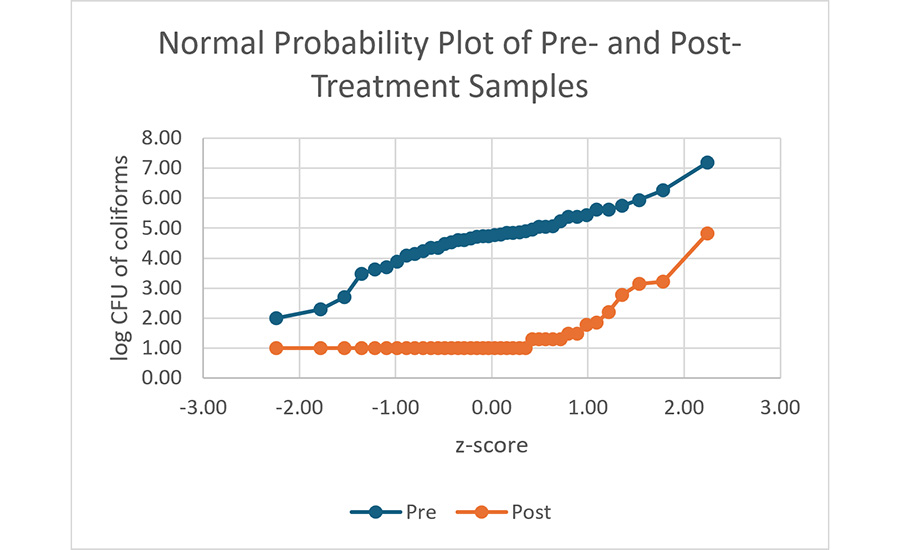
The process has yielded the expected plant and product hygiene benefits. Work continues to install a similar process at other locations. However, there is a new wrinkle. Peeled whole onions are also a fungible commodity that can be processed to produce diced and slivered onions. In this case, the edible portion has already been potentially contaminated. This lactic acid process is no longer appropriate.
To conclude, consider four additional commodities with a similar problem: tomatoes, cucumbers, peaches, and bell peppers. All can have surface contamination, and all have some potential for internalization, which remains largely intractable at present. These commodities are also commonly waxed early in distribution to reduce moisture loss and control mold growth. That wax layer can shield microbial contamination from any later mitigation step. Because all four are used in fresh-cut operations, this protected contamination becomes a source of risk. If contamination is known to occur, then the conversion to food has either begun too late or been handled imperfectly.
A 'No Wax' Proposal
In experimental work, lots of unwaxed tomatoes, cucumbers, bell peppers, and peaches were sourced and treated with a silver ion system similar to the one used for cantaloupe, with promising results. In normal commerce, however, these commodities are waxed to prevent mold and dehydration. Once waxing has occurred, the silver ion treatment is no longer useful. The question now is whether suppliers are willing to modify their wash process before waxing, or whether a close supplier relationship could be developed to source unwaxed raw material. Again, the challenge is starting early enough. Continuing to source and cut waxed product may mean accepting an unknown level of risk without a practical mitigation plan. These products are marketed as food, but they have also been subject to recalls. How will the industry gain the information needed to make decisions about these changes?
The produce industry remains under pressure to move the "high-care" area closer to production and to increase sampling size and frequency; however, it will never be possible to prove that a lot is safe simply by testing it. It is impossible to prove the absence of contamination through sampling alone. Test-and-release is a doomed strategy. The better path is to test and validate systems, and then improve the process itself.
References
- Ukuku, D.O. and W.F. Fett. "Effectiveness of Chlorine and Nisin-EDTA Treatments of Whole Melons and Fresh-Cut Pieces for Reducing Native Microflora and Extending Shelf Life." Journal of Food Safety 22 (August 2002): 231–353. https://www.ars.usda.gov/research/publications/publication/?seqNo115=135083.
- Ukuku D.O., D.J. Geveke, L. Chau, and B.A. Niemira. "Microbial Safety and Overall Quality of Cantaloupe Fresh-Cut Pieces Prepared From Whole Fruit After Wet Steam Treatment." International Journal of Food Microbiology 16 (2016): 86–92. https://pubmed.ncbi.nlm.nih.gov/27240141/.
- Assar, S., K. Marshall, and S. Sales. "Outbreaks Linked to Cantaloupe: Improving Food Safety and Protecting Public Health." Presented at 2025 International Association for Food Protection (IAFP) Annual Meeting, Cleveland, Ohio.
- Burris, K., S. Scott, C.M. Ferreira, et al. "Cantaloupe Fruit Colonization via the Blossom Route Exhibits a Dose-Response Pattern at Very Low Levels of Initial Challenge." Presented at the 2026 International Association for Food Protection (IAFP) Annual Meeting, July 2026, New Orleans, Louisiana.
- Wilhelmsen, E., C. McGinnis, and J. Brennan. "Developing, Optimizing, and Commercializing a Silver Ion-Based Wash Process for Whole Cantaloupe Using a Cloth-Based Aggregated Sampling Tool." Poster P2-122. Presented at the 2026 IAFP Annual Meeting, July 2026, New Orleans, Louisiana.
- Zhang, R. "Microbial Analysis of Cantaloupe Surfaces Using Culture and Metagenomic Methods." Poster presented at the 2024 IAFP Annual Meeting, July 2024, Long Beach, California. https://microtally.com/wp-content/uploads/2024/08/Richard-IAFP-Poster-2024.pdf.
- Wilhelmsen, E. Unpublished results.
- Gutierrez Rodriguez, E., V. Santillan Oleas, A. de Lorenzi, E. Martinez Analuisa, and E. Wilhelmsen. "Evaluation of the Inactivation Capacity of Lactic Acid Against E. coli O157:H7 on Whole Unpeeled Yellow Onions." Presented at the 2026 IAFP Annual Meeting, July 2026, New Orleans, Louisiana.