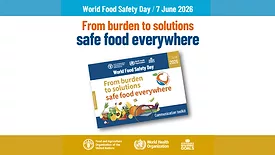
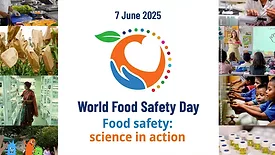
Following the release of WHO’s new foodborne disease burden estimates and relating to the 2026 World Food Safety Day theme, “From Burden to Solutions—Safe Food Everywhere,” FAO and WHO are highlighting how Codex Alimentarius standards and related work help prevent foodborne disease.
Recognizing World Food Safety Day (WFSD) 2026 and the new estimates on the global burden of foodborne disease, WHO’s Elaine Borghi, Ph.D. discusses the development of the estimates and how they can be used to drive effective interventions that meaningfully improve food safety and public health.
In this episode of Food Safety Matters, we speak to WHO’s Dr. Elaine Borghi about the new global foodborne disease burden estimates, updates to the methodology, key insights from the data, and the importance of using data to target food safety interventions, aligning with the WFSD theme “From Burden to Solutions—Safe Food Everywhere.”
Ahead of World Food Safety Day, FAO and WHO have introduced a Food Safety Roadmap Development Tool and an online learning course on Codex-aligned risk assessments, supporting competent authorities and other stakeholders seeking to utilize science and data to improve national food safety systems.
The theme, “From Burden to Solutions—Safe Food Everywhere,” stresses the role of evidence-based action, promoting the forthcoming updated WHO global foodborne disease estimates as a data source to inform targeted food safety and public health interventions.
As part of the educational campaign, the New York State Department of Agriculture and Markets (AGM) has been releasing a series of social media posts this week to showcase the work conducted by department staff to ensure the state’s food supply is safe.
Science plays a fundamental role in food safety risk assessment. This special World Food Safety Day article examines the complementary role of "art," encapsulated by human skills and execution, in ensuring food safety.
Industry-leading resource developed with Cornell University’s College of Agriculture and Life Sciences (CALS) and 20+ global experts provides a framework for building and enhancing environmental monitoring programs.
When combined with ozone, nanobubbles become a powerful cleaning and sanitation tool, avoiding residues and complex handling, which are common with traditional chemicals.
FAO Senior Food Safety Officer Markus Lipp and FAO Director General Qu Dongyu both delivered recent messages emphasizing the fundamental role that science plays in achieving food safety goals around the globe.