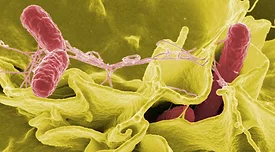
A study led by scientists at the University of Birmingham has found that one multidrug-resistant (MDR) strain of Escherichia coli—MDR ST131—has the ability to outcompete other strains of E. coli in a healthy gut.
A recent U.S.-based study analyzing the risk of multidrug-resistant (MDR) foodborne pathogen contamination of retail meats associated with the processor region of origin and shipping distance to the final destination suggests that increased distance is linked to increased MDR bacterial contamination.
During World Antimicrobial Awareness Week (November 18–24), the U.S. Department of Agriculture (USDA) released its USDA Strategy to Address Antimicrobial Resistance (AMR) 2023.
According to recent research from the U.S. Centers for Disease Control and Prevention (CDC), infections caused by Salmonella with antimicrobial resistance (AMR) only to clinically important antibiotics were not associated with poorer outcomes, suggesting that factors other than treatment failure may be important.
Penn State University (PSU) scientists have received a $1 million grant from the U.S. Department of Agriculture (USDA) to assess the level of antimicrobial resistance (AMR) among foodborne bacteria in Puerto Rico's dairy industry and to train farmers and students on AMR mitigation.
Matvælastofnun, known as the Icelandic Food and Veterinary Authority in English, recently published a report on the country’s antibiotic use for animals and antimicrobial resistance (AMR) of bacteria in animals and food during 2022.
A recent study aiming to investigate the usefulness of publicly available whole genome sequencing (WGS) data for Salmonella surveillance has provided an overview of antimicrobial resistance (AMR) among different serovars and defined the most common antibiotic resistance genes.
The U.S. Department of Agriculture (USDA) has awarded $2.48 million in grants to the University of Nebraska-Lincoln (UNL) for research that aims to improve food safety and animal health in swine production.
Using whole genome sequencing (WGS), a recent study led by Michigan State University (MSU) has demonstrated widespread antimicrobial resistance (AMR) among foodborne Campylobacter jejuni in the state, and the ability to trace the origins of specific strains.
The use of artificial intelligence (AI) tools like big data and machine learning for antimicrobial resistance (AMR) surveillance in livestock production shows promise for informing AMR mitigation efforts, according to a recent study led by University of Nottingham researchers.