Food Safety
search
Ask Food Safety AI
cart
facebook twitter linkedin instagram youtube
  • Sign In
  • Create Account
  • Sign Out
  • My Account
Food Safety
  • NEWS
    • Latest News
    • Sponsored Insights
    • Sponsored White Papers
  • PRODUCTS
  • TOPICS
    • Contamination Control
    • Food Types
    • Management
    • Process Control
    • Regulatory
    • Sanitation
    • Supply Chain
    • Testing and Analysis
  • PODCAST
  • EXCLUSIVES
    • Food Safety Five Newsreel
    • eBooks
    • FSM Distinguished Service Award
    • Interactive Product Spotlights
    • Videos
  • MORE
    • BUYER'S GUIDE
    • NEWSLETTERS >
      • Archive Issues
      • Subscribe to eNews
    • Store
    • ASK FSM AI
  • WEBINARS
  • FOOD SAFETY SUMMIT
  • FSM FEATURES
    • FSM Features Collection
    • eMag Archives
    • Editorial Advisory Board
    • Contact
    • Advertise
  • SIGN UP!

Blue Star Foods introduces scan on demand, QR code traceability app for seafood

In seconds, the consumer scans the QR code, and that product's detail is displayed.
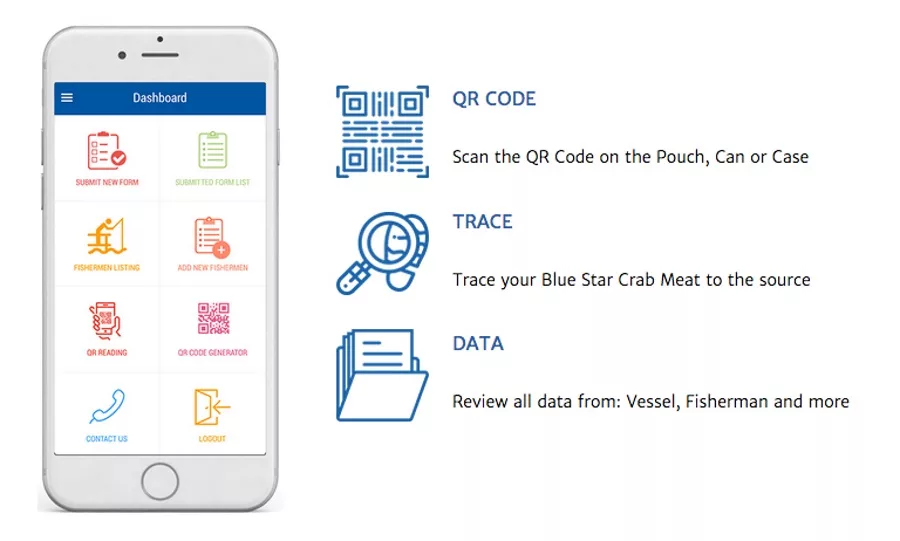
Blue Star Foods QC traceability
March 6, 2018

Blue Star Foods, Doral, Fla., introduced what is dubbed as the first-ever “scan on demand” QR code-enabled verifiable traceability application for seafood.

“We developed this application as an improvement fishery project for our core business and to guarantee the longevity of the Blue Swimming Crab Species,” says John Keeler, chief executive officer and chief scientific officer. “With the help of partners such as Wilderness Markets to design the system and our efforts to implement the system in the field, the pilot has validated our hypothesis. We can see a direct correlation to improper fishing practices within Blue Swimming Crab and how it impacts the supply chain and the economics related to the harvesting and sales of Blue Swimming Crab. We have a clear picture of both negative and positive practices. Additionally, due to the design of the system, we can move our system as needed to any country of harvest and point of processing. Harvesting vessels are provided with a GPS tracking unit that records each vessel’s activities from departure port to return and to the point of processing. Testing in other wild-caught, farmed and aquaculture scenarios are extremely promising.”

“Millennials want to know where their seafood is from, how it is caught, reared and farmed. What are the social, economic and environmental impacts of consuming any species? Our application helps maintain the Blue Swimming Crab species by capturing all relevant harvest and yield data,” adds Keeler. “In seconds, the consumer scans the QR code, and that product's detail is displayed. Learning from data, connected with API’s, all actions recorded. From actual data, we learn how the Blue Swimming Crab species is affected by the harvesting techniques and lack of regulatory enforcement. Our app is improving our fishing practices, one pound of Blue Swimming Crab meat at a time.”

Blue Star’s QR code-enabled Eco-Fresh Pouch provides verifiable traceability in “green” retail-ready packaging.

Looking for quick answers on food safety topics?
Try Ask FSM, our new smart AI search tool.
Ask FSM →


This article was originally posted on www.refrigeratedfrozenfood.com.
KEYWORDS: frozen seafood QR codes sustainable seafood traceability

Share This Story

Recommended Content

JOIN TODAY
to unlock your recommendations.

Already have an account? Sign In

  • people holding baby chicks

    Serovar Differences Matter: Utility of Deep Serotyping in Broiler Production and Processing

    This article discusses the significance of Salmonella in...
    Meat/Poultry
    By: Nikki Shariat Ph.D.
  • woman washing hands

    Building a Culture of Hygiene in the Food Processing Plant

    Everyone entering a food processing facility needs to...
    Food Prep/Handling
    By: Richard F. Stier, M.S.
  • graphical representation of earth over dirt

    Climate Change and Emerging Risks to Food Safety: Building Climate Resilience

    This article examines the multifaceted threats to food...
    Management
    By: Maria Cristina Tirado Ph.D., D.V.M. and Shamini Albert Raj M.A.
Manage My Account
  • eMagazine Subscription
  • Subscribe to Newsletters
  • Manage My Preferences
  • Website Registration
  • Subscription Customer Service

More Videos

Sponsored Content

Sponsored Content is a special paid section where industry companies provide high quality, objective, non-commercial content around topics of interest to the Food Safety Magazine audience. All Sponsored Content is supplied by the advertising company and any opinions expressed in this article are those of the author and not necessarily reflect the views of Food Safety Magazine or its parent company, BNP Media. Interested in participating in our Sponsored Content section? Contact your local rep!

close
  • Top view portrait of two factory workers standing by conveyor belt during quality inspection at food production, copy space
    Sponsored byFlexXray

    Foreign Material By the Numbers: What the 2026 Benchmark Report Reveals

  • a conveyorized industrial metal detector system that appears to resemble a Loma Systems IQ4 Metal Detector setup with an integrated conveyor belt and control panel for food or package inspection.
    Sponsored byMettler Toledo

    Beyond Detection: How to Avoid Physical Contamination in Food Through a Smarter Inspection Strategy

  • The image displays a bottling plant production line, commonly used in the beverage industry for filling and packaging soft drinks.
    Sponsored byBIOIONIX

    Sustainability with ROI: A Beverage Producer Case Study in Water Savings

Popular Stories

Dr. Heidi Overton speaking at Senate hearing

In Senate Hearing, FDA Commissioner Nominee Says Lack of Resources Will Challenge GRAS Reform

rangpur lime

Pathogens Found on Brazilian Citrus Fruit Present Emerging Food Safety Concerns

lightbulb on a plate next to fork and knife representing food innovation ideas

EFSA Outlines Scientific Needs for Regulatory Preparedness, Risk Assessment

allergens ebook

Events

October 6, 2026

Advances in Environmental Monitoring Science and Strategy

Live: October 6, 2026 at 2:00 pm EDT: This webinar will cover how environmental monitoring science and EMP strategies support sanitation verification and the safe production of food.

October 15, 2026

How to Prevent Physical Contamination in Food Production and Strengthen Compliance

Live: October 15, 2026 at 2:00 pm EDT: Attend this webinar to gain insight into how product inspection helps protect your brand, reduce recall risk, and support compliance.

October 29, 2026

FDA Proposes Major GRAS Reform: What It Could Mean for Your Business

Live: October 29, 2026 at 2:00 pm EDT: Attend this webinar to examine potential implications for self-GRAS, Flavor and Extract Manufacturers Association (FEMA) GRAS, and food-contact substances.

View All

Products

Global Food Safety Microbial Interventions and Molecular Advancements

Global Food Safety Microbial Interventions and Molecular Advancements

See More Products

Related Articles

  • cooked prawn plated with lime slices

    FSANZ Announces Changes to Food Standards Code; Provides New Guidance for Seafood, Cell-Cultured Sectors

    See More
  • repositrak

    ReposiTrak to Host Traceability Webinar for Seafood Suppliers

    See More
  • raw squid

    Emerging Foodborne Pathogen Arcobacter a Concern for Seafood, RTE Foods

    See More

Related Products

See More Products
  • food-safety-making.jpg

    Food Safety: Making Foods Safe and Free From Pathogens

  • 1118396308.jpg

    High Throughput Analysis for Food Safety

  • 1119160553.jpg

    Food Safety: Innovative Analytical Tools for Safety Assessment

See More Products

Events

View AllSubmit An Event
  • May 12, 2026

    Leveraging AI for Food Safety: From Strategy to Impact

    On Demand: This dynamic workshop brings together leaders from industry, academia, and government to demonstrate how AI can be practically applied in food safety—from data strategy to daily execution.
View AllSubmit An Event

Related Directories

  • NorthStar Automation

    The NorthStar WMS utilizing barcode scanning provides functionality for the food industry: 1.) Full traceability 2.) Lot control 3.) Allergen control 4.) Mock recall 5.) 60+ reports and KPIs 6.) FIFO, FEFO
  • Aqua Star

    Aqua Star is a privately-owned seafood company headquartered in Seattle. Since 1990 we have harvested and sourced premium seafood from fishermen and farms we know and trust. Our employees are experts in sourcing, processing, product development, marketing and sales. We operate in 17 countries across the globe to source and process the finest products possible and ensure quality and transparency for all of our seafood.
×

Never miss the latest news and trends driving the food safety industry

Newsletters | Website | FSM Features Collection

JOIN TODAY!
  • RESOURCES
    • Advertise
    • Contact Us
    • Directories
    • Store
    • Want More
  • SIGN UP TODAY
    • Create Account
    • eMagazine
    • Newsletters
    • Customer Service
    • Manage Preferences
  • SERVICES
    • Marketing Services
    • Reprints
    • Market Research
    • List Rental
    • Survey/Respondent Access
  • STAY CONNECTED
    • LinkedIn
    • Facebook
    • Instagram
    • X (Twitter)
  • PRIVACY
    • PRIVACY POLICY
    • TERMS & CONDITIONS
    • DO NOT SELL MY PERSONAL INFORMATION
    • PRIVACY REQUEST
    • ACCESSIBILITY

Copyright ©2026. All Rights Reserved BNP Media, Inc. and BNP Media II, LLC.

Design, CMS, Hosting & Web Development :: ePublishing