The AI Transformation in Food Production: Is Your Facility Prepared?

Need to Know
- AI can support food safety and defect detection, predictive maintenance, yield and supply chain optimization, and preservation of institutional knowledge
- Manufacturers can start with clearly defined, high-impact operational problems, rather than attempting broad AI deployment all at once
- AI applications affecting food safety, quality, or compliance require appropriate validation, documentation, explainability, governance, and human oversight
From strengthening contamination oversight to preserving institutional knowledge, artificial intelligence (AI) offers new tools for addressing persistent challenges in food production. However, realizing these benefits requires manufacturers to establish a robust digital and data foundation.
The food industry faces numerous pressures, including narrow profit margins, evolving food safety requirements, supply chain volatility, and high employee turnover. At the same time, a single recall or food safety incident can cause significant financial and reputational damage.
Against this backdrop, manufacturers are exploring AI applications across production and supply chain operations. Yet there remains a gap between technological potential and results on the factory floor. Successful AI implementation requires more than purchasing software; manufacturers must identify specific operational problems and build the data infrastructure needed to support AI applications.
Critical Pillars of AI-Driven Food Manufacturing
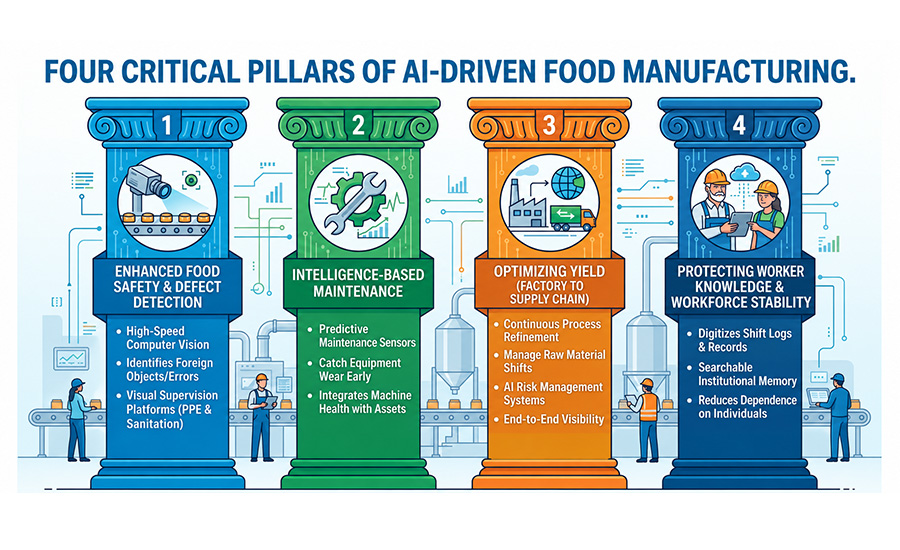
AI applications are emerging across food production, with opportunities to support both food safety and operational efficiency. Four key areas (Figure 1) include:
- Enhanced food safety and defect detection
- AI-enabled predictive maintenance
- Yield and supply chain optimization
- Protection of institutional knowledge and workforce stability
Enhanced Food Safety and Defect Detection
Food safety and quality inspection are important areas of AI application. Computer vision, X-ray, spectral imaging, and other sensor-based systems can inspect products at production-line speeds. Reported performance varies by technology and application; for example, some foreign-object X-ray and laser systems have achieved detection accuracy exceeding 95 percent.1
AI-enabled visual monitoring can also be applied to facility operations. Cloud-based computer vision platforms, for example, can be used to monitor activities such as personal protective equipment (PPE) compliance.2
Beyond inspection, machine learning can analyze process data to identify changes or patterns that could indicate emerging operational problems. During a recall or traceback investigation, AI-enabled data analysis can also help manufacturers more rapidly identify potentially affected lots, ingredients, suppliers, and distribution pathways.
Looking for quick answers on food safety topics?
Try Ask FSM, our new smart AI search tool.
Ask FSM →
Such capabilities may become increasingly valuable as industry prepares for FDA's Food Traceability Rule, established pursuant to Section 204 of the Food Safety Modernization Act (FSMA). The original compliance date was January 20, 2026. FDA subsequently proposed extending that date by 30 months to July 20, 2028.3 The additional implementation time provides covered entities with an opportunity to evaluate and improve their supply chain data and traceability systems.
AI-Enabled Predictive Maintenance
Within food production, unexpected equipment downtime can contribute to waste, production delays, and depending on the process, temperature-control and other food safety concerns. Predictive maintenance uses equipment and sensor data to identify changes that may indicate developing equipment problems. Specialized software, often integrated with enterprise resource planning (ERP) or asset-management systems, can connect equipment-condition data with maintenance activities, allowing teams to intervene before some failures occur.
Across industrial manufacturing, unplanned downtime has been estimated to cost approximately $50 billion annually, with equipment failure accounting for 42 percent of interruptions.4 Although these figures are not specific to food manufacturing, they illustrate the broader operational significance of equipment reliability.
The benefits of predictive maintenance also depend on the equipment, failure mode, available data, and implementation. McKinsey has cautioned that advanced predictive techniques are practical for only a subset of maintenance applications and should not be treated as a universal solution. Based on the firm's observations of digital maintenance and reliability transformations in heavy industries, companies have the potential to increase asset availability by 5–15 percent and reduce maintenance costs by 18–25 percent.5
For food manufacturers, maintaining reliable equipment is only one part of improving production performance. The amount of usable product produced from available raw materials also affects efficiency, food loss, and profitability.
Optimizing Yield and Supply Chain Performance
On the factory floor, raw materials can vary in characteristics such as quality, grade, composition, and potency. Equipment settings and process conditions can also affect the amount of usable finished product produced from available inputs. Integrated production data can help manufacturers better understand how these variables interact and identify opportunities to improve yield.
The opportunity exists within a broader global food-loss challenge. An estimated 13.2 percent of food is lost after harvest and before reaching the retail stage, including losses occurring during transportation, storage, wholesale, and processing.6 Although this figure encompasses losses beyond manufacturers' direct control and should not be interpreted as a measure of processing inefficiency, it underscores the broader opportunity to reduce food loss throughout production and supply chains.
By bringing together information from ERP, manufacturing execution systems (MES), laboratory systems, scales, sensors, and other sources, manufacturers can provide AI and machine-learning models with the contextual data needed to identify patterns affecting yield.7 Such applications can support process optimization by identifying relationships among raw material characteristics, operating conditions, equipment behavior, and production outcomes.
Beyond the plant, AI can also support supply chain forecasting, planning, inventory management, risk management, and decision-making.8 However, these applications depend on reliable data and infrastructure and on the ability to integrate information across otherwise fragmented systems.
Protecting Institutional Knowledge and Workforce Stability
Employee turnover can also create operational challenges when experienced personnel leave with knowledge accumulated through years of troubleshooting equipment, processes, and unusual operating conditions.
Digitizing shift logs, maintenance records, standard operating procedures, troubleshooting information, and employee experience can help preserve this institutional knowledge. Research into AI-supported knowledge management has highlighted both the potential value and the difficulty of capturing tacit knowledge held by experienced employees.9
Once information has been documented and structured, AI-enabled search and knowledge-management tools can make it easier for employees to retrieve relevant operational knowledge. Rather than replacing experienced personnel, these systems can provide another means of preserving and transferring knowledge across teams and generations of workers.10
The Blueprint for AI Readiness
Successful AI implementation depends on preparation. For food manufacturers considering AI applications, four areas warrant particular attention (Figure 2).
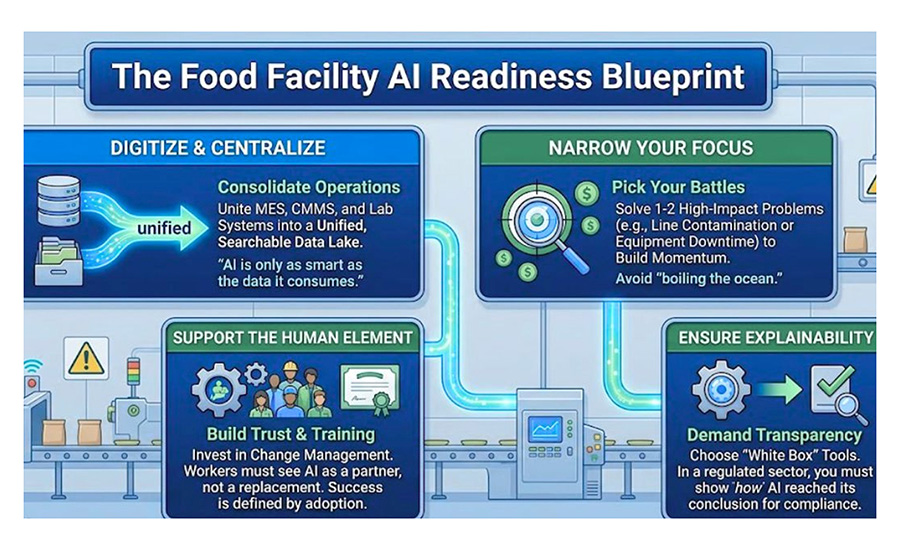
Digitize and centralize operational data. AI systems depend on the quality, availability, and context of the data they consume. Manufacturers should evaluate how information from systems such as MES, computerized maintenance management systems (CMMS), laboratory systems, ERP platforms, sensors, and other sources can be organized and made accessible for analysis. Establishing a robust data backbone is a fundamental step in supporting advanced analytics and machine-learning applications.5
Start with clearly defined problems. Rather than attempting to automate numerous processes at once, manufacturers can begin by identifying one or two high-impact operational problems for which appropriate data are available. Focused applications provide an opportunity to assess performance, refine data and workflows, and establish internal experience before expanding AI use.
Prepare and involve the workforce. Technology implementation also depends on the people who use it. Training, change management, and employee participation can help workers understand the purpose and limitations of AI tools and how those tools fit into existing food safety, quality, maintenance, and operational responsibilities. Human expertise remains particularly important when AI is being used to support decisions with safety or compliance implications.
Establish AI governance and appropriate explainability. Manufacturers should also consider how AI systems will be evaluated, monitored, documented, and governed throughout their lifecycle. The National Institute of Standards and Technology (NIST) AI Risk Management Framework provides a voluntary framework for incorporating trustworthiness considerations into the design, development, use, and evaluation of AI systems.11
For AI applications affecting food safety, quality, or compliance decisions, manufacturers should prioritize appropriate transparency, validation, documentation, traceability, and human oversight. In a regulated sector, it is essential to be able to show how an AI reached a conclusion, which makes choosing "white box" tools (e.g., systems where the logic is transparent, rather than a "black box" of hidden algorithms) that support audit and compliance needs an absolute necessity. Explainable AI techniques can provide insight into the factors influencing model outputs, although the appropriate level and method of explainability will depend on the system, its intended use, and associated risks.12
For manufacturers preparing to adopt AI, treating operational data as a strategic asset and beginning with clearly defined, high-impact applications can provide a practical foundation for broader implementation. AI alone cannot resolve the complex food safety and operational challenges facing food manufacturers, but facilities with reliable data, appropriate infrastructure, defined governance, and an engaged workforce will be better positioned to evaluate where these technologies can provide meaningful value.
References
- Chen, Z., G. Zhang, and F. Zhang. "Multimodal AI for Real-Time Food Safety and Quality: From Sensors to Foundation Models, Edge Deployment, and Regulation." Food Science & Nutrition 14, no. 2 (February 2026). https://onlinelibrary.wiley.com/doi/10.1002/fsn3.71534.
- Messer, R. "The End of the Server Room: What Happens When Your Cameras Start." Forbes. May 20, 2026. https://www.forbes.com/councils/forbestechcouncil/2026/05/20/the-end-of-the-server-room-what-happens-when-your-cameras-start/.
- U.S. Food and Drug Administration (FDA). FSMA Final Rule on Requirements for Additional Traceability Records for Certain Foods. https://www.fda.gov/food/food-safety-modernization-act-fsma/fsma-final-rule-requirements-additional-traceability-records-certain-foods.
- Garibian, E. "How Predictive Maintenance Supports Resilient Manufacturing." Forbes. June 25, 2025. https://www.forbes.com/councils/forbestechcouncil/2025/06/25/how-predictive-maintenance-supports-resilient-manufacturing/.
- Bradbury, S., B. Carpizo, M. Gentzel, D. Horah, and J. Thibert. "Digitally Enabled Reliability: Beyond Predictive Maintenance." McKinsey & Company, October 4, 2018. https://www.mckinsey.com/capabilities/operations/our-insights/digitally-enabled-reliability-beyond-predictive-maintenance.
- Food and Agriculture Organization of the United Nations (FAO). "Food Loss and Food Waste." FAO Policy Support and Governance Gateway. https://www.fao.org/policy-support/policy-themes/food-loss-and-food-waste/en.
- Koks, M. "How AI Can Optimize Yield in Food and Beverage Manufacturing." Infor. May 28, 2026. https://www.infor.com/blog/ai-optimize-yield-food-beverage-manufacturing
- Cohen, M.C., T. Dai, G. Perakis, et al. "OM Forum—Supply Chain Management in the AI Era: A Vision Statement from the Operations Management Community." Manufacturing & Service Operations Management 28, no. 3 (March 2026). https://pubsonline.informs.org/doi/10.1287/msom.2025.1065.
- Müller-Czygan, G. and V. Tarasyuk. "Filling Data Gaps with Operational and Experiential Knowledge from Employees—Opportunities and Challenges for AI-Based Solutions." In Industry 4.0—Transforming the Future Beyond Manufacturing, Volume 2: Human-Centred, Organizational and Societal Transformations. IntechOpen, March 2026. https://www.intechopen.com/books/1005745.
- Eschbach, A. "AI Is Reshaping Food Manufacturing: Is Your Factory Ready?" Forbes. September 3, 2026. https://www.forbes.com/councils/forbestechcouncil/2026/09/03/ai-is-reshaping-food-manufacturing-is-your-factory-ready.
- National Institute of Standards and Technology (NIST). Artificial Intelligence Risk Management Framework (AI RMF 1.0). January 2023. https://www.nist.gov/itl/ai-risk-management-framework.
- Arrighi, L., I.A. de Moraes, M. Zullich, M. Simonato, D.F. Barbin, and S. Barbon Junior. "Explainable Artificial Intelligence Techniques for Interpretation of Food Models: A Review." Artificial Intelligence Review 59, no. 7 (April 2026). https://link.springer.com/article/10.1007/s10462-026-11553-2.