AFDO North Central Region to host meeting during summit
February 11, 2019
The Food Safety Summit has announced eight certificate/certification classes to be offered at the 21st annual Conference & Expo taking place May 6-9, 2019 at the Donald E. Stephens Convention Center in Rosemont, Illinois.
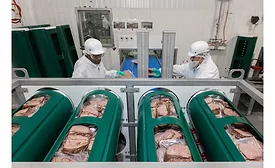
Food Safety Strategies was recently able to talk to K. Joseph Swanson, vice president of operations, West Liberty Foods, about high-pressure processing (HPP) technology, and how it has changed over the years.
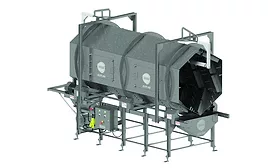
Being the weakest link in any organization or supply chain is not an award one should strive for. But the axiom “a team, organization or process is only as good as its weakest link” is true, as is the processes of food safety and sanitation are only as good as the weakest links. These links can be categorized into objective (mechanical) and subjective (human) areas. So how can the weakest links in the sanitary food supply chain be identified and continually improved?
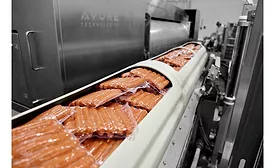
Meat products have been one of the main drivers of high pressure processing (HPP) technology in the last few years, spurred on by the need for improved food safety and demand for fresh, clean, ready-to-eat (RTE) foods.
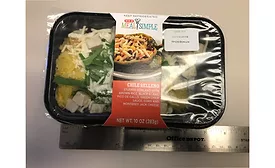
Taylor Farms TX, Inc., a Dallas, Texas establishment, is recalling approximately 2,100 pounds of chicken products incorrectly labeled as “Chile Relleno” products due to misbranding and undeclared allergens, the U.S. Department of Agriculture’s Food Safety and Inspection Service (FSIS) announced.
Pilgrim’s Pride Corporation, a Mt. Pleasant, Texas establishment, is recalling approximately 58,020 pounds of not-ready-to-eat (NRTE) breaded chicken products that may be contaminated with extraneous materials, specifically rubber, the U.S. Department of Agriculture’s Food Safety and Inspection Service (FSIS) announced today.
 RSS
RSS