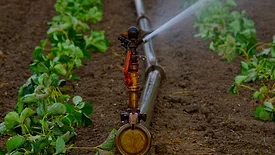
Researchers at the University of Georgia’s College of Agricultural and Environmental Sciences are researching a sunlight-based method for controlling microbial contaminants—specifically, Salmonella and Escherichia coli—in irrigation water used for food crops. After enough research is conducted, the UGA team hopes to create an app that will help growers enhance food safety.
Two reports by the National Advisory Committee on Microbiological Criteria for Foods (NACMCF) have advised the U.S. Food and Drug Administration (FDA) and the U.S. Department of Agriculture’s Food Safety and Inspection Service (USDA’s FSIS) on microbial testing of ready-to-eat (RTE) foods and the safety of recycled water in food production, respectively.
As the intended enforcement discretion period for the Food Safety Modernization Act (FSMA) Agricultural Water Proposed Rule will come to an end on January 26, 2022, the U.S. Food and Drug Administration (FDA) has released a fact sheet to help prepare growers.
The U.S. Food and Drug Administration (FDA) has worked with the U.S. Environmental Protection Agency (EPA) to update the protocol for the development and registration of antimicrobial treatments for preharvest agricultural water, removing Listeria monocytogenes from the organism test panel.
In this episode of Food Safety Matters, we review the top food safety stories of 2022 and their impacts, the lessons learned, and what the future may hold in 2023 and beyond. Specifically, we discuss COVID-19 and the supply chain, FDA’s Agricultural Water Proposed Rule, food safety culture, the infant formula crisis, USDA-FSIS’ proposed regulatory framework for reducing Salmonella in poultry, the FSMA Food Traceability Final Rule, and the Reagan-Udall Foundation’s review of FDA’s Human Foods Program.
The U.S. Food and Drug Administration released a draft guidance that outlines a risk assessment approach to evaluate the microbial food safety risk of antimicrobial resistance (AMR) posed by new antimicrobial animal drugs. The draft guidance is open for comment.
To help growers mitigate food safety risks posed by wild birds, an ongoing study funded by the Center for Produce Safety is examining the prevalence of different species in agriculture and whether they carry and transmit foodborne pathogens.
Researchers from the U.S. Department of Agriculture’s Agricultural Research Service are using a bioplastic coating to naturally shield seeds from Aspergillus, a type of fungi that produces aflatoxin. Exposure to aflatoxins is a food safety issue due to the compound’s carcinogenic and other harmful effects.
The Allergen Bureau has launched its new “Assessing Agricultural Cross-Contact 2022” guide, which aims to assist agrifood businesses in mitigating allergen cross-contamination.