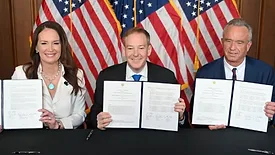
Although EPA Administrator Lee Zeldin said the new strategy exemplifies how “the Trump EPA is laser-focused on Making America Healthy Again [MAHA],” the announcement comes as the agency continues to receive criticisms for the Administration’s history of decisions to back off PFAS regulation.
Researchers found that EPA’s interpretation of drinking water contaminant monitoring data, in which PFAS measurements that fall below laboratory reporting limits are treated as “zero,” could underestimate “forever chemical” occurrence by as much as 56 percent.
EPA is reassessing glyphosate’s human health risks and carcinogenic potential after a federal court vacated its previous determination. An expert source raised concerns stemming from the fact that EPA has already disqualified 78 percent of independent studies identified in its review.
A memo from EPA leadership to its Regional Water Division directors withdraws guidance that encouraged states and wastewater utilities to use existing Clean Water Act authorities to prevent “forever chemicals” from entering waterways and drinking water systems.
The Memorandum of Understanding expands interagency collaboration on food contaminant monitoring, including for toxic heavy metals and per- and polyfluoroalkyl substances (PFAS), under the National Residue Program.
The ruling in the case Monsanto v. Durnell shields pesticide manufacturers like Bayer–Monsanto, the maker of glyphosate-based Roundup, in failure-to-warn lawsuits. A legal expert explained to Food Safety Magazine how this decision potentially weakens state right-to-know chemical health warning laws like California's Proposition 65.
The Paraquat Prevention Act would cancel all EPA-registered uses of the herbicide and permanently prohibit its reregistration. More than 70 countries, including the EU and China, have banned the domestic use of paraquat, although China still manufactures and exports the chemical to the U.S.
With two proposed rules issued on May 18, the Trump EPA followed through on its stated intent to rescind or extend the compliance date for Biden-era drinking water limits for several “forever chemicals” of concern.
Arguing that states’ authority to require pesticide health warnings is critical to filling gaps in EPA oversight and risk communication, a coalition has filed an amicus brief in the U.S. Supreme Court case Monsanto v. Durnell, in which Monsanto (now Bayer), the maker of glyphosate-based Roundup, seeks to strike down that authority.
EPA has announced its sixth Contaminant Candidate List, which includes PFAS, microplastics, pharmaceuticals, disinfection byproducts, and other chemicals and microbes. Concurrently, HHS unveiled its Systematic Targeting Of MicroPlastics (STOMP)
initiative to address and understand microplastics in the human body.