
Elanco Animal Health is a global leader in animal health dedicated to innovating and delivering products and services to prevent and treat disease in farm animals and pets. veterinarians, stakeholders, and society as a whole.

Integrated Pest Management: Protecting Poultry Operations as Seasons Change
As seasons change, so do pest dynamics—with significant flock health and food safety implications for poultry producers.
Specifically, warmer weather brings increased pest pressures, driven by environmental conditions that support rapid population growth and migration between outdoor and indoor environments. A critical consideration for food safety is that insects and rodents act as vectors for dangerous pathogens, including Salmonella, Campylobacter, and Escherichia coli.
Therefore, as winter fades into spring, it is in the best interest of poultry operations to reassess their pest control programs and ensure they have a proactive Integrated Pest Management (IPM) strategy in place, complemented by effective chemical control practices.
Seasonal Drivers of Pest Population Growth
Poultry houses provide an ideal environment for pests year-round, offering consistent access to heat, feed, water, and shelter. However, pest pressures intensify in spring and summer as warmer temperatures accelerate insect life cycles. Spring also serves as a primary breeding season, leading to rapid population expansion.
As pests proliferate, they also find their way indoors. Cracks and crevices, ventilation systems, and routine farm activities can present opportunities for pests to enter structures. As a result, poultry facilities face a situation where existing indoor populations are compounded by pests originating outdoors.
Key Pests of Concern in Warmer Months
While pests can persist year-round, certain species become more problematic during warmer seasons. Most notably, housefly activity will sharply increase. These insects breed in decaying organic material, including manure, litter, and waste in dumpsters. They can also easily move between outdoor and indoor environments, especially during periods of increased farm activity.
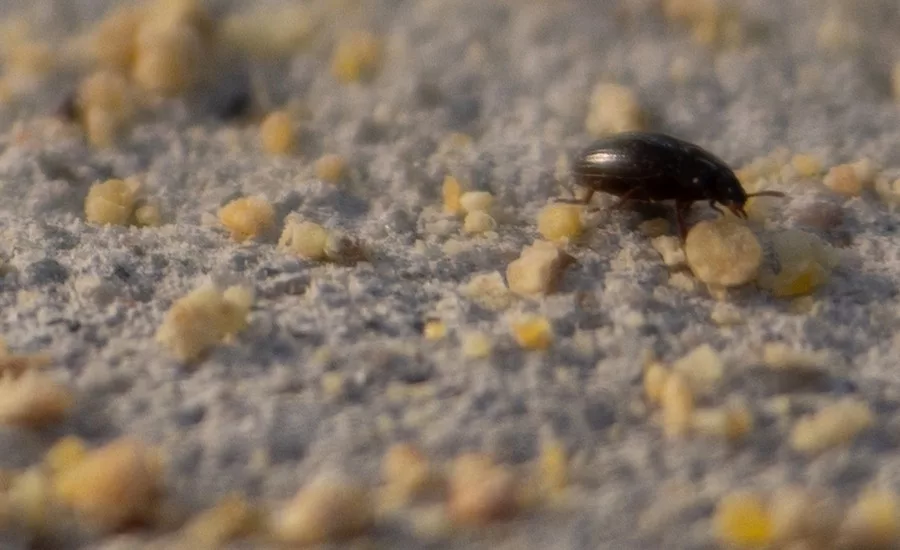
Darkling beetles are common in poultry houses year-round but may also establish outdoor populations in warmer conditions. These pests prefer dark, sheltered environments close to feed sources, and frequently harbor beneath equipment, litter, or structural features.
Other insects of concern include mites and bedbugs. Additionally, rodents remain a constant issue due to their ability to exploit environmental and structural vulnerabilities.
Pest Populations as Vectors for Foodborne Pathogens
Pest control is closely linked to pre-harvest food safety, as insects and rodents are well-documented vectors for pathogens that are relevant to animal and human health.
For example, work conducted by Elanco has shown that darkling beetles can carry the same Salmonella strains as those identified in processing plants. Flies and rodents are also associated with the spread of Salmonella, E. coli, Campylobacter, and avian influenza.
Heightened pest activity can amplify pathogen loads and increase contamination risk through movement across surfaces, contact with feed and water systems, and ingestion by birds, introducing pathogens directly into the flock.
Even if individual pests carry low pathogen loads, large populations, often numbering in the millions, can significantly elevate the microbial load on poultry, leading to contamination that follows birds through post-harvest.
Core Components of an Effective IPM Program
An IPM program is the foundation of pest control in poultry operations. Rather than relying solely on chemical interventions to address threats, IPM prioritizes environmental and operational controls to address pests at the source by targeting pest harborage and breeding opportunities.
Key components of an effective IPM program include:
- Structural maintenance: For example, sealing cracks and openings in poultry houses and installing barriers to deter entry (e.g., heavy gravel to prevent rodents)
- Vegetation management: Such as maintaining short grass around houses and ventilation areas, and reducing the accumulation of organic debris near structures
- Sanitation and waste management: Including the regular removal of organic material and litter buildup, and the proper management of dumpsters and waste storage areas
- Harborage site reduction: Accomplished by eliminating unused equipment or materials, such as pallets, that provide shelter for pests, and monitoring areas beneath fixtures like migration fences where pests may congregate.
Without strong IPM practices, subsequent chemical controls will be rendered ineffective, as pests will continue to find suitable environments for survival and reproduction.
Chemical Control: An Added Layer of Defense
Chemical interventions remain an important component of pest control, particularly during periods of high infestation. However, their effectiveness depends on proper mixing and application, in strict adherence to label instructions.
In operations where licensed applicators handle insecticide mixing and application, onsite collaboration between applicators and producers can ensure transparency and correct application.
Insecticide Selection and Application
Classes of insecticides used in poultry production can include:
- Neurotoxic insecticides, including pyrethroids, organophosphates, neonicotinoids, and spinosyns, which target the insect nervous system but are prone to resistance development
- Physical or non-neurotoxic agents, such as insect growth regulators (IGRs), boric acid, and diatomaceous earth, which act on developmental processes and are less likely to drive resistance.
An important challenge in pest control is the development of resistance to insecticides among pests, particularly to neurotoxic chemical classes. Several strategies can help mitigate the development of resistance while ensuring the maximum effectiveness of insecticides, such as combining modes of action.
For example, the use of IGRs to prevent larval populations from reaching maturity, alongside neurotoxic insecticides to target adult pests and reduce current breeding populations, can be especially impactful when applied earlier in the breeding season. This dual approach reduces the immediate presence of pests while limiting the long-term risk of resistance.
Resistance Management Through Chemical Rotation
It is especially important to rotate the types of neurotoxic insecticides used in a poultry operation, as alternating between chemical classes minimizes selection pressure for resistance.
Continuous monitoring and systematic observations can help signal whether a change in an operation’s insecticide strategy is required. In some cases, pest samples may be submitted for sensitivity testing to determine which insecticides remain effective against a specific population. These data, which an expert insecticide partner like Elanco can help generate, are important to guide targeted chemical selection and rotation strategies.
The Way Forward for Poultry Operations Facing Seasonal Pest Pressures
Seasonal increases in pest activity present a predictable but significant challenge for poultry producers. The relationship between pest control and food safety underscores the importance of implementing a robust IPM strategy, complemented by effective and intentional chemical controls.
With the help of an expert IPM and insecticide partner like Elanco, producers can effectively and efficiently reduce pest-related hazards at pre-harvest and help ensure food safety throughout the poultry production cycle.


