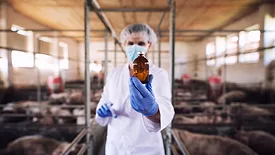
In a recent independent report evaluating popular restaurant chains’ policies on antibiotics in meat, many chains received a failing grade, while only one received an A+.
A recent project led by Purdue University researchers has identified challenges to food safety in the low-moisture food industry, ranging from culture-based barriers to hygienic design and hesitance adopting food safety technologies.
A multistate foodborne outbreak of Listeria monocytogenes infections spanning more than two years has sickened 11 people and resulted in the death of an infant. The outbreak is linked to ready-to-eat (RTE) meat and poultry products from Yu Shang Food Inc.
A recent survey of Finnish municipal food inspectors has provided insight into the challenges inspectors face when trying to control food businesses that repeatedly violate food safety regulations, and suggested possible methods for motivating businesses to take corrective actions.
The latest UK-Veterinary Antimicrobial Resistance and Sales Surveillance report shows that levels of antimicrobial resistance (AMR) in pathogens from livestock and poultry are declining, and observes a 10-year-low in the number of antibiotics sold for use in food-producing animals.
The United States Department of Agriculture’s National Institute of Food and Agriculture (USDA-NIFA) is investing $14 million into dozens of projects aimed at advancing food safety research, outreach, and training.
With funding from the Center for Produce Safety (CPS), a team of researchers are developing a rapid viability test for the challenging parasite Cyclospora cayetanensis.
On December 18, the U.S. Food and Drug Administration (FDA) will hold an educational webinar for regulators and industry about food labeling and allergen labeling requirements.
The European Commission amended its regulation on the microbiological criteria for foods to revise the requirements for food business operators regarding Listeria monocytogenes in ready-to-eat (RTE) foods.
The UK Food Standards Agency (FSA) has opened submissions for companies to express interest in a sandbox program to help ensure the safety of cell-cultivated foods.
 RSS
RSS