Food Safety
search
Ask Food Safety AI
cart
facebook twitter linkedin instagram youtube
  • Sign In
  • Create Account
  • Sign Out
  • My Account
Food Safety
  • NEWS
    • Latest News
    • White Papers
  • PRODUCTS
  • TOPICS
    • Contamination Control
    • Food Types
    • Management
    • Process Control
    • Regulatory
    • Sanitation
    • Supply Chain
    • Testing and Analysis
  • PODCAST
  • EXCLUSIVES
    • Food Safety Five Newsreel
    • eBooks
    • FSM Distinguished Service Award
    • Interactive Product Spotlights
    • Videos
  • BUYER'S GUIDE
  • MORE
    • NEWSLETTERS >
      • Archive Issues
      • Subscribe to eNews
    • Store
    • Sponsor Insights
    • ASK FSM AI
  • WEBINARS
  • FOOD SAFETY SUMMIT
  • EMAG
    • eMagazine
    • Archive Issues
    • Editorial Advisory Board
    • Contact
    • Advertise
  • SIGN UP!
Testing & AnalysisMethodsMicrobiological Testing & Analysis

New Peel Plate® Microbial Tests Have Major Improvements Over Older Methods
October 1, 2016

As the number of microbiology tests performed in the food industry increases due to companies meeting new regulatory requirements, fulfilling customer demands and with added emphasis on internal QA/QC programs, efforts are being made to streamline testing methods–both hands-on time to set up a test and time to final result.

One important line of development has been to improve ready-to-use plates in which the only requirement is to add sample without the need for molten agar. The latest, and most significant improvement, is the Peel Plate® developed by Charm Sciences and available from Weber Scientific. It consists of a dehydrated medium contained in a molded plastic dish with a flexible film cover to maintain sterility before use and during incubation.

Features of Peel Plate
1.    It is very easy to inoculate, and the gel characteristics allow the sample to wick and diffuse through the entire plate in just a few seconds.

2.    Once inoculated, all that is required is to replace the peel back cover. No unique spreading devices are needed.

3.    Following standard microbiology practice, plates are inverted and can be stacked easily, because of how the Peel Plate is molded. This prevents them from sliding around and also maximizes air circulation because of the space between each plate.

4.    Colonies are easy to count and read, thanks to clear color formation from the indicator dyes that are used.

Available Tests
Several tests are available: Aerobic Plate Count (AC); coliforms (CC); combined coliforms/E. coli (EC); Enterobacteriaceae (EB) and yeast and molds (YM). Colony counting is easily quantified by color: AC colonies are red; coliforms and Enterobacteriaceae are also red, while E. coli colonies are blue-black–this also avoids having to note gas formation, which is not always obvious. YM colonies are blue, green or gray.

The chemistry of the indicator dyes is well-known to microbiologists. For AC, tetrazolium chloride is used; for other tests, substrates that are targets for characteristic enzymes. So the methods are based on a well-established principle and presented in a format that is very user-friendly.

Regulatory Approvals
These are important, and studies have been carried to obtain the following certifications. Aerobic Plate Count and coliform/E. coli are both AOAC-RI and PMO-NCIMS approved; YM is AOAC-RI approved. Samples tested included a wide variety of dairy products including raw milks (from cows, sheep and goats), a wide range of pasteurized and flavored milks and other products such as ice cream, UHT milk, creams and fermented milk products. This list is by no means exhaustive, and neither is it limited to dairy products–meat and poultry matrices have been tested–ground beef and turkey, liquid egg and carcass rinses.

Environmental Testing
The Peel Plate is also suitable for environmental samples, an area of testing that has been increasingly recognized as important in reducing microbial contamination of product. For example, sponges used to sample surfaces are placed in a suitable resuspension medium in which they are squeezed to maximize recovery of microorganisms. From this suspension, a 1-mL sample is taken and used to inoculate a plate.

If a larger sub-sample is required, then a high-volume version of Peel Plate is also available which will accommodate a 5-mL sample.

Automated Colony Counter
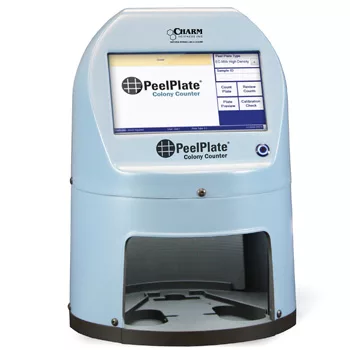
While colonies are easy to see and record with the naked eye, the latest development is an automated colony counter that reads Peel Plates in a few seconds and retains an electronic record of the result. According to Sharon Wilson, senior national accounts manager for Weber Scientific, “This adds further savings in terms of time to analyze a result, and record-keeping is becoming increasingly important as food companies seek to comply with FSMA regulations.”

Market Acceptance
Fred Weber, President, Weber Scientific, also notes, “The interest in this product is outstanding. Of all the many benefits that people often mention, the ability to stack plates 20 high without them sliding around and the convenience of the rapid self-wicking with no spreading device required.” This was borne out at major food conventions during the summer of 2016. At both the Institute of Food Technologists (IFT) annual meeting in Chicago and the International Association for Food Protection (IAFP) convention in St. Louis, there was a very high level of interest from attendees, who immediately appreciated what the Peel Plate had to offer, and its advantages. 

Free Samples
Free samples of Peel Plate are available. Please contact Weber Scientific at 1-800-328-8378 or info@weberscientific.com.

www.weberscientific.com

>
Author(s): Weber Scientific

Looking for quick answers on food safety topics?
Try Ask FSM, our new smart AI search tool.
Ask FSM →


Share This Story

Recommended Content

JOIN TODAY
to unlock your recommendations.

Already have an account? Sign In

  • people holding baby chicks

    Serovar Differences Matter: Utility of Deep Serotyping in Broiler Production and Processing

    This article discusses the significance of Salmonella in...
    Food Type
    By: Nikki Shariat Ph.D.
  • woman washing hands

    Building a Culture of Hygiene in the Food Processing Plant

    Everyone entering a food processing facility needs to...
    Food Prep/Handling
    By: Richard F. Stier, M.S.
  • graphical representation of earth over dirt

    Climate Change and Emerging Risks to Food Safety: Building Climate Resilience

    This article examines the multifaceted threats to food...
    Management
    By: Maria Cristina Tirado Ph.D., D.V.M. and Shamini Albert Raj M.A.
Manage My Account
  • eMagazine Subscription
  • Subscribe to Newsletters
  • Manage My Preferences
  • Website Registration
  • Subscription Customer Service

More Videos

Sponsored Content

Sponsored Content is a special paid section where industry companies provide high quality, objective, non-commercial content around topics of interest to the Food Safety Magazine audience. All Sponsored Content is supplied by the advertising company and any opinions expressed in this article are those of the author and not necessarily reflect the views of Food Safety Magazine or its parent company, BNP Media. Interested in participating in our Sponsored Content section? Contact your local rep!

close
  • The image displays a person selecting packaged fresh chicken meat from a supermarket display cooler.
    Sponsored byCorbion

    Developing a Future-Proof Food Safety Strategy for Meat and Poultry Products

  • The image shows a variety of fresh produce packaged in plastic trays and wrap.
    Sponsored byWaters Corporation

    PFAS-Free Food Packaging by August 2026

  • This image displays a multi-stage water filtration system designed to remove contaminants from drinking water.
    Sponsored byWaterdrop Filter

    The 4.0 ppt Era: Future-Proofing Your Food Supply Chain Against 'Forever Chemicals'

Popular Stories

half shredded block of cheddar cheese and pile of cheese shreds on wooden cutting board

Patient Count in Raw Farm E. coli Outbreak Grows, Majority are Young Children

RAW FARM-brand raw cheddar cheese shreds

Amid E. coli Outbreak, Congress Urges FDA to Mandate Raw Cheese Recall

smiling employee in bottling factory looking at camera with arms crossed in front of production line

GFSI Unveils Updated Food Safety Culture Framework

foreign material webinar


Events

April 8, 2026

Foreign Material Contamination: Why In-Line Reinspection Isn't Enough

Live: April 8, 2026, at 11:00 am EDT: From this webinar, attendees will learn why reinspecting with in-line equipment is not sufficient when it comes to potential foreign material contamination.

April 16, 2026

Recordkeeping and Document Management for Food Safety Compliance

Live: April 16, 2026, at 2:00 pm EDT: From this webinar, attendees will learn why recordkeeping and document control are essential to food safety and business management.

May 11, 2026

The Food Safety Summit

Stay informed on the latest food safety trends, innovations, emerging challenges, and expert analysis. Leave the Summit with actionable insights ready to drive measurable improvements in your organization. Do not miss this opportunity to learn from experts about contamination control, food safety culture, regulations, sanitation, supply chain traceability, and so much more.

View All

Products

Global Food Safety Microbial Interventions and Molecular Advancements

Global Food Safety Microbial Interventions and Molecular Advancements

See More Products

Related Articles

  • AFNOR Certifies Two new BAX® System Methods, Renews a Third

    See More
  • 3M Petrifilm Rapid Aerobic Count Plate Earns Official Methods of Analysis Distinction by AOAC International

    See More
  • Neogen Introduces NeoFilm™ for Simple Microbial Tests

    See More

Related Products

See More Products
  • global food.jpg

    Global Food Safety Microbial Interventions and Molecular Advancements

  • 9781138070912.jpg

    Trends in Food Safety and Protection

  • 1444333348.jpg

    Handbook of Food Safety Engineering

See More Products

Events

View AllSubmit An Event
  • August 7, 2025

    Achieve Active Managerial Control of Major Risk Factors Using a Food Safety Management System

    On Demand: From this webinar, attendees will learn about changes to the FDA Food Code, which now includes a requirement for FSMS. 
View AllSubmit An Event

Related Directories

  • Nestle Quality Assurance Center Dublin

    The Nestle Quality Assurance Center (NQAC) Dublin provides the analytical testing businesses need to ensure product safety for consumers. We have supported the food industry world-wide for over three decades and offer an expansive portfolio of over 200 methods to meet your food safety testing needs.
×

Never miss the latest news and trends driving the food safety industry

Newsletters | Website | eMagazine

JOIN TODAY!
  • RESOURCES
    • Advertise
    • Contact Us
    • Directories
    • Store
    • Want More
  • SIGN UP TODAY
    • Create Account
    • eMagazine
    • Newsletters
    • Customer Service
    • Manage Preferences
  • SERVICES
    • Marketing Services
    • Reprints
    • Market Research
    • List Rental
    • Survey/Respondent Access
  • STAY CONNECTED
    • LinkedIn
    • Facebook
    • Instagram
    • X (Twitter)
  • PRIVACY
    • PRIVACY POLICY
    • TERMS & CONDITIONS
    • DO NOT SELL MY PERSONAL INFORMATION
    • PRIVACY REQUEST
    • ACCESSIBILITY

Copyright ©2026. All Rights Reserved BNP Media, Inc. and BNP Media II, LLC.

Design, CMS, Hosting & Web Development :: ePublishing