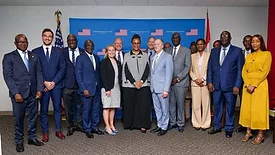
The Food and Agriculture Organization of the United Nations (FAO) recently held a workshop in the Bahamas to develop a plan for improving the country’s food safety capacity, based on the findings of a 12-month project.
In this episode of Food Safety Matters, we talk with Lone Jespersen, Ph.D., Founder and Principal of Cultivate, and Carol Wallace, Ph.D., Professor and Researcher at the University of Central Lancashire. Dr. Jespersen and Dr. Wallace discuss the concept of behavioral “nudging” of frontline workers, and how food businesses can drive incremental, continuous improvement of their food safety cultures.
A transdisciplinary team of researchers, educators, and extension experts led by Michigan State University (MSU) has received a $10 million grant from the U.S. Department of Agriculture (USDA) to create safer, more stable food systems.
Prevention is a key focus in alleviating food fraud. In the food supply chain specifically, the lack of understanding and awareness regarding food fraud facilitators provides numerous opportunities for fraudsters to engage in criminal behavior. This article introduces the problem of food document fraud and the role documents play in facilitating food fraud events. Topics covered include crime prevention theory, food fraud prevention, food fraud facilitators, types and classifications of documents targeted in fraud, a food document fraud survey, and how food document fraud fits into a food fraud vulnerability assessment.
Since 2000, outbreaks have been attributed to fresh, soft Queso Fresco-type cheeses made from pasteurized milk, which have been contaminated by L. monocytogenes after pasteurization
This article presents the key findings of outbreak investigations from 2014–2021 that have been linked to the consumption of fresh, soft queso fresco-type cheeses in the U.S. The authors outline some of the specific circumstances that small manufacturers of all cheeses may encounter in an effort to provide lessons learned and highlight available resources.
This article looks back at the events of the 1993 E. coli outbreak associated with hamburgers served at Jack in the Box restaurants along the U.S. West Coast, examining the regulatory changes inspired by the fatal outbreak and its impact. Also discussed are the corporate and industry changes, spearheaded by Dr. David Theno, that set new standards for leadership and management in foodservice and food safety.
An increasingly critical element of food safety and defense planning is assurance of data integrity—the ability to keep data unchanged as it is communicated or stored. Information that is used for decision-making or reporting cannot be compromised, altered, or manipulated by unauthorized users. Threat information is best shared through the establishment and voluntary participation of an Information Sharing and Analysis Center (ISAC). Food and agriculture is the only sector that lacks an ISAC. With security threats against the sector increasing and cyber threats against the global supply system also on the rise, it is imperative that a food and agriculture ISAC be formed.
Food safety auditing has progressed a great deal in the last three decades, but it is clear that it has yet to keep up with changing needs, expectations, and technological developments. This article explores the envisioned future of auditing, including how to develop talent and retain auditors, the qualities of a successful auditor, the importance of calibration among auditing teams, developments in technology and tools for auditors, and changes in processes with certification bodies, among other aspects.
Meal kits use a direct-to-consumer model of delivering perishable, pre-measured ingredients for pre-selected recipes that are then used to prepare and cook meals at home. Meal kits are likely to contain a variety of foods that may grow or be contaminated by pathogenic bacteria. Meal kit manufacturers also often repackage ingredients into plain or branded packaging, which can result in the consumption of unexpected ingredients or allergens.
Small food manufacturers, defined as those with less than 500 full-time employees, have experienced significant challenges to operate and supply food during the COVID-19 pandemic. To better support small manufacturers in Georgia, the University of Georgia Marine Extension and the Georgia Sea Grant conducted free, onsite COVID-19 assessments at seven seafood processing/distributing facilities through the first five months of 2021. Completed assessment reports and recommendations are summarized in this article. Manufacturers demonstrated remarkable adaptability to protect workers and avoid closing, despite supply shortages and continually changing public health guidance.