Food Safety
search
Ask Food Safety AI
cart
facebook twitter linkedin
  • Sign In
  • Create Account
  • Sign Out
  • My Account
Food Safety
  • NEWS
    • Latest News
    • White Papers
  • PRODUCTS
  • TOPICS
    • Contamination Control
    • Food Types
    • Management
    • Process Control
    • Regulatory
    • Sanitation
    • Supply Chain
    • Testing and Analysis
  • PODCAST
  • EXCLUSIVES
    • Food Safety Five Newsreel
    • eBooks
    • FSM Distinguished Service Award
    • Interactive Product Spotlights
    • Videos
  • BUYER'S GUIDE
  • MORE
    • ENEWSLETTER >
      • Archive Issues
      • Subscribe to eNews
    • Store
    • Sponsor Insights
    • ASK FSM AI
  • WEBINARS
  • FOOD SAFETY SUMMIT
  • EMAG
    • eMagazine
    • Archive Issues
    • Editorial Advisory Board
    • Contact
    • Advertise
  • SIGN UP!

Meat Science Review

Sequence-specific removal of STECs via CRISPR-Cas9 system
By Hua Yang, Mo Jia, Ifigenia Geornaras, Keith E. Belk
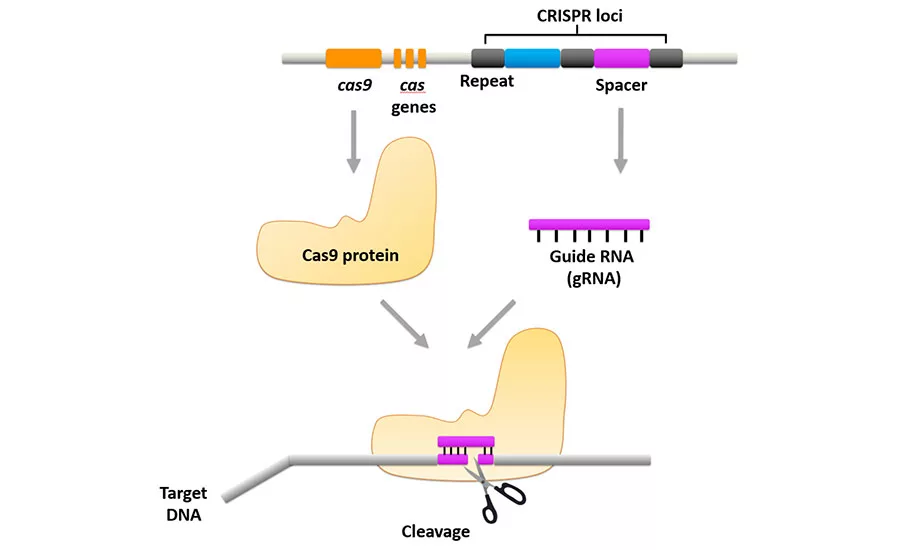
Illustration of the CRISPR-Cas9 system containing Cas9 protein and guide RNA
Figure 1
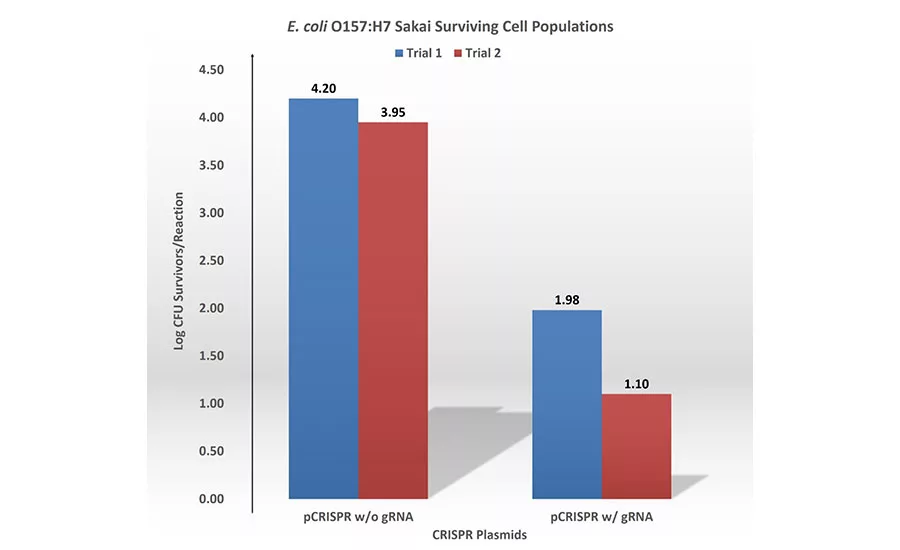
E. coli O157:H7 Sakai Surviving Cell Populations
Figure 2
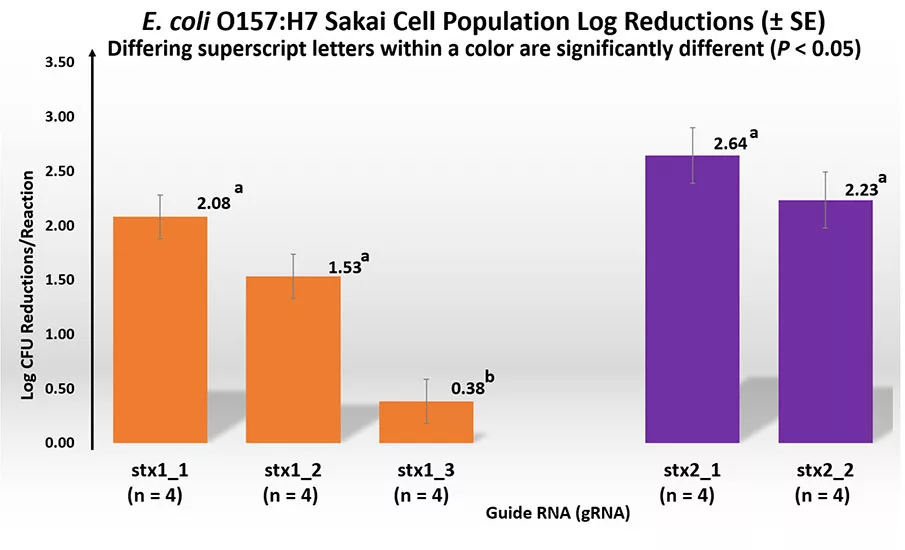
E. coli O157:H7 Sakai Cell Population Log Reductions
Figure 3
Illustration of the CRISPR-Cas9 system containing Cas9 protein and guide RNA
E. coli O157:H7 Sakai Surviving Cell Populations
E. coli O157:H7 Sakai Cell Population Log Reductions
February 20, 2018

Clustered Regularly Interspaced Short Palindromic Repeats (CRISPR) and CRISPR-associated proteins (Cas) together comprise the CRISPR-Cas system. In bacteria, this system confers an adaptive immunity against invading mobile elements such as viruses and plasmids. The CRISPR-Cas9 system has emerged as a programmable and versatile tool for precise genome editing in a wide variety of organisms. In contrast, research conducted in the Department of Animal Sciences at Colorado State University focused on exploiting the CRISPR-Cas9 system for selective killing of a bacterial pathogen relevant to meat safety by targeting specific virulence genes.

The CRISPR-Cas9 system contains two key factors: the Cas9 protein, which can cleave double-stranded DNA, and guide RNA (gRNA) which is transcribed from the CRISPR sequence (Figure 1). The function of the Cas9 protein is like a pair of scissors. Guide RNA is complimentary to the target sequence and is able to guide the Cas9 protein to the sequence-specific site of cleavage. The interaction between the Cas9 protein and the target DNA leads to the creation of a double-stranded DNA break. Such DNA cleavage can be used either to edit or to kill organisms. In recent studies, CRISPR-Cas9 systems have been explored for developing sequence-specific antimicrobials, which means that by targeting the cleavage of specific sites in a genome of interest, the kill should be limited to only organisms containing that specific gene or genes.

In this study, we designed and cloned gRNAs targeting Shiga toxin genes (stx1 or stx2) and used a two-plasmid platform to deliver this Shiga toxin-specific CRISPR-Cas9 system into bacterial cells to kill a Shiga toxin-producing Escherichia coli (STEC) strain. The CRISPR-Cas9 system can be programmed to selectively kill pathogens that harbor the Shiga toxin genes while leaving those non-target bacterial populations unaffected.

Shiga toxin gRNAs were designed by screening Shiga toxin gene sequences for NGG on the 3’ side. The designed 20-nucleotide gRNA was then cloned into a CRISPR plasmid (pCRISPR), resulting in a CRISPR plasmid with a gRNA (pCRISPR w/gRNA). The successful cloning of gRNA was confirmed by Sanger Sequencing. The Cas9 plasmid (pCas9) and pCRISPR with gRNA were then introduced into E. coli O157:H7 Sakai cells to determine the killing efficiency of the designed CRISPR-Cas9 system. In addition, pCas9 and pCRISPR without a gRNA were introduced into E. coli O157:H7 Sakai cells to serve as a control. When the pCRISPR with gRNA was introduced into the recipient E. coli O157:H7 cells containing pCas9 plasmids, an approximately 2.2- to 2.9-log lower number of E. coli O157:H7 cells was observed compared with that of the control pCRISPR without gRNA (Figure 2). This result provided evidence that introduction of a CRISPR-Cas9 system targeting Shiga toxin genes can achieve sequence-specific killing of STEC.

Killing target cells using the CRISPR-Cas9 system could be highly related to its gRNA sequence. In the next step, we designed three gRNAs (stx1-1, stx1-2 and stx1-3) that targeted the stx1 gene at different locations and two gRNAs (stx2-1 and stx2-2) that targeted the stx2 gene at different locations. We compared their efficiencies in killing E. coli O157:H7 Sakai cells. For the stx1 gene, we found no significant difference in cell reductions between cells that contained stx1-1 (2.08 log reduction) and stx1-2 (1.53 log reduction) gRNAs (Figure 3). However, significantly (P < 0.05) lower cell reductions were observed for cells containing the stx1-3 gRNA (0.38 log reduction) compared with the cells containing stx1-1 and stx1-2 gRNAs. For the stx2 gene, no significant (P > 0.05) differences in cell reductions were obtained between the stx2-1 (2.64 log reduction) and stx2-2 (2.23 log reduction) gRNAs (Figure 3). This result demonstrated varied reductions of E. coli O157:H7 Sakai cells when different gRNAs were used, suggesting that gRNAs are critical factors that determine the killing efficiencies of STEC.

In summary, this study provides proof-of-concept evidence that the CRISPR-Cas9 system with gRNA can selectively kill pathogenic bacteria by targeting a specific gene of choice. Furthermore, killing efficiencies can be improved by designing gRNAs to target virulence genes for sequence-specific removal of pathogenic bacteria, target antimicrobial resistance genes for killing antibiotic-resistant bacteria and target genes involved in biofilm development and formation of bacterial persister cells in biofilms. It also can improve sanitizer efficiency against biofilms in meat-processing environments. Further research will focus on developing a delivery system that allows us to apply the CRISPR-Cas9 system in real meat production and processing environments. NP


Citations

  • Bielaszewska M, Schmidt H, Liesegang A, Prager R, Rabsch W, Tschäpe H, Cízek A, Janda J, Bláhová K, Karch H. 2000. Cattle can be a reservoir of sorbitol-fermenting Shiga toxin-producing Escherichia coli O157:H− strains and a source of human diseases. J Clin Microbiol, 38(9):3470-3. 
  • Bikard D, Euler CW, Jiang W, Nussenzweig PM, Goldberg GW, Duportet X, Fischetti VA, Marraffini LA. 2014. Exploiting CRISPR-Cas nucleases to produce sequence-specific antimicrobials. Nat Biotechnol, 32(11):1146-50. doi:10.1038/nbt.3043.  
  • Citorik RJ, Mimee M, Lu TK. 2014. Sequence-specific antimicrobials using efficiently delivered RNA-guided nucleases. Nat Biotechnol, 32(11):1141-5. doi:10.1038/nbt.3011. 
  • Doudna JA, Charpentier E. 2014. The new frontier of genome engineering with CRISPR-Cas9. Science, 346(6213), 1258096. doi:10.1126/science.1258096.
  • Hsu PD, Lander ES, Zhang F. 2014. Development and applications of CRISPR-Cas9 for genome engineering. Cell, 157(6):1262-78. doi:10.1016/j.cell.2014.05.010.
  • Jiang W, Bikard D, Cox D, Zhang F, Marraffini LA. 2013. RNA-guided editing of bacterial genomes using CRISPR-Cas systems. Nat Biotechnol, 31(3):233-9. doi: 10.1038/nbt.2508. 
  • Sternberg SH, Redding S, Jinek M, Greene EC, Doudna JA. 2014. DNA interrogation by the CRISPR RNA-guided endonuclease Cas9. Nature, 507(7490):62-7. doi:10.1038/nature13011.
  • Wiedenheft B, Sternberg SH, Doudna JA. 2012. RNA-guided genetic silencing systems in bacteria and archaea. Nature, 482(7385):331-8. doi:10.1038/nature10886. 

Looking for quick answers on food safety topics?
Try Ask FSM, our new smart AI search tool.
Ask FSM →


This article was originally posted on www.provisioneronline.com.
KEYWORDS: E. coli meat science review pathogen reduction strategies pathogens STEC

Share This Story

Hua Yang, Center for Meat Safety and Quality, Colorado State University
Mo Jia is a student at the Colorado State University and placed third in the Ph.D. Research Competition at the American Meat Science Association’s 70th RMC in College Station, Texas, this past June.
Ifigenia Geornaras, Center for Meat Safety and Quality, Colorado State University
Keith E. Belk, Center for Meat Safety and Quality, Colorado State University

Recommended Content

JOIN TODAY
to unlock your recommendations.

Already have an account? Sign In

  • people holding baby chicks

    Serovar Differences Matter: Utility of Deep Serotyping in Broiler Production and Processing

    This article discusses the significance of Salmonella in...
    Meat/Poultry
    By: Nikki Shariat Ph.D.
  • woman washing hands

    Building a Culture of Hygiene in the Food Processing Plant

    Everyone entering a food processing facility needs to...
    Food Prep/Handling
    By: Richard F. Stier, M.S.
  • graphical representation of earth over dirt

    Climate Change and Emerging Risks to Food Safety: Building Climate Resilience

    This article examines the multifaceted threats to food...
    Risk Assessment
    By: Maria Cristina Tirado Ph.D., D.V.M. and Shamini Albert Raj M.A.
Manage My Account
  • eMagazine Subscription
  • Subscribe to eNewsletter
  • Manage My Preferences
  • Website Registration
  • Subscription Customer Service

More Videos

Sponsored Content

Sponsored Content is a special paid section where industry companies provide high quality, objective, non-commercial content around topics of interest to the Food Safety Magazine audience. All Sponsored Content is supplied by the advertising company and any opinions expressed in this article are those of the author and not necessarily reflect the views of Food Safety Magazine or its parent company, BNP Media. Interested in participating in our Sponsored Content section? Contact your local rep!

close
  • Salmonella bacteria
    Sponsored byThermoFisher

    Food Microbiology Testing Methods: Salmonella species

  • a diagram explaining indicator organisms
    Sponsored byHygiena

    How Proactive Listeria Testing Helps Prevent Six- and Seven-Figure Recalls

  • woman grocery shopping
    Sponsored byCorbion

    Designing Safety Into Every Bite: Proactive Risk Mitigation for Refrigerated Foods

Popular Stories

NRTE breaded stuffed chicken

USDA Indefinitely Delays Enforcement of Salmonella as Adulterant in Raw Breaded, Stuffed Chicken

digital map of europe

EU Publishes Food Fraud Tool Mapping Thousands of Cases Since 2016

non-conforming product

How to Handle Non-Conforming Product

Events

December 11, 2025

How to Develop and Implement an Effective Food Defense Strategy

Live: December 11, 2025 at 2:00 pm EDT: From this webinar, attendees will learn common areas where companies encounter challenges in their food defense strategies and how to address them.

May 11, 2026

The Food Safety Summit

Stay informed on the latest food safety trends, innovations, emerging challenges, and expert analysis. Leave the Summit with actionable insights ready to drive measurable improvements in your organization. Do not miss this opportunity to learn from experts about contamination control, food safety culture, regulations, sanitation, supply chain traceability, and so much more.

View All

Products

Global Food Safety Microbial Interventions and Molecular Advancements

Global Food Safety Microbial Interventions and Molecular Advancements

See More Products

Related Articles

  • New Software From University of George Improves Accuracy of DNA Sequence Analysis

    New Software From University of George Improves Accuracy of DNA Sequence Analysis

    See More
  • digital rendering of dna strands

    CFIA’s GeneSeekR Program Identifies Specific Strains of Foodborne E. Coli, Possible Severity of Illness

    See More
  • illustration of brain made of data connections with FDA logo overlay

    FDA to Engage With Stakeholders on Direction of New Era of Smarter Food Safety via Day-Long Virtual Event

    See More

Related Products

See More Products
  • 1444333348.jpg

    Handbook of Food Safety Engineering

  • 9781498721776.jpg

    Handbook of Food Processing: Food Safety, Quality, and Manufacturing Processes

  • 9781138198463.jpg

    Food Safety Management Programs: Applications, Best Practices, and Compliance

See More Products

Events

View AllSubmit An Event
  • August 7, 2025

    Achieve Active Managerial Control of Major Risk Factors Using a Food Safety Management System

    On Demand: From this webinar, attendees will learn about changes to the FDA Food Code, which now includes a requirement for FSMS. 
  • August 12, 2025

    Systematic Approach to Hazard Analysis: Considering Product- and Process-Specific Risks

    On Demand: From this webinar, attendees will learn where and why hazard analysis can fail, especially for high-risk products like leafy greens and meat/poultry.
View AllSubmit An Event

Related Directories

  • Meritech

    Remove more than 99.9% of pathogens from both hands and footwear in 12 seconds with CleanTech Automated Handwashing Stations and Industrial Boot Scrubbers. All equipment is Made in USA with on-site service support available. Over 35 years of experience helping food safety leaders ensure hygiene excellence at their facility.
×

Never miss the latest news and trends driving the food safety industry

eNewsletter | Website | eMagazine

JOIN TODAY!
  • RESOURCES
    • Advertise
    • Contact Us
    • Directories
    • Store
    • Want More
  • SIGN UP TODAY
    • Create Account
    • eMagazine
    • eNewsletter
    • Customer Service
    • Manage Preferences
  • SERVICES
    • Marketing Services
    • Reprints
    • Market Research
    • List Rental
    • Survey/Respondent Access
  • STAY CONNECTED
    • LinkedIn
    • Facebook
    • Instagram
    • X (Twitter)
  • PRIVACY
    • PRIVACY POLICY
    • TERMS & CONDITIONS
    • DO NOT SELL MY PERSONAL INFORMATION
    • PRIVACY REQUEST
    • ACCESSIBILITY

Copyright ©2025. All Rights Reserved BNP Media.

Design, CMS, Hosting & Web Development :: ePublishing