A session at the 2022 International Association for Food Protection (IAFP) Annual Meeting discussed recent developments in applications of predictive tools for meat and poultry products.
The U.S. Department of Agriculture’s Food Safety and Inspection Service (USDA’s FSIS) will soon declare Salmonella to be an adulterant in breaded and stuffed raw chicken products.
The U.S. Department of Agriculture’s Food Safety and Inspection Service (USDA’s FSIS) and the state of Oregon have finalized a cooperative agreement that allow for Oregon’s inspection program to inspect meat products produced for shipment within the state.
A study published in China CDC Weekly gives insight into the mortality rate of past foodborne botulism outbreaks in China, and also points out seasonal, regional, and product trends associated with botulism cases.
The U.S. Department of Agriculture’s Food Safety and Inspection Service (USDA’s FSIS) has signed a cooperative agreement with the University of Maryland and EpiX Analytics to develop quantitative risk assessments for Salmonella in chicken and turkey.
The UK conducts annual surveillance of Escherichia coli with antimicrobial resistance (AMR) on retail meats. The 2021 data shows the prevalence of AMR E. coli has remained low and consistent in retail beef and pork since 2015.
Consumer Reports is calling on the U.S. Department of Agriculture (USDA) to more stringently enforce Salmonella contamination after an investigation by the group revealed the prevalence of Salmonella in chicken products at retail.
The Food Safety Authority of Ireland recently published an audit report that focused on food businesses’ levels of compliance with food law as it relates to traceability and labeling for meat products.
However, the reduction has not translated to a decrease in salmonellosis cases associated with contaminated poultry.
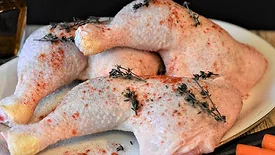
As part of an assessment of the efficacy of performance standards that were established in 2015, The U.S. Department of Agriculture’s Food Safety and Inspection Service (USDA’s FSIS) has published new findings about Salmonella contamination of chicken parts.
In this episode of Food Safety Matters, we speak with Dr. Charles Hofacre, the Principal at The Southern Poultry Research Group, and Dr. Bill Potter, a Food Safety Technical Advisor at Elanco Animal Health, about a multi-hurdle approach to controlling Salmonella in poultry, pre-harvest intervention strategies for pathogen contamination, and USDA’s renewed focus on Salmonella in poultry.
 RSS
RSS


.webp?height=168&t=1661887788&width=275 "USDA FSIS logo")