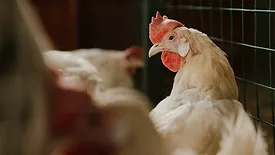
The U.S. Department of Agriculture’s Food Safety and Inspection Service (USDA’s FSIS) released a proposed determination to declare Salmonella an adulterant in breaded stuffed raw chicken products, building upon the proposed regulatory framework to reduce Salmonella infections linked to poultry products.
Approximately 46 percent of honey imported to the EU is adulterated, according to the European Food Safety Authority (EFSA). These findings are the result of an EU-coordinated action, titled, “From the Hives.”
The U.S. Food and Drug Administration (FDA) conducted an assignment to collect and test imported honey in 2021 and 2022 for economically motivated adulteration (also known as food fraud), finding 10 percent of samples to be adulterated.
The U.S. Department of Agriculture’s Food Safety and Inspection Service (USDA’s FSIS) has proposed a regulatory framework that would change food safety in the poultry industry, including new flock testing requirements, enhancing process control and verification, and implementing enforceable final product standards.
Traditionally, food safety issues associated with alcoholic beverages focus on chemical or physical hazards from the processing line. Intoxication with alcoholic beverages, as it relates to food safety, is less reported in the literature. However, the addition of cheap methanol to illicitly produced liquor—a rising issue in Asia—is increasingly being studied as a food safety and food adulteration issue.
The U.S. Department of Agriculture’s Food Safety and Inspection Service (USDA’s FSIS) will soon declare Salmonella to be an adulterant in breaded and stuffed raw chicken products.
Assuring food safety in this "New Era of Smarter Food Safety" and with the increasing use of whole genome sequencing provides many new challenges for food safety professionals. While these challenges are many and multi-faceted, it is helpful to look back to the "old" era of food safety, to some of the foundational concepts in the 1938 Food, Drug, and Cosmetic Act that are still in force today. In this article, the authors focus first on one of many important legal terms that is extremely important and often misunderstood: adulteration.