Food Safety
search
Ask Food Safety AI
cart
facebook twitter linkedin
  • Sign In
  • Create Account
  • Sign Out
  • My Account
Food Safety
  • NEWS
    • Latest News
    • White Papers
  • PRODUCTS
  • TOPICS
    • Contamination Control
    • Food Types
    • Management
    • Process Control
    • Regulatory
    • Sanitation
    • Supply Chain
    • Testing and Analysis
  • PODCAST
  • EXCLUSIVES
    • Food Safety Five Newsreel
    • eBooks
    • FSM Distinguished Service Award
    • Interactive Product Spotlights
    • Videos
  • BUYER'S GUIDE
  • MORE
    • ENEWSLETTER >
      • Archive Issues
      • Subscribe to eNews
    • Store
    • Sponsor Insights
    • ASK FSM AI
  • WEBINARS
  • FOOD SAFETY SUMMIT
  • EMAG
    • eMagazine
    • Archive Issues
    • Editorial Advisory Board
    • Contact
    • Advertise
  • SIGN UP!

How a warehouse execution system assists with recalls

Don’t rely on an ERP system to manage all aspects of your warehouse—not if you need real-time connectivity.
By Wayne Labs
Westfalia Technologies Inc.
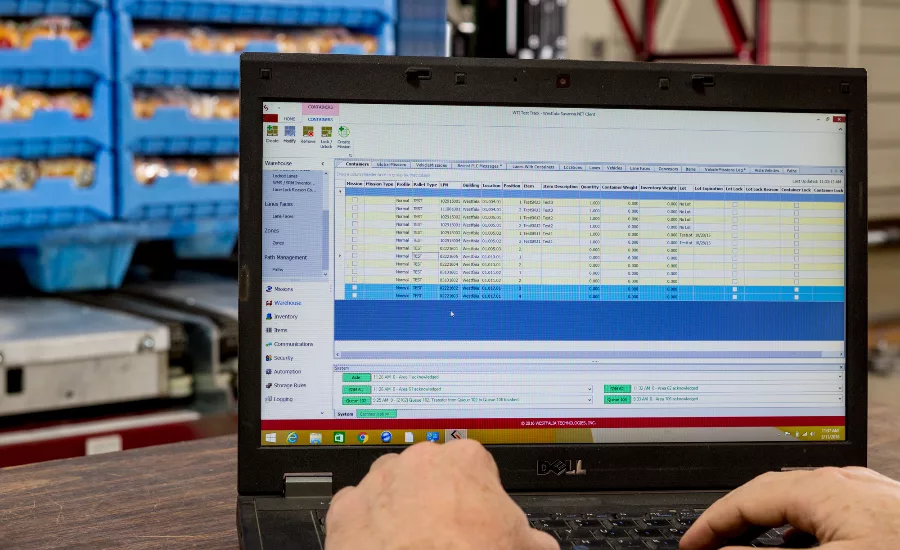
Warehouse execution systems like Westfalia’s Savanna.NET can manage a warehouse in real time, minimize the chance of bad product getting out the door, and supervise a fully automated warehouse, such as an AR/RS. Source: Westfalia Technologies Inc.
 Dave Williams
Westfalia Technologies Inc.
 Dave Williams
January 8, 2018

A recent study performed by the Food Marketing Institute and Grocery Manufacturers Association, revealed that one recall can cost a food or beverage company an average of $10 million, not including lost sales profits and a tarnished brand reputation.

However, food and beverage processors can respond to problems within the manufacturing process more quickly by connecting a warehouse execution system (WES) to external systems both upstream and downstream in the supply chain. This will often prevent contaminated products from ever leaving the facility, saving the processor both time and money.

FE spoke with Dave Williams, Westfalia Technologies’ vice president of software development, to get a more detailed picture of how a WES integrated with other systems can not only help manage a recall process, but also prevent bad products from going out the door in the first place, thus preventing a recall.

FE: What role does a WES play in recalls?

Dave Williams: By providing a high-degree of product traceability, an integrated WES can help manufacturers discover and act upon issues that have caused the malfunction or contamination sooner. Earlier detection often allows manufacturers to better understand what product is to be recalled, thus possibly reducing the scope of the recall effort and targeting the affected inventory.

FE: What exactly are the modules contained in a WES?

Williams: Conceivably, most of the modules within a WES can be used to execute the recall process.  Quality control, receiving and returns processing, labor management, equipment control and reporting are a few modules that play key roles in smoothly executing a product recall

FE: What systems should a WES be able to connect to or integrate with and exchange data? For example, ERP, MES, LIMs, supply chain management systems, etc.?

Williams: A well-designed and implemented WES should be able to easily connect to, and communicate, with any system that can send and/or receive information.

FE: Some ERP systems have a warehouse management function. Why not just use that?

Williams: Using a WMS to help manage a recall might be sufficient for non-automated facilities, but once automation is introduced, the need to effectively orchestrate both manual and automated tasks becomes crucial.

Looking for quick answers on food safety topics?
Try Ask FSM, our new smart AI search tool.
Ask FSM →

FE: How can a WES speed up the recall process?

Williams: By utilizing a WES that is tightly integrated with other supply chain systems, manufacturers are able to more quickly and easily identify products that are part of a recall. Further, companies can utilize the information from the WES to provide their customers with the necessary information needed to identify and return the recalled product efficiently, saving both the company and its customers time and money.

FE: Can a WES also manage location of trucks in transit, or is that the responsibility of a different (fleet management) system? If so, how should the fleet management system integrate with the WES?

Williams: A fleet management system is typically responsible for managing the location of vehicles in transit, but connecting these systems to a WES provides complete, integrated visibility of a company’s orders through the time of delivery. Should the need for a recall arise, a WES that interfaces with other systems in the supply chain, like fleet management systems, allows a company to identify where the affected product is and take the appropriate action much more quickly.

FE: How can a WES help with returns?

Williams: A well-managed recall process is a must to process recalled product accurately and efficiently. There are many different recall scenarios that a manufacturer must be prepared to handle. Should the products be discarded? Is special handling required? Do the products need to be quarantined for further inspection? Are there specific reporting requirements that need to be completed? Many of these processes can be automated within a WES to guide individuals through the process, thus ensuring a complete, well-organized, well-documented, efficient handling of the affected product.

FE: How can a WES help manage recalls?

Williams: A WES that is integrated with manufacturing processes can also be used to recognize issues and provide automatic alerts to the warehouse when products are contaminated to keep the product in-house, thus eliminating the recall process. This allows the manufacturer to more easily identify and locate affected products before they leave the warehouse.

Contaminated products are potentially hazardous to the end customer, but could be extremely detrimental to a company’s financial health as well. By implementing a tightly integrated WES into the supply chain process, manufacturers are able to quickly identify, track and efficiently recall contaminated or malfunctioning products when necessary—saving time, money and often their reputation.

FE: How does the use of a WES compare in cost to just using an ERP for the warehousing function? What more can a user expect from a WES compared to using just an ERP’s warehousing function?

Williams: In my opinion, clearly defining the roles of each system is crucial to the success of any effort to integrate systems and processes. ERP systems are traditionally designed to handle the “front-end” and “back-end” tasks of the order fulfillment process. That is, functions like order capture and planning and billing functions are things that an ERP does well, while a WES is designed to handle the inventory management and order fulfillment operations within a facility. When the lines of responsibility are clearly defined, each system can perform the tasks that it does best and the entire process runs much smoother.

FE: Is a WES more real-time in nature than using an ERP’s warehousing functionality?

Williams: When it comes to communicating with automation, a WES is more tightly integrated with the equipment than a traditional ERP system might be. Also, because a WES is designed to communicate with and direct the actions of automation, as well as those in a conventional warehouse, it can perform these tasks seamlessly.

FE: Does a WES integrate with or control robotic automation on the plant floor?

Williams: Absolutely. The warehouse control components of a WES not only communicate to, but also coordinate the efforts of various pieces of automation, which helps to make the entire order fulfillment process more efficient.

FE: Anything I should have asked but didn’t?

Williams: As more companies turn to automation to produce, manage and deliver their products, the role of a well-designed WES continues to become mission-critical for managing inventories, while quickly and efficiently fulfilling ever-increasing order demands. Integrating a WES with other systems within a company’s supply chain allows for total traceability across the lifecycle of a product and provides tremendous efficiencies through-out the entire order fulfillment process.

About Dave Williams:

Dave Williams is the vice president of software development for Westfalia Technologies Inc. (Westfalia), a leading provider of logistics solutions for plants, warehouses and distribution centers since 1992. Williams spearheads Westfalia’s software and solutions delivery operations. In his role, he provides leadership and guidance for the design and implementation of solutions that contribute to strategic business goals while aligning with the overall information systems architecture.

This article was originally posted on www.foodengineeringmag.com.

This article was originally posted on www.foodengineeringmag.com.

KEYWORDS: food safety software supply chain Warehouse execution system

Share This Story

Wayne labs 200px
Wayne Labs has more than 20 years of editorial experience in industrial automation. He served as senior technical editor for I&CS/Control Solutions magazine for 18 years where he covered software, control system hardware and sensors/transmitters. Labs ran his own consulting business and contributed feature articles to Electronic Design, Control, Control Design, Industrial Networking and Food Engineering magazines. Before joining Food Engineering, he served as a senior technical editor for Omega Engineering Inc. Labs also worked in wireless systems and served as a field engineer for GE’s Mobile Communications Division and as a systems engineer for Bucks County Emergency Services. In addition to writing technical feature articles, Wayne covers FE’s Engineering R&D section.

Recommended Content

JOIN TODAY
to unlock your recommendations.

Already have an account? Sign In

  • people holding baby chicks

    Serovar Differences Matter: Utility of Deep Serotyping in Broiler Production and Processing

    This article discusses the significance of Salmonella in...
    Testing & Analysis
    By: Nikki Shariat Ph.D.
  • woman washing hands

    Building a Culture of Hygiene in the Food Processing Plant

    Everyone entering a food processing facility needs to...
    Personal Hygiene/Handwashing
    By: Richard F. Stier, M.S.
  • graphical representation of earth over dirt

    Climate Change and Emerging Risks to Food Safety: Building Climate Resilience

    This article examines the multifaceted threats to food...
    Risk Assessment
    By: Maria Cristina Tirado Ph.D., D.V.M. and Shamini Albert Raj M.A.
Manage My Account
  • eMagazine Subscription
  • Subscribe to eNewsletter
  • Manage My Preferences
  • Website Registration
  • Subscription Customer Service

More Videos

Sponsored Content

Sponsored Content is a special paid section where industry companies provide high quality, objective, non-commercial content around topics of interest to the Food Safety Magazine audience. All Sponsored Content is supplied by the advertising company and any opinions expressed in this article are those of the author and not necessarily reflect the views of Food Safety Magazine or its parent company, BNP Media. Interested in participating in our Sponsored Content section? Contact your local rep!

close
  • Salmonella bacteria
    Sponsored byThermoFisher

    Food Microbiology Testing Methods: Salmonella species

  • a diagram explaining indicator organisms
    Sponsored byHygiena

    How Proactive Listeria Testing Helps Prevent Six- and Seven-Figure Recalls

  • woman grocery shopping
    Sponsored byCorbion

    Designing Safety Into Every Bite: Proactive Risk Mitigation for Refrigerated Foods

Popular Stories

NRTE breaded stuffed chicken

USDA Indefinitely Delays Enforcement of Salmonella as Adulterant in Raw Breaded, Stuffed Chicken

non-conforming product

How to Handle Non-Conforming Product

spoonfuls of food ingredients

FDA’s Developing Rule to Tighten GRAS Oversight Moves to White House

Events

December 11, 2025

How to Develop and Implement an Effective Food Defense Strategy

Live: December 11, 2025 at 2:00 pm EDT: From this webinar, attendees will learn common areas where companies encounter challenges in their food defense strategies and how to address them.

May 11, 2026

The Food Safety Summit

Stay informed on the latest food safety trends, innovations, emerging challenges, and expert analysis. Leave the Summit with actionable insights ready to drive measurable improvements in your organization. Do not miss this opportunity to learn from experts about contamination control, food safety culture, regulations, sanitation, supply chain traceability, and so much more.

View All

Products

Global Food Safety Microbial Interventions and Molecular Advancements

Global Food Safety Microbial Interventions and Molecular Advancements

See More Products

Related Articles

  • cows

    How to avoid USDA import refusals with preparation

    See More
  • Jason Andersen

    How IIoT can improve food and beverage bottom lines

    See More
  • Cybersecurity

    How food and beverage processors can fight cyberattacks

    See More

Related Products

See More Products
  • 9781138198463.jpg

    Food Safety Management Programs: Applications, Best Practices, and Compliance

  • 1119053595.jpg

    Food Safety for the 21st Century: Managing HACCP and Food Safety throughout the Global Supply Chain, 2E

  • 1119258073.jpg

    FSMA and Food Safety Systems: Understanding and Implementing the Rules

See More Products

Related Directories

  • Instant Recall LLC

    Instant Recall automates best practice workflows, data analysis and regulatory reporting for mock recalls, product holds, withdrawals, and recalls for the food industry. Learn why the food industry consistently chooses us as the shared solution for food recall preparedness, recall communications execution, and cost recovery!
  • Computerway Food Systems

    Computerway Food Systems is a world leader in integrated plant floor and enterprise-level information systems designed specifically for food manufacturing and processing operations. Incorporated in 1986, Computerway modules include precise Recall and Traceability, real-time Production Control, accurate and aged Inventory of products and packaging, and scanned Shipping and Receiving operations.
  • Recall InfoLink Inc.

    Recall InfoLink is a subscription software that makes recall process management easier and more effective. The cloud platform enables companies across the supply chain to easily distribute recall information, track progress in real time, generate reports for compliance needs, and complete modernized mock recall exercises.
×

Never miss the latest news and trends driving the food safety industry

eNewsletter | Website | eMagazine

JOIN TODAY!
  • RESOURCES
    • Advertise
    • Contact Us
    • Directories
    • Store
    • Want More
  • SIGN UP TODAY
    • Create Account
    • eMagazine
    • eNewsletter
    • Customer Service
    • Manage Preferences
  • SERVICES
    • Marketing Services
    • Reprints
    • Market Research
    • List Rental
    • Survey/Respondent Access
  • STAY CONNECTED
    • LinkedIn
    • Facebook
    • Instagram
    • X (Twitter)
  • PRIVACY
    • PRIVACY POLICY
    • TERMS & CONDITIONS
    • DO NOT SELL MY PERSONAL INFORMATION
    • PRIVACY REQUEST
    • ACCESSIBILITY

Copyright ©2025. All Rights Reserved BNP Media.

Design, CMS, Hosting & Web Development :: ePublishing