Analysis of Food Packaging Film by Headspace GC/MS
Food packaging material is typically manufactured as a thin film and coated with inks that usually contain multiple, harmful, volatile organics. Therefore, they must be carefully monitored and quantitated to ensure that the amounts are limited.
Traditionally, the test for solvent materials in food packaging film is performed using a technique of heating a square meter of the film material inside a mason jar. This jar is then opened and tested (by smell) for volatile organic compounds. Later, this test was expanded to extract a headspace sample out of the mason jar by syringe and then injected into a gas chromatograph (GC) for quantitative analysis. This produced significantly better results and provided laboratories with a quantitative number. This process is still very time-consuming and labor intensive because of the number of manual steps involved. The manual process of cutting food packaging, placing it in a mason jar, heating the jar and manually collecting a sample for GC analysis dramatically limits the number of samples that can be analyzed each day. The technique demonstrated here will greatly improve the efficiency and throughput of this analysis.
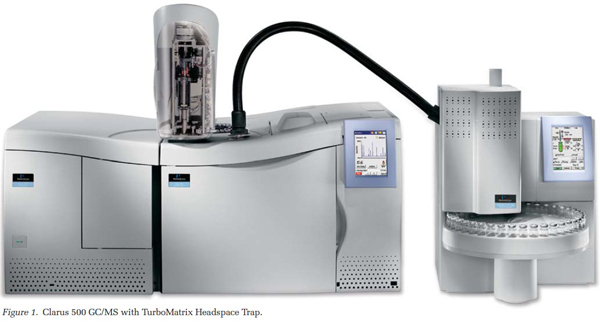 This analysis can be completely automated using a PerkinElmer® TurboMatrix™ Headspace (HS) sampler with the Clarus® 500 Gas Chromatograph/Mass Spectrometer (GC/MS). This system passed all the requirements for food packaging analysis.
Experimental
The first food packaging film used for this experiment was from a typical package of cookies. This film was cut into squares: 325 cm2 pieces. The typical volume used in a mason jar is a square meter, but this volume is not required for the headspace sampler. The desired sensitivity can be reached with significantly lower quantities. The second packaging material tested was obtained from a shopping bag that you would typically find at a department store.
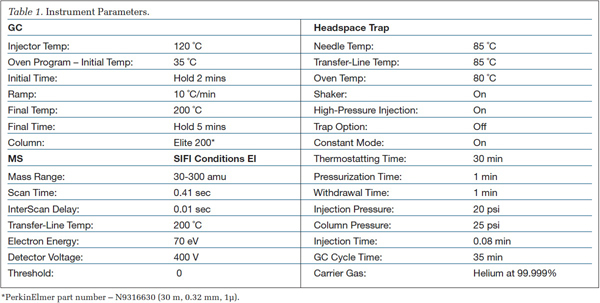 The pieces of film were added directly to a 22-mL headspace vial. The vial was then sealed with silicone/PTFE septa. In addition, a calibration standard was prepared to get an estimate of the expected concentration of the typical solvents. This standard was prepared by adding 4.7 μg of each solvent in a 22-mL headspace vial (Table 1).
The instrument used for this analysis was a TurboMatrix HS 40 Headspace Trap sampler run in headspace-only mode. This bypassed the trapping capability. If extra sensitivity is required, the trap option could be used for up to 100 times lower detection levels. The shaker option on the headspace was utilized for a faster equilibration of the solid film material. The headspace was controlled using remote control software and was coupled to the Clarus 500 GC/MS. The GC was equipped with a programmable split/splitless (PSS) injector and programmable pneumatic control (PPC).Deactivated fused silica (0.32 mm) transfer line connects the sampler to the GC. The GC column was directly connected to this transfer line using a universal union. The MS was controlled via software and operated in electron ionization (EI) mode.
Results
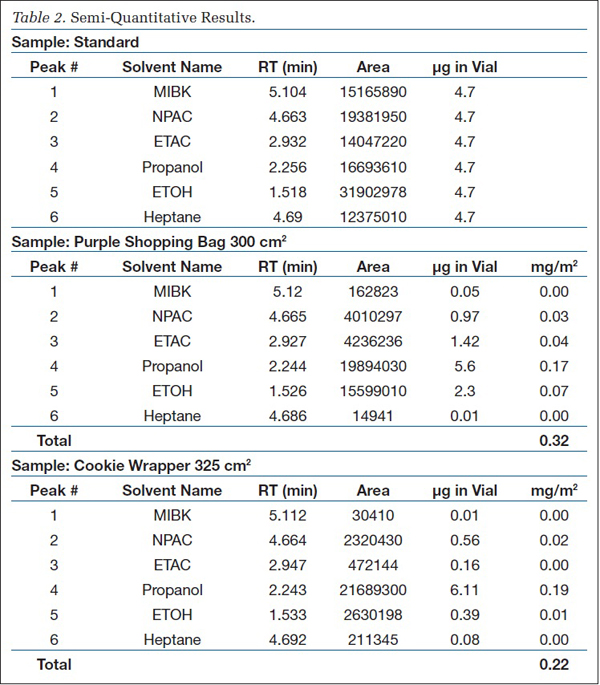
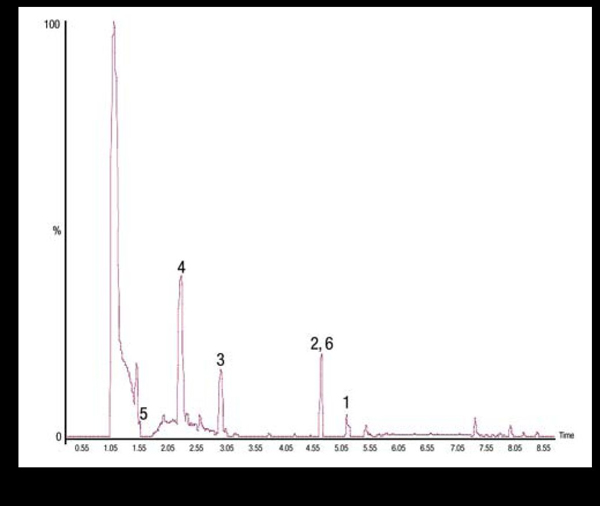
The sampler was successful in analyzing the solvents in food packaging. Six solvents were identified: 1 – MIBK (methyl isobutyl ketone), 2 – NPAC (n-propyl acetate), 3 – ETAC (ethyl acetate), 4 – propanol, 5 – ethanol and 6 – heptane (Figures 1 and 2). Ethanol and propanol were the largest responders and overloaded the system. However, the requirements of the testing were to only get semi-quantitative information. Therefore, the overloading was accepted. All components were positively identified using a NIST library database.
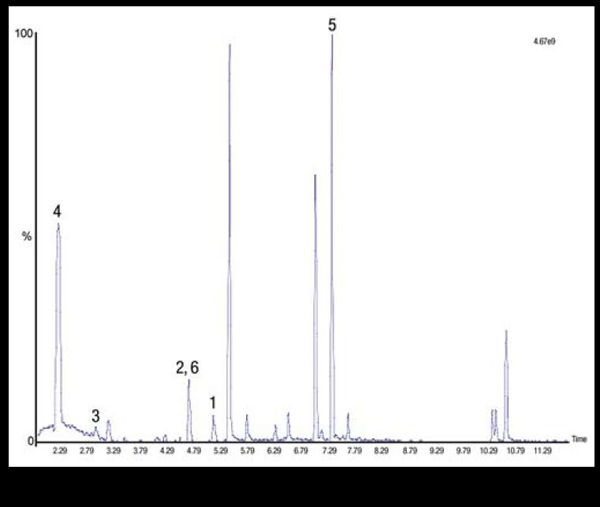 The cookie package/wrapper had approximately 0.22 mg/m2 of solvents found. However, propanol was very significant, making up the large majority of the total solvents identified. The cookie wrapper also had a lower level of interferences from outside sources (Figure 1: Chromatogram of Cookie Wrapper). The shopping bag had approximately 0.32 mg/m2 of total solvent material (of the six solvents tested, Table 2). This represented a very good response of all six solvents. In addition,
 there is a significant amount of other materials found in the food film. This is evident in the chromatogram shown in Figure 2 (Chromatogram of Shopping Bag Film with Expanded Ethanol Chromatogram). Because of the ability of the MS to extract only the required ion from the component of interest, this interference was not an issue.
The headspace system enabled the method to be set up and run unattended with no sample preparation. This eliminated the need for mason jars and operator attention.
In addition, the system showed a significant amount of sensitivity for the required components, demonstrating the ease of setup methodologies of many types of food packaging at many different levels.
The significant response of the volatile solvent material by this heated headspace technique would allow for a flame ionization detector (FID) to be used as a substitute for the MS detector. While the MS gives a positive identification as well as selectivity, the FID can be used in a majority of standard QA/QC environments.
Conclusions
The PerkinElmer TurboMatrix Headspace Trap with the Clarus 500 GC/MS meets all the requirements for food packaging analysis. The main requirement for this application is fast, easy and quantitative solvent determination. Using the setup demonstrated here, the sample is placed into a vial and placed in the autosampler tray of the headspace. Then the automated analysis is completed without operator attention. In addition, the headspace’s overlapping thermostatting allows up to 12 samples to be processed simultaneously, thus allowing 50–75 analyses per day.
Miles Snow and Heidi Grecsek are at PerkinElmer, Inc.
Looking for quick answers on food safety topics?
Try Ask FSM, our new smart AI search tool.
Ask FSM →