Food Safety
search
Ask Food Safety AI
cart
facebook twitter linkedin instagram youtube
  • Sign In
  • Create Account
  • Sign Out
  • My Account
Food Safety
  • NEWS
    • Latest News
    • White Papers
  • PRODUCTS
  • TOPICS
    • Contamination Control
    • Food Types
    • Management
    • Process Control
    • Regulatory
    • Sanitation
    • Supply Chain
    • Testing and Analysis
  • PODCAST
  • EXCLUSIVES
    • Food Safety Five Newsreel
    • eBooks
    • FSM Distinguished Service Award
    • Interactive Product Spotlights
    • Videos
  • BUYER'S GUIDE
  • MORE
    • NEWSLETTERS >
      • Archive Issues
      • Subscribe to eNews
    • Store
    • Sponsor Insights
    • ASK FSM AI
  • WEBINARS
  • FOOD SAFETY SUMMIT
  • EMAG
    • eMagazine
    • Archive Issues
    • Editorial Advisory Board
    • Contact
    • Advertise
  • SIGN UP!
Testing & AnalysisMicrobiological

Effortless Water Testing for Coliforms and Escherichia coli with Colilert® and Colisure®
By Weber Scientific.com
October 1, 2018

Colilert® is a one-step method for water quality and compliance testing, giving results for total coliform and Escherichia coli in 18 or 24 hours with less than 1 minute of hands-on time. Colilert has a full range of regulatory approvals and has become the perfect test for a wide variety of source water applications, including required regulatory compliance testing, bottled water testing, and for fresh-cut produce or fruit rinse water (before or after processing).

Approvals and recognitions include:

•    FDA/NCIMS/PMO for total coliform for plant and farm source waters; recognized for use by certified milk laboratories for negative and positive confirmation for total coliform testing

•    USEPA, AOAC, and IBWA approved for total coliforms and E. coli

•    Accepted by APHA Standard Methods for the Examination of Water and Wastewater for total coliforms and E. coli

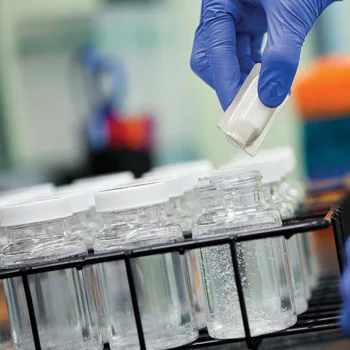
Colilert is pre-measured, unit dosed, and ready to use with clear, easy-to-read colorimetric results. It detects a single viable coliform or E. coli per sample. The sample collection, incubation, and reading can all be done in the same vessel. Colilert can be used as a presence/absence test for total coliforms and to specifically identify the presence or absence of E. coli through fluorescence with definitive results in 24–28 hours. Quanti-Tray® can be used for the added benefit of quantification of results. An 18-hour version allows the user to read afternoon samples the next morning—before the next day’s samples arrive. “I’m thrilled to learn about this test!” is the most common comment from new Colilert users, reports Weber Scientific sales manager Asif Rahman.

How Colilert Works
The Colilert test uses proprietary Defined Substrate Technology (DST) to simultaneously detect total coliforms and E. coli. Two nutrient-indicators, ONPG and MUG, are the major sources of carbon in Colilert and can be metabolized by the coliform enzyme β-galactosidase and the E. coli enzyme β-glucuronidase, respectively. As coliforms grow in the Colilert test, they use β-galactosidase to metabolize ONPG and change the water color from colorless to yellow. E. coli use β-glucuronidase to metabolize MUG and create fluorescence. Since most noncoliforms do not have these enzymes, they are unable to grow and interfere. The few noncoliforms that do have these enzymes are selectively suppressed by the Colilert test’s specifically formulated matrix.

This approach is different from traditional media, which provide a nutrient-rich environment that supports the growth of both target organisms and nontargets. When nontargets grow and mimic target organisms, false positives occur. Growth of nontargets can also suppress target organisms and give false negatives in traditional media. How the Colisure Test Works

Colisure® also detects coliforms and E. coli but with the convenience of a long-read window and a definitive color change for both positive and negative results. A distinct magenta color means there’s no mistaking a positive result. Results are definitive at 24 hours with a read window that lasts up to 48 hours and can be used for presence/absence or quantification testing with Quanti-Tray. “This technology is truly the gold standard of rapid coliform in water testing,” according to Sharon Wilson, Weber Scientific’s vice president of marketing and product development. The Colisure test uses proprietary DST nutrient indicators CPRG and MUG to detect total coliforms and E. coli.

Automated Water Sample Handling for Coliform and E. coli Quantification
The Quanti-Tray Sealer PLUS is the next-generation sealer in the Quanti-Tray system. The sealer makes quantification with Quanti-Tray and Quanti-Tray/2000 possible while saving time and improving laboratory efficiency.

With Quanti-Tray, a 100-mL sample is divided into 51 wells. Then the most-probable-number approach is used to determine the number of bacteria in the original sample. Automation minimizes hands-on time and maximizes throughput (up to four samples per minute). The relatively large number of wells provides a high counting range of 1–200 (without dilutions) and very tight 95 percent confidence limits.

The Quanti-Tray/2000 is based on the same statistical model as the traditional 15-tube serial dilution. With the Quanti-Tray/2000, the sample is automatically divided into the proper portions when sealed by the Quanti-Tray Sealer PLUS. The system does not require the use of test tubes, Durham tubes, or any dilutions. By automatically distributing the sample into 97 wells of two different sizes, Quanti-Tray/2000 yields a counting range of 1–2,419 CFU/100 mL with a far better 95 percent confidence limit than a 15-tube serial dilution.

Weber Scientific is an authorized distributor of IDEXX products to the food and beverage industries in the U.S. and Canada.


Author(s): Weber Scientific

Looking for quick answers on food safety topics?
Try Ask FSM, our new smart AI search tool.
Ask FSM →


Share This Story

Weber Scientific distributes laboratory supplies and equipment throughout North America and is focused on the specialized testing needs of the dairy and food industries.

Recommended Content

JOIN TODAY
to unlock your recommendations.

Already have an account? Sign In

  • people holding baby chicks

    Serovar Differences Matter: Utility of Deep Serotyping in Broiler Production and Processing

    This article discusses the significance of Salmonella in...
    Food Type
    By: Nikki Shariat Ph.D.
  • woman washing hands

    Building a Culture of Hygiene in the Food Processing Plant

    Everyone entering a food processing facility needs to...
    Sanitation
    By: Richard F. Stier, M.S.
  • graphical representation of earth over dirt

    Climate Change and Emerging Risks to Food Safety: Building Climate Resilience

    This article examines the multifaceted threats to food...
    Best Practices
    By: Maria Cristina Tirado Ph.D., D.V.M. and Shamini Albert Raj M.A.
Manage My Account
  • eMagazine Subscription
  • Subscribe to Newsletters
  • Manage My Preferences
  • Website Registration
  • Subscription Customer Service

More Videos

Sponsored Content

Sponsored Content is a special paid section where industry companies provide high quality, objective, non-commercial content around topics of interest to the Food Safety Magazine audience. All Sponsored Content is supplied by the advertising company and any opinions expressed in this article are those of the author and not necessarily reflect the views of Food Safety Magazine or its parent company, BNP Media. Interested in participating in our Sponsored Content section? Contact your local rep!

close
  • This image displays a multi-stage water filtration system designed to remove contaminants from drinking water.
    Sponsored byWaterdrop Filter

    The 4.0 ppt Era: Future-Proofing Your Food Supply Chain Against "Forever Chemicals"

  • The image displays a bottling plant production line, commonly used in the beverage industry for filling and packaging soft drinks.
    Sponsored byBIOIONIX

    Sustainability with ROI: A Beverage Producer Case Study in Water Savings

  • factory
    Sponsored byIFC

    A Clean Break to Reset the Environment with Chlorine Dioxide

Popular Stories

recalled Pâté en Croûte products from France

Fatal Listeriosis Outbreak in France Linked to RTE Meats

magnifying glass hovering over question mark on yellow background

FDA Redacts All Key Details in Summary of Fatal Listeriosis Outbreak Linked to Produce

FoodSafetyMattersFinal-900x550-(002).jpg

Ep. 213. Richard Stier: Driving Continuous Improvement in Food Safety and Sanitation

Events

March 26, 2026

Continuous Pathogen Control: Enhancing Sanitation and Environmental Monitoring in Food Processing

Live: March 26, 2026, at 2:00 pm EST: This session explores the role of continuous airborne pathogen control technology in supporting sanitation and environmental monitoring programs within food processing environments.

March 31, 2026

Regulatory Risk, Ingredient Safety, and GRAS: What Companies Need to Act on Now

Live: March 31, 2026, at 11:00 am EDT: From this webinar, attendees will recognize patterns in food policy affecting dietary guidelines, UPFs, state legislative actions, and expected GRAS reform.

April 8, 2026

Foreign Material Contamination: Why In-Line Reinspection Isn't Enough

Live: April 8, 2026, at 11:00 am EDT: From this webinar, attendees will learn why reinspecting with in-line equipment is not sufficient when it comes to potential foreign material contamination.

View All

Products

Global Food Safety Microbial Interventions and Molecular Advancements

Global Food Safety Microbial Interventions and Molecular Advancements

See More Products

Related Articles

  • Health Canada Extends DuPont™ BAX® System Certification to Include Composited Samples for E. coli O157:H7 Testing

    See More
  • Testing for non-O157 STEC Escherichia coli in Beef

    See More
  • Madison Chemical Co. Proclean Degreaser

    Madison Chemical’s Water-Based ProClean® DEGREASER Ideal for Food, Beverage Plants

    See More

Related Products

See More Products
  • 1118396308.jpg

    High Throughput Analysis for Food Safety

  • 1119160553.jpg

    Food Safety: Innovative Analytical Tools for Safety Assessment

  • 1119053595.jpg

    Food Safety for the 21st Century: Managing HACCP and Food Safety throughout the Global Supply Chain, 2E

See More Products
×

Never miss the latest news and trends driving the food safety industry

Newsletters | Website | eMagazine

JOIN TODAY!
  • RESOURCES
    • Advertise
    • Contact Us
    • Directories
    • Store
    • Want More
  • SIGN UP TODAY
    • Create Account
    • eMagazine
    • Newsletters
    • Customer Service
    • Manage Preferences
  • SERVICES
    • Marketing Services
    • Reprints
    • Market Research
    • List Rental
    • Survey/Respondent Access
  • STAY CONNECTED
    • LinkedIn
    • Facebook
    • Instagram
    • X (Twitter)
  • PRIVACY
    • PRIVACY POLICY
    • TERMS & CONDITIONS
    • DO NOT SELL MY PERSONAL INFORMATION
    • PRIVACY REQUEST
    • ACCESSIBILITY

Copyright ©2026. All Rights Reserved BNP Media, Inc. and BNP Media II, LLC.

Design, CMS, Hosting & Web Development :: ePublishing